RedAndWhiteBaron wrote: ↑Fri Oct 23, 2020 7:46 pm
I'll cede on the definition... the point was that low level slips and steep turns look and feel quite similar, in terms of how banked you are.
If you think about it, you’ll agree that they look similar, but feel quite different. In a steep coordinated turn you are pressed straight down into your seat and you feel heavy. In a slip you have only 1g, and are slid or leaned to the side. Even in a slipping turn, the rate of turn is modest and the g barely more than 1.
Look the same - feel different.
---------- ADS -----------
DId you hear the one about the jurisprudence fetishist? He got off on a technicality.
I've experimented at altitude entering a stall from either a skidding and slipping turn a while ago. The skidding turn produced a very abrupt wing drop and spin entry on my otherwise very benign Cherokee. On the other hand, I could not for the life of me produce a spin entry from a slipping configuration no matter how much I pulled. The high wing would drop and it's back flying again with the slightest release of the back pressure.
My question is... What needs to happen for a slipping turn to produce an "over the top" spin entry versus just correcting itself like how what I experienced? I'm guessing had I kept the rudder and back pressure in after the initial wing drop would it only then transition into the "over the top" entry? Has there ever been any documented base to final accidents that was a result of slipping (not skidding) turns?
RedAndWhiteBaron wrote: ↑Fri Oct 23, 2020 7:46 pm
I'll cede on the definition... the point was that low level slips and steep turns look and feel quite similar, in terms of how banked you are.
If you think about it, you’ll agree that they look similar, but feel quite different. In a steep coordinated turn you are pressed straight down into your seat and you feel heavy. In a slip you have only 1g, and are slid or leaned to the side. Even in a slipping turn, the rate of turn is modest and the g barely more than 1.
Look the same - feel different.
I would agree, this is more correct. They look the same if you look out the side window or to the horizon (the horizon may be higher if you're keeping the nose down to unload the wings). The feel comes with experience and training though, while the look of it is what dominates to a pilot in training - or at least to me. To put it Freudian terms, the id is telling me they're the same while the ego is telling me they're not.
Pilotdaddy wrote: ↑Sat Oct 24, 2020 7:10 am
I've experimented at altitude entering a stall from either a skidding and slipping turn a while ago. The skidding turn produced a very abrupt wing drop and spin entry on my otherwise very benign Cherokee. On the other hand, I could not for the life of me produce a spin entry from a slipping configuration no matter how much I pulled. The high wing would drop and it's back flying again with the slightest release of the back pressure.
My question is... What needs to happen for a slipping turn to produce an "over the top" spin entry versus just correcting itself like how what I experienced? I'm guessing had I kept the rudder and back pressure in after the initial wing drop would it only then transition into the "over the top" entry? Has there ever been any documented base to final accidents that was a result of slipping (not skidding) turns?
Correct me if I'm wrong - a PA-140 is not certified for intentional spins?
RedAndWhiteBaron wrote: ↑Sat Oct 24, 2020 8:15 pm
Correct me if I'm wrong - a PA-140 is not certified for intentional spins?
The 140 is certified for intentional spins, subject to additional weight & balance and recovery informaion provided in Service Bulletin 753. I stand to be corrected, but I believe SB 753 was the result of several fatal spin accidents early in the 140's life.
RedAndWhiteBaron wrote: ↑Sat Oct 24, 2020 8:15 pm
Correct me if I'm wrong - a PA-140 is not certified for intentional spins?
As mentioned above, it is certified for intentional spins at the utility category. The SB referred to above also brought up something interesting in that the plane should be trimmed to a 96mph power off glide prior to the spin maneouver. Don't recall ever seeing that type of guidance in other planes prior.
There is some very good discussion on this thread but one essential point has not been mentioned. Talking about slipping and skidding is not a lot of use if the pilot does not recognize uncoordinated flight.
Personally I think there are actually 3 states of uncoordinated flight , Slipping, Skidding, and Slopping. Slopping is when the aircraft is allowed to fly in an uncoordinated flight because the pilot is not aware the airplane is uncoordinated. I see a lot of slopping.....
I would suggest the OP start with up air work exercises to work at keeping the aircraft coordinated so that it becomes automatic. Steep turns, dutch rolls and roll about a point are all excellent exercises
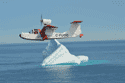
I was slopping yesterday, while testing a C180 amphibian, following a float change, and ventral fin installation. For those pilots who are not truly appreciating the need to attend to the pedals during maneuvering, try this: Level flight at a slow cruise speed, and without using any pedal, roll back and forth 20 - 30 degrees angle of bank, at least twice, and watch the ball - it'll be sloshing (and so will you!). Do exactly the same thing again, while slightly leading the aileron application with pedal application, and again watch the ball - you will certainly see a difference!
Big Pistons Forever wrote: ↑Sun Oct 25, 2020 9:15 am
There is some very good discussion on this thread but one essential point has not been mentioned. Talking about slipping and skidding is not a lot of use if the pilot does not recognize uncoordinated flight.
That's not the problem. I recognize uncoordinated flight well enough for my stage of training I think (notwithstanding today - I was flying from the right seat for the first time and in a new type. Couldn't coordinate a turn to save my life). The problem is I feel like the aircraft will fall out of the sky at any moment while doing it, whether a steepish turn or full rudder slip. This is fine at altitude, because I know I can recover (I rather enjoy spins) - which is not the case close to the ground.
RedAndWhiteBaron wrote: ↑Sun Oct 25, 2020 2:33 pm The problem is I feel like the aircraft will fall out of the sky at any moment while doing it, whether a steepish turn or full rudder slip. This is fine at altitude, because I know I can recover (I rather enjoy spins) - which is not the case close to the ground.
Have you tried having your instructor just demo multiple full-rudder forward slips all the way to the flare? Even better if it's a slipping turn to final into a full forward slip the whole way down. Then let you have a go.
That and maybe some "tight" 360's on the downwind and 270's downwind to base.
Obviously you aren't oblivious to your issue, so just practise and repetition should really help you get it figured out.
GoinVertical wrote: ↑Sun Oct 25, 2020 5:08 pm
Have you tried having your instructor just demo multiple full-rudder forward slips all the way to the flare? Even better if it's a slipping turn to final into a full forward slip the whole way down. Then let you have a go.
This is a great exercise. (It demonstrates) -- The aircraft is flying just fine, it is not stalled and won't (unless the nose is pulled up and airspeed degrades). It's simply a very high drag configuration, with a consequently steep approach angle. You cannot spin if the aircraft isn't stalled.
---------- ADS -----------
Last edited by rookiepilot on Sun Oct 25, 2020 5:36 pm, edited 1 time in total.
GoinVertical wrote: ↑Sun Oct 25, 2020 5:08 pm
Have you tried having your instructor just demo multiple full-rudder forward slips all the way to the flare? Even better if it's a slipping turn to final into a full forward slip the whole way down. Then let you have a go.
This is a great exercise. (It demonstrates) -- The aircraft is flying just fine, it is not stalled and won't (unless the nose is pulled up and airspeed degrades). It's simply a very high drag configuration. You cannot spin if the aircraft isn't stalled.
This does sound like a good idea, I will suggest it. I'm quite OK with a gentle slip all the way to the flare, but not so much a full rudder slip. Given the right traffic and weather conditions I'm sure it would be doable. Thanks.
A good way to think of a stall, which MUST be present for a spin to occur -- is angle of attack exceeding a critical value -- load factor is a related concept. ( I'm probably not the best one to explain it )
In a turn with a high wing loading, for example, with crossed controls, is when the risk of a spin exists, if close to the stalling speed of the aircraft. In a deliberate slipping turn, the nose would be down, and the wings unloaded.
My understanding is a spin IS possible from both a slip and a skid, but a skid would result in a much more violent event. Hence we read about base to final accidents in this configuration, where the aircraft gets too slow, steep bank, and additional inside rudder to "help". Boom....
However, in either event, the wings must be loaded up to where AOA is exceeded.
A F-18 obviously does 90 degree turns at a very high wing loading, but at a high airspeed, so the critical angle of attack of the wings are not exceeded. It's quite possible the fusalage is acting as a "wing" in such a turn. (AuxBat?)
Hence, it is very difficult if not impossible to stall, let alone spin, with the NOSE DOWN.
An exception would be severe wind shear. I landed once in Sedona, AZ once, when the wind was blowing 25-30. Sedona is on a big ridge, and is surrounded by even higher mountains.
On final in a 172 RG, at 70 KIAS, nose down, power on, descending in moderately rough air, 500 AGL, the stall warning screeched without warning and the nose dropped -- implying at least a 20 knot airspeed loss. I was wary of this, and advanced power immediately to fly out of it.
I learned later, landing in that direction wasn't advised, due to the unpredictable winds at that airport.
Someone please clarify if I'm wrong in my description on load factor / AOA in this context.
rookiepilot wrote: ↑Sun Oct 25, 2020 5:53 pm
A good way to think of a stall, which MUST be present for a spin to occur -- is angle of attack exceeding a critical value -- load factor is a related concept. ( I'm probably not the best one to explain it )
A stall depends only on AoA, and nothing else. It will occur at any speed, any load factor, and any attitude, if the critical AoA is exceeded, and will not occur otherwise - correct me if I'm wrong.
A F-18 obviously does 90 degree turns at a very high wing loading, but at a high airspeed, so the critical angle of attack of the wings are not exceeded. It's quite possible the fusalage is acting as a "wing" in such a turn. (AuxBat?)
At a 90° bank, the only thing holding you aloft is thrust and inertia, and your load factor is infinite, if understand the physics correctly. But yes, you may be able to use the fuselage as an airfoil; I'm nowhere near that level of pilotage. Probably best to leave the physics of 90° turns for another thread.
Hence, it is very difficult if not impossible to stall, let alone spin, with the NOSE DOWN.
It is never impossible to stall. Difficult perhaps, given a competent pilot, but never impossible.
I want to thank everyone who has replied to my questions - this thread has turned from a specific question into a much more general "Help RedAndWhiteBaron with his fear of the ground" thread. Thank you.
GoinVertical wrote: ↑Sun Oct 25, 2020 5:08 pm
Have you tried having your instructor just demo multiple full-rudder forward slips all the way to the flare? Even better if it's a slipping turn to final into a full forward slip the whole way down. Then let you have a go.
This is a great exercise. (It demonstrates) -- The aircraft is flying just fine, it is not stalled and won't (unless the nose is pulled up and airspeed degrades). It's simply a very high drag configuration. You cannot spin if the aircraft isn't stalled.
.
This does sound like a good idea, I will suggest it. I'm quite OK with a gentle slip all the way to the flare, but not so much a full rudder slip. Given the right traffic and weather conditions I'm sure it would be doable. Thanks.
This sound like an every-day engine failure in the circuit practice approach. Nothing enormously special.
---------- ADS -----------
DId you hear the one about the jurisprudence fetishist? He got off on a technicality.
I slipped into final landing at home today, just for practice. In my 150, a full pedal slip produced about a 30 bank to fly straight, so allowing the plane to bank to 45 to turn to final was not that unusual. Otherwise, there should be little need for such a steep bank close to the ground, unless you've badly misjudged, in which case, an overshoot might be the safer thing to do.
As for enroute traffic avoidance, while I was delivering a C180 amphibian to Collingwood on Saturday, my traffic was a flock of opposite direction Canada geese, dead ahead, same altitude, no radio position report. So I turned away to my right, they turned away to their right, and all was good. Even a fairly late decision to turn only required a 10 degree bank to avert collision with a happy margin.
PilotDAR wrote: ↑Mon Oct 26, 2020 2:43 pm
As for enroute traffic avoidance, while I was delivering a C180 amphibian to Collingwood on Saturday, my traffic was a flock of opposite direction Canada geese, dead ahead, same altitude, no radio position report.
Did you ask con-flock-ting traffic to please advise?
What code were they squawking?
---------- ADS -----------
DId you hear the one about the jurisprudence fetishist? He got off on a technicality.