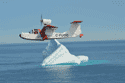
The Olds-Didsbury Flying Association Cessna 150M, C-GAJQ, was operating on a local flight 20
nm NW of Olds-Didsbury (CEA3) airport, AB with just the pilot on board. While flying at low altitude
over Glennifer Lake, the aircraft contacted the snow-covered lake surface. The aircraft settled into
the snow and the nose landing gear collapsed before the aircraft came to rest. The pilot was
uninjured; the 406 MHz ELT activated.
Low Level Flying Thread
Moderators: sky's the limit, sepia, Sulako, lilfssister, North Shore
Re: Low Level Flying Thread
Yup, it's the same as a glassy water landing whether actually intending to land or not. You need some texture to be able to determine distance. This is taught as a part of a float rating, but not normally trained as a part of "land" flying - but you can still get yourself in trouble.
If you have to fly low over unbroken snow (and there aren't many good reasons for this, unless you're on skis, and landing on it, try to have your shadow in view if conditions provide one. If it's a day with no shadows, the hazard is extra bad.
Stay as close to shore as practical, but really, just don't fly needlessly low, your choices are greatly reduced, as is your reaction time. If you're low flying, you should already know everything about the area, and have a plan to land ahead at any moment. If it's an unbroken snow surface away from shore, that plan is already very weak.
If you have to fly low over unbroken snow (and there aren't many good reasons for this, unless you're on skis, and landing on it, try to have your shadow in view if conditions provide one. If it's a day with no shadows, the hazard is extra bad.
Stay as close to shore as practical, but really, just don't fly needlessly low, your choices are greatly reduced, as is your reaction time. If you're low flying, you should already know everything about the area, and have a plan to land ahead at any moment. If it's an unbroken snow surface away from shore, that plan is already very weak.

Re: Low Level Flying Thread
Very unfortunate. I remember flying that plane over to drumheller and back. It ran like a C150 should. As a member of the ODFA, the monthly meeting covered it in some pretty significant detail. The pilot was present, and acknowledged that it was all pilot error and seemed pretty apologetic about the whole ordeal, although there were some people quite heated about his decision to fly so low over a snow-covered surface straddled by powerlines. I'm not in much of a position to say more on the matter, but there are currently measures underway to find out what will become of the plane. Currently, it seems like the pilot is either buying it for way more than it's currently worth, or paying for repairs out of his pocket. Insurance would be a pain because of the "pilot error" part of it. I'm just glad a local flight school has another 150 for a decent (although somewhat higher) rate for me to rent.
-
Schooner69A
- Rank 7

- Posts: 639
- Joined: Thu Nov 06, 2008 5:17 pm
- Location: The Okanagan
Re: Low Level Flying Thread
PilotDAR said: " If you're low flying, you should already know everything about the area, and have a plan to land ahead at any moment."
Concur. Never, ever low fly in an area you haven't recce'd....
PS Many pilots are comfortable flying at the same height as wires...
Concur. Never, ever low fly in an area you haven't recce'd....
PS Many pilots are comfortable flying at the same height as wires...
Re: Low Level Flying Thread
Why would it? If it was a lake, he was likely far enough away from everyone that it was legal to do what he was doing.
Lots of pilots crash airplanes on landing due to 'pilot error'. Only 'pilot error' would seem a bit of a stretch for the insurance not wanting to pay out.
Negligence? Would also be hard to prove. The most accurate description would likely be 'bad judgement'. But is that enough not to pay out?
As an AvCanada discussion grows longer:
-the probability of 'entitlement' being mentioned, approaches 1
-one will be accused of using bad airmanship
-the probability of 'entitlement' being mentioned, approaches 1
-one will be accused of using bad airmanship
Re: Low Level Flying Thread
I would prefer to let the pilots who crash airplanes doing stupid stuff to pay for it out of pocket rather than having to pay out of my pocket for higher insurance.digits_ wrote: ↑Tue Mar 08, 2022 8:44 amWhy would it? If it was a lake, he was likely far enough away from everyone that it was legal to do what he was doing.
Lots of pilots crash airplanes on landing due to 'pilot error'. Only 'pilot error' would seem a bit of a stretch for the insurance not wanting to pay out.
Negligence? Would also be hard to prove. The most accurate description would likely be 'bad judgement'. But is that enough not to pay out?
Re: Low Level Flying Thread
C-GAGS, a privately registered Van's RV-4, was conducting a local flight from Pitt Meadows
Airport (CYPK) BC, with the pilot and 1 passenger onboard. During a low altitude pass near North
Beach on Alouette Lake, the aircraft impacted the water but was able to become airborne again.
The propeller was damaged during the impact and the engine began vibrating. When the pilot
reduced power, the engine (Avco Lycoming O-320-E2D) failed catastrophically. The pilot opened
the canopy as he glided the aircraft to a ditching in the lake where it remained upright after impact.
The pilot assisted the passenger in egressing from the aircraft. The airplane rapidly sank and the
pilot and passenger swam approximately 40 feet to the shore. The occupants were initially assisted
by nearby kayakers and subsequently were transported to South Beach by a recreational boater.
They were met by BC ambulance service attendants. Both pilot and passenger were examined and
transported to a local hospital with minor injuries.
The aircraft was substantially damaged and a recovery is being planned.
Airport (CYPK) BC, with the pilot and 1 passenger onboard. During a low altitude pass near North
Beach on Alouette Lake, the aircraft impacted the water but was able to become airborne again.
The propeller was damaged during the impact and the engine began vibrating. When the pilot
reduced power, the engine (Avco Lycoming O-320-E2D) failed catastrophically. The pilot opened
the canopy as he glided the aircraft to a ditching in the lake where it remained upright after impact.
The pilot assisted the passenger in egressing from the aircraft. The airplane rapidly sank and the
pilot and passenger swam approximately 40 feet to the shore. The occupants were initially assisted
by nearby kayakers and subsequently were transported to South Beach by a recreational boater.
They were met by BC ambulance service attendants. Both pilot and passenger were examined and
transported to a local hospital with minor injuries.
The aircraft was substantially damaged and a recovery is being planned.

Re: Low Level Flying Thread
500' regulation? Not sure they could argue that he was practicing circuits in a 150 on an ice strip...
I guess I should write something here.
Re: Low Level Flying Thread
That's only applicable within a certain lateral distance of manmade objects or people etc. That's why I mentioned that in the middle of a lake, you're likely far enough away from stuff that your legal minimum required altitude is likely 0 ft.
As an AvCanada discussion grows longer:
-the probability of 'entitlement' being mentioned, approaches 1
-one will be accused of using bad airmanship
-the probability of 'entitlement' being mentioned, approaches 1
-one will be accused of using bad airmanship

Re: Low Level Flying Thread
Interesting that the insurance would be a hassle, since it was pilot error.
Most crashes are pilot error.
Seems rather pointless to have insurance, if not going to use it.
I then wouldn't waste my money on buying insurance at all.
Most crashes are pilot error.
Seems rather pointless to have insurance, if not going to use it.
I then wouldn't waste my money on buying insurance at all.
Whitney
Re: Low Level Flying Thread
If you have an accident while you were flying outside the rules of the CAR's, insurance could cite that as a reason to deny a claim. CAR 602.15 states the permissible reasons for low flying, fooling around having fun is not one of them. If to strike the water, or any other "not suitable for landing surface" in powered flight in a GA landplane during a recreational flight, it's going to be hard to explain how you were abiding by CAR 602.15 while you were doing it.
Re: Low Level Flying Thread
602.15 list exemptions that allow you to go lower than allowed by 602.14.PilotDAR wrote: ↑Sat May 07, 2022 2:31 pm If you have an accident while you were flying outside the rules of the CAR's, insurance could cite that as a reason to deny a claim. CAR 602.15 states the permissible reasons for low flying, fooling around having fun is not one of them. If to strike the water, or any other "not suitable for landing surface" in powered flight in a GA landplane during a recreational flight, it's going to be hard to explain how you were abiding by CAR 602.15 while you were doing it.
If you fly 1ft agl in the middle of a big lake for fun on wheels, then that is allowed by 602.14, and thus 602.15 does not apply.
As an AvCanada discussion grows longer:
-the probability of 'entitlement' being mentioned, approaches 1
-one will be accused of using bad airmanship
-the probability of 'entitlement' being mentioned, approaches 1
-one will be accused of using bad airmanship
Re: Low Level Flying Thread
Well... 602.14 is titled "Minimum Altitudes and Distances", and 602.14 requires a minimum distance of 500 feet, but says nothing about allowing flight at low altitude. 602.15 specifies Permissible Low altitude flight, and gives specific conditions. I'm not sure that you can assume that 602.14(b) exempts a pilot from complying with 602.15.If you fly 1ft agl in the middle of a big lake for fun on wheels, then that is allowed by 602.14, and thus 602.15 does not apply.
If I were going to have a pilot error accident at low altitude, I'd sure want to be complying with 602.15 while I were doing it!
Re: Low Level Flying Thread
You need 500 ft to be away from structures. 602.14 prohibits low flight in certain circumstances. If it's not prohibited, it's allowed.PilotDAR wrote: ↑Sat May 07, 2022 3:46 pmWell... 602.14 is titled "Minimum Altitudes and Distances", and 602.14 requires a minimum distance of 500 feet, but says nothing about allowing flight at low altitude. 602.15 specifies Permissible Low altitude flight, and gives specific conditions. I'm not sure that you can assume that 602.14(b) exempts a pilot from complying with 602.15.If you fly 1ft agl in the middle of a big lake for fun on wheels, then that is allowed by 602.14, and thus 602.15 does not apply.
If I were going to have a pilot error accident at low altitude, I'd sure want to be complying with 602.15 while I were doing it!
602.15 specifically refers to 602.14 for every paragraph. You only need 602.15 if you can't comply with 602.14
Which paragraph would I violate when flying at 1ft over a lake, for fun, in a landplane, more than 500 ft away from a structure or person? (Assume we're not in a provincial or national park).Minimum Altitudes and Distances
602.14 (1) [Repealed, SOR/2002-447, s. 2]
(2) Except where conducting a take-off, approach or landing or where permitted under section 602.15, no person shall operate an aircraft
(a) over a built-up area or over an open-air assembly of persons unless the aircraft is operated at an altitude from which, in the event of an emergency necessitating an immediate landing, it would be possible to land the aircraft without creating a hazard to persons or property on the surface, and, in any case, at an altitude that is not lower than
(i) for aeroplanes, 1,000 feet above the highest obstacle located within a horizontal distance of 2,000 feet from the aeroplane,
(ii) for balloons, 500 feet above the highest obstacle located within a horizontal distance of 500 feet from the balloon, or
(iii) for an aircraft other than an aeroplane or a balloon, 1,000 feet above the highest obstacle located within a horizontal distance of 500 feet from the aircraft; and
(b) in circumstances other than those referred to in paragraph (a), at a distance less than 500 feet from any person, vessel, vehicle or structure.
SOR/2002-447, s. 2
Permissible Low Altitude Flight
602.15 (1) A person may operate an aircraft at altitudes and distances less than those specified in subsection 602.14(2) where the aircraft is operated at altitudes and distances that are no less than necessary for the purposes of the operation in which the aircraft is engaged, the aircraft is operated without creating a hazard to persons or property on the surface and the aircraft is operated
(a) for the purpose of a police operation that is conducted in the service of a police authority;
(b) for the purpose of saving human life;
(c) for fire-fighting or air ambulance operations;
(d) for the purpose of the administration of the Fisheries Act or the Coastal Fisheries Protection Act;
(e) for the purpose of the administration of the national or provincial parks; or
(f) for the purpose of flight inspection.
(2) A person may operate an aircraft, to the extent necessary for the purpose of the operation in which the aircraft is engaged, at altitudes and distances less than those set out in
(a) paragraph 602.14(2)(a), where operation of the aircraft is authorized under Subpart 3 or section 702.22; or
(b) paragraph 602.14(2)(b), where the aircraft is operated without creating a hazard to persons or property on the surface and the aircraft is operated for the purpose of
(i) aerial application or aerial inspection,
(ii) aerial photography conducted by the holder of an air operator certificate,
(iii) helicopter external load operations, or
(iv) flight training conducted by or under the supervision of a qualified flight instructor.
As an AvCanada discussion grows longer:
-the probability of 'entitlement' being mentioned, approaches 1
-one will be accused of using bad airmanship
-the probability of 'entitlement' being mentioned, approaches 1
-one will be accused of using bad airmanship
Re: Low Level Flying Thread
Well, I'm not a legal expert, but where 602.15(2)(b) does give specific allowances under the specified circumstances to not comply with 602.14(2)(b), I opine that if you're not within those conditions, you're violating the regulation. But, I'm open to the opinion of a keen legal mind on that.
But, if you're going to low fly outside the conditions of 602.15(2)(b), I'd have your facts well confirmed before the accident and before seeking an insurance settlement.
I have on a number of occasions flown low "for the purpose of saving a human life" and on the occasions where TC became aware of my doing that, they were entirely agreeable, with my explanation. I don't think that TC get terribly wound up about low flying when it's just someone being silly, and they are well away from anyone else. I do think that insurers look really carefully to assure that the flight was flown with good airmanship and consideration of the regulations in the case of a claim.
But, if you're going to low fly outside the conditions of 602.15(2)(b), I'd have your facts well confirmed before the accident and before seeking an insurance settlement.
I have on a number of occasions flown low "for the purpose of saving a human life" and on the occasions where TC became aware of my doing that, they were entirely agreeable, with my explanation. I don't think that TC get terribly wound up about low flying when it's just someone being silly, and they are well away from anyone else. I do think that insurers look really carefully to assure that the flight was flown with good airmanship and consideration of the regulations in the case of a claim.
Re: Low Level Flying Thread
But in my example you *are* complying with 602.14(2)(b), so 602.15 is irrelevant.PilotDAR wrote: ↑Sat May 07, 2022 5:28 pm Well, I'm not a legal expert, but where 602.15(2)(b) does give specific allowances under the specified circumstances to not comply with 602.14(2)(b), I opine that if you're not within those conditions, you're violating the regulation. But, I'm open to the opinion of a keen legal mind on that.
Note that 602.14(2)(b) states you have to be 500 ft away from structures and people, you do *not* have to be 500 ft above ground or obstacles.
As an AvCanada discussion grows longer:
-the probability of 'entitlement' being mentioned, approaches 1
-one will be accused of using bad airmanship
-the probability of 'entitlement' being mentioned, approaches 1
-one will be accused of using bad airmanship
Re: Low Level Flying Thread
I'm not sure I"m the kind of mind PilotDAR is referring to, but there's plenty of precedent for TC pursuing an enforcement action against pilots below 500' agl only because they were closer than 500' to a person (and weren't landing or taking off at the time). The one that comes to mind is a helicopter pilot who was filming an ice skater somewhere remote, someone can find the citation on CANLII pretty easily I think.
For reference, there are different low-flying requirements for 703, 704, and 705 operators of a minimum altitude of 300, 500 and 1000 agl, in 703.27, 704.23, and 705.32. If you're not regulated in part VII, then you can absolutely fly all day long at 0' agl, as long it's not a built up area and you don't fly within 500' of a person vehicle or structure.
For reference, there are different low-flying requirements for 703, 704, and 705 operators of a minimum altitude of 300, 500 and 1000 agl, in 703.27, 704.23, and 705.32. If you're not regulated in part VII, then you can absolutely fly all day long at 0' agl, as long it's not a built up area and you don't fly within 500' of a person vehicle or structure.
DId you hear the one about the jurisprudence fetishist? He got off on a technicality.
Re: Low Level Flying Thread
Yeah, I'm not sure, but I can't disagree with your logic. That said, I'm pretty cautious about low flying any airplane I don't own. I'm prepared to defend my flying of my airplane to my insurance company, I'm a little more cautious when it's someone else's plane, lest the insurer find a reason to not pay a claim, I don't want to be in the middle of what could be, in such circumstances....But in my example you *are* complying with 602.14(2)(b), so 602.15 is irrelevant


Re: Low Level Flying Thread
digits_ wrote: ↑Sat May 07, 2022 3:56 pmYou need 500 ft to be away from structures. 602.14 prohibits low flight in certain circumstances. If it's not prohibited, it's allowed.PilotDAR wrote: ↑Sat May 07, 2022 3:46 pmWell... 602.14 is titled "Minimum Altitudes and Distances", and 602.14 requires a minimum distance of 500 feet, but says nothing about allowing flight at low altitude. 602.15 specifies Permissible Low altitude flight, and gives specific conditions. I'm not sure that you can assume that 602.14(b) exempts a pilot from complying with 602.15.If you fly 1ft agl in the middle of a big lake for fun on wheels, then that is allowed by 602.14, and thus 602.15 does not apply.
If I were going to have a pilot error accident at low altitude, I'd sure want to be complying with 602.15 while I were doing it!
602.15 specifically refers to 602.14 for every paragraph. You only need 602.15 if you can't comply with 602.14
Which paragraph would I violate when flying at 1ft over a lake, for fun, in a landplane, more than 500 ft away from a structure or person? (Assume we're not in a provincial or national park).Minimum Altitudes and Distances
602.14 (1) [Repealed, SOR/2002-447, s. 2]
(2) Except where conducting a take-off, approach or landing or where permitted under section 602.15, no person shall operate an aircraft
(a) over a built-up area or over an open-air assembly of persons unless the aircraft is operated at an altitude from which, in the event of an emergency necessitating an immediate landing, it would be possible to land the aircraft without creating a hazard to persons or property on the surface, and, in any case, at an altitude that is not lower than
(i) for aeroplanes, 1,000 feet above the highest obstacle located within a horizontal distance of 2,000 feet from the aeroplane,
(ii) for balloons, 500 feet above the highest obstacle located within a horizontal distance of 500 feet from the balloon, or
(iii) for an aircraft other than an aeroplane or a balloon, 1,000 feet above the highest obstacle located within a horizontal distance of 500 feet from the aircraft; and
(b) in circumstances other than those referred to in paragraph (a), at a distance less than 500 feet from any person, vessel, vehicle or structure.
SOR/2002-447, s. 2
Permissible Low Altitude Flight
602.15 (1) A person may operate an aircraft at altitudes and distances less than those specified in subsection 602.14(2) where the aircraft is operated at altitudes and distances that are no less than necessary for the purposes of the operation in which the aircraft is engaged, the aircraft is operated without creating a hazard to persons or property on the surface and the aircraft is operated
(a) for the purpose of a police operation that is conducted in the service of a police authority;
(b) for the purpose of saving human life;
(c) for fire-fighting or air ambulance operations;
(d) for the purpose of the administration of the Fisheries Act or the Coastal Fisheries Protection Act;
(e) for the purpose of the administration of the national or provincial parks; or
(f) for the purpose of flight inspection.
(2) A person may operate an aircraft, to the extent necessary for the purpose of the operation in which the aircraft is engaged, at altitudes and distances less than those set out in
(a) paragraph 602.14(2)(a), where operation of the aircraft is authorized under Subpart 3 or section 702.22; or
(b) paragraph 602.14(2)(b), where the aircraft is operated without creating a hazard to persons or property on the surface and the aircraft is operated for the purpose of
(i) aerial application or aerial inspection,
(ii) aerial photography conducted by the holder of an air operator certificate,
(iii) helicopter external load operations, or
(iv) flight training conducted by or under the supervision of a qualified flight instructor.
Gliding distance from shore?
Kidding aside the reg is 500 feet from the nearest person vehicle vessel or structure. So no reg broken if you have the equipment.
Re: Low Level Flying Thread
Gliding distance from shore restrictions don’t apply to private operations as long as you have flotation devices aboard.
DId you hear the one about the jurisprudence fetishist? He got off on a technicality.
-
Big Pistons Forever
- Top Poster

- Posts: 5959
- Joined: Wed Feb 18, 2004 7:17 pm
- Location: West Coast
Re: Low Level Flying Thread
There is always the "don't do nothing stupid" CAR, 602.01(1); that TC enforcement can use for the particularly egregious acts. In any case Youtube has been a big help for TC so if you are doing a "look at me !!!" low pass chances are somebody is videoing it.
Personally I would be more worried about the insurance company. They will almost always pay out but they don't have to renew your coverage. I know of one pilot who forgot to put his wheels down. Airplane was written off and he was fully paid out with no issues, however when he purchased a replacement airplane (same make and model) the insurance company declined his application for coverage on the new one. With that rejection no other company would touch him and he ended up re-selling the airplane and hanging up his David Clark's.
Personally I would be more worried about the insurance company. They will almost always pay out but they don't have to renew your coverage. I know of one pilot who forgot to put his wheels down. Airplane was written off and he was fully paid out with no issues, however when he purchased a replacement airplane (same make and model) the insurance company declined his application for coverage on the new one. With that rejection no other company would touch him and he ended up re-selling the airplane and hanging up his David Clark's.

Re: Low Level Flying Thread
N638JM, an amateur-built non-aerobatic Arion Aircraft Lightning, was conducting a flight from
Baudette International Airport (KBDE), USA to Roseau Municipal Airport/Rudy Billberg Field
(KROX), USA on a VFR flight plan with a planned fly-by of a cottage located on Lake of the
Woods, ON with only the pilot onboard. The aircraft conducted a low-level fly-by of the cottage and,
once past the cottage, conducted a climbing 60° to 75° bank right turn. During the climbing steep
turn, the left wing dropped and the aircraft descended rapidly in a nose-down attitude. The aircraft
collided with terrain on an island located 15 NM south of Kenora (CYQK), ON. The pilot received
fatal injuries. The aircraft was destroyed and there was no post-impact fire. A person who observed
the accident reported it to emergency services. The OPP and the TSB deployed to the site.
Baudette International Airport (KBDE), USA to Roseau Municipal Airport/Rudy Billberg Field
(KROX), USA on a VFR flight plan with a planned fly-by of a cottage located on Lake of the
Woods, ON with only the pilot onboard. The aircraft conducted a low-level fly-by of the cottage and,
once past the cottage, conducted a climbing 60° to 75° bank right turn. During the climbing steep
turn, the left wing dropped and the aircraft descended rapidly in a nose-down attitude. The aircraft
collided with terrain on an island located 15 NM south of Kenora (CYQK), ON. The pilot received
fatal injuries. The aircraft was destroyed and there was no post-impact fire. A person who observed
the accident reported it to emergency services. The OPP and the TSB deployed to the site.
Re: Low Level Flying Thread
C-FLRI, a privately registered Cessna 206, was conducting a VFR flight from Leader (CJD5), SK,
to a private aerodrome 4 nautical miles southwest of Eatonia (CJG2) SK, with one person onboard.
While enroute, the aircraft encountered low cloud/fog and the pilot descended to remain visual with
the ground. In whiteout conditions, the aircraft's wing impacted the ground during the base leg turn
to final. The aircraft came to rest in a field and sustained sustainable damage. The pilot was not
injured. The ELT activated and the signal was received.
to a private aerodrome 4 nautical miles southwest of Eatonia (CJG2) SK, with one person onboard.
While enroute, the aircraft encountered low cloud/fog and the pilot descended to remain visual with
the ground. In whiteout conditions, the aircraft's wing impacted the ground during the base leg turn
to final. The aircraft came to rest in a field and sustained sustainable damage. The pilot was not
injured. The ELT activated and the signal was received.
Re: Low Level Flying Thread
C-FWGF, a private Cessna 150G, was conducting a local flight under visual flight rules from a
private land in St-Urbain-Premier, QC with a student pilot and a passenger on board. While he
was flying very low over a house located in the municipality of St-Rémi, QC, the aircraft
performed a maneuver at low altitude before hitting an electricity distribution line and
crashed in the parking lot of a private home. A fire broke out and the aircraft
been destroyed. The 2 occupants, seriously injured, were extricated from the aircraft and transported to
a hospital center.
private land in St-Urbain-Premier, QC with a student pilot and a passenger on board. While he
was flying very low over a house located in the municipality of St-Rémi, QC, the aircraft
performed a maneuver at low altitude before hitting an electricity distribution line and
crashed in the parking lot of a private home. A fire broke out and the aircraft
been destroyed. The 2 occupants, seriously injured, were extricated from the aircraft and transported to
a hospital center.

