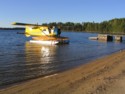
My two bits .... an engine failure over glassy water out in the middle would suck. Worse yet ... if your floats where kinda rotten needing a complete rebuild ... I don't imagine they would stand up to the potential hard bounce or pound if you prefer to call it that on the one chance flare if you get it wrong. Add to that the potential for a partially obscured ceiling -X into that equaltion and it gets even worse.
I landed once in the middle of Queen Charlette sound on a absolutely glassy water flat calm day to sit and watch the whales with a group of passengers and it was the most difficult landing I have ever had to do in my float carrier. I'll take the McNeill break water approach all day long in a south easter rather than that flat glassy water stuff. Who knows ... maybe I suck .... maybe I need a few more landing to hone the skill but what I did learn from that experience is that I do not wish to do it again without some form of visual reference on the water to touch down on next time.
Cat Driver wrote:It is not like this accident happened at the north pole, it happened in a populated area a few miles from the aircrafts base and it looks like there was a breakdown in flight following and communications.
That, ., is the only issue in this case. There is nothing else that has any bearing whatsoever on it.
I would also throw in the lack of survival equipment, considering that only one of the occupants was wearing flotation gear...
Are you trying to say that there were no lifejackets in the airplane?? I would expect a better response from you.
For all of you saying the weather was below VFR, I think you should re read Cat's previous post.. If it was 200' at the airport, that would make it 550' at the spit. They were reporting 4 miles at the airport, so in my limited experience, that would mean that it was VFR.. Marginal, as I said in a previous post, but doable.. Just so we are all clear, partially obscured does not constitute a ceiling.
Flying the west coast is challenging, this is why people ask for west coast time so often. Unless you've done it, you wouldn't understand.
Are you trying to say that there were no lifejackets in the airplane?? I would expect a better response from you.
I could be wrong, but I assumed that widow made similar statements. Didn't she say her husband was the only one on board with a personal floatation device or was it he was the only one with a floater vest?
For all of you saying the weather was below VFR, I think you should re read Cat's previous post.. If it was 200' at the airport, that would make it 550' at the spit.
Weather at an airport miles away doesn't guarantee local weather. Besides, even if it was VFR, did he maintain the required clearance from cloud or did he fly right up through it?
Marginal, as I said in a previous post, but doable
If weather is "marginal" at what point do pilot err on the side of safety and stay on the ground? "Marginal but doable" wouldn't instill a lot of confidence in me if I strapped to a VFR Beaver. If we're at least talking about an airplane that was IFR capable it's a different story.
Are you trying to say that there were no lifejackets in the airplane?? I would expect a better response from you.
I could be wrong, but I assumed that widow made similar statements. Didn't she say her husband was the only one on board with a personal floatation device or was it he was the only one with a floater vest?
For all of you saying the weather was below VFR, I think you should re read Cat's previous post.. If it was 200' at the airport, that would make it 550' at the spit.
Weather at an airport miles away doesn't guarantee local weather. Besides, even if it was VFR, did he maintain the required clearance from cloud or did he fly right up through it?
Marginal, as I said in a previous post, but doable
If weather is "marginal" at what point do pilot err on the side of safety and stay on the ground? "Marginal but doable" wouldn't instill a lot of confidence in me if I strapped to a VFR Beaver. If we're at least talking about an airplane that was IFR capable it's a different story.
Ahh.. CID.. I would expect no less from you.. Again you have just shown your lack of experience in this industry..
Nobody said there was no lifejackets in the airplane. It was only shown that widows husband wore a floater jacket.. (I know for a fact that he always wore one..)
As most coastal pilots do not wish to fly in cloud, I would bet that the pilot flew around any clouds he encountered. Nobody has shown that he flew into less than VFR conditions so as usual, you are trying to throw this into the worst possible situation.
I think you will find that Enviroment Canada has a definition for Marginal VFR. If you had any clue about this industry you would know that.. Now while you think about that, why is it legal to fly special VFR into a control zone with a 200' ceiling and 1 mile vis??? Are you suddenly a better pilot when you encounter a control zone?
As usual you beak off with no actual knowledge of what you are talking about.. When you provide us with your licence status and actual flying time we may actually take you seriously..
All the life jackets were still strapped in place inside the wreckage. All the seatbelts undone. (edited to add: the TSB report said one life jacket was missing, but that is incorrect)
Worse yet ... if your floats where kinda rotten needing a complete rebuild ... I don't imagine they would stand up to the potential hard bounce or pound if you prefer to call it that on the one chance flare if you get it wrong.
Apparently they had time to get out, but not time to get their life jackets before the aircraft sank.
---------- ADS -----------
Last edited by Widow on Tue Jun 05, 2007 8:01 am, edited 1 time in total.
Sorry widow I didn't remember seeing that info in your previous posts.....
But as to not getting the life jackets on.....I was trained to fly floats by a newfie and he always wore one of those mustang inflatables, as did I, when flying floats. I know they are not transport approved, but who cares they are comfortable, easy to use and they work.
I was shocked when i went to work for a certain, un-named, amphib operator out of YTZ and they laughed at the idea. Not only the owner and ops manager but the rest of the pilots. Their argument was how safe would that make the passengers feel. Well maybe in addition of the certified packaged stowed inflatables these could be provided just encase....
Now that may be overkill, but in the case of this beaver if everyone in fact got out it could have saved 5 lives. Realising that search and rescue was't called out and the one survivor likely died of exposure....
Would you do a north atlantic run in a light aircraft with out putting on a survival suit before getting over the water? Anywho just a brief of topic type of comment.
One other important issue here is the fact (as I understand it) that the airplane departed Campbell River and crossed Quadra Island to eventually end up coming down on the other side of the island in the Sutil Channel.
That would mean that he would have to cross terrain that rose to a minimum (from my research) of 200 feet ASL. That narrows the margin down significantly.
1) The operator was known to have shitty maitenance and there is good reason to believe that the aircraft's condition was a major factor in the outcome of this accident.
2) Even if everything up to the accident had occured in an identical fashion, the presence of a water jettisonable ELT, proper flight following, and mustang inflatables for all the passengers who weren't wearing floater coats would have increased the probability of surviving this accident many times over.
We can sit here and debate the weather and the pilot's decision making all day, but those factors are not going to fundamentally change in the near future. Meanwhile there are several very tangible steps that could be implemented that would begin saving lives on a very short timetable. Everyone who flies on the west coast as either a passenger or pilot owes a big debt of gratitude to widow for her tireless work the make meaningful change.
Which is why we have been demanding that the TSB issue a credible report and safety recommendations. In a timely manner would have been nice, too.
PS. Thanks Lommer!
Oh ya, and do any of you folks work with Interfor contracts? I notice they've made some interesting changes to their Air Carrier Standards. I like to think that has had something to do with my continued pressures as well. I'm hoping some of that will be used as WorkSafe BC and BC Forest Safety Council work on a way to cover air taxi's in the forest industry's CORE/SAFE programs.
---------- ADS -----------
Last edited by Widow on Tue Jun 05, 2007 10:31 am, edited 1 time in total.
That would mean that he would have to cross terrain that rose to a minimum (from my research) of 200 feet ASL. That narrows the margin down significantly.
And knowing the weather patterns in that area the ceiling where he was flying could have been 10,000 feet.
Or he could have flown around the land over water, we just do not know exactly what the weather conditions were as he flew along.
I get the feeling from some posters here that to many float plane pilots fly in weather that is either illegal or unsafe...
So what exactly is the solution to this possible problem?
Maybe some of you who feel that these pilots are dangerous should spend some time at the Campbell River Spit and express your concerns to all these pilots?
---------- ADS -----------
The hardest thing about flying is knowing when to say no
After over a half a century of flying no one ever died because of my decision not to fly.
I remember that morning very clearly. I remember looking out the door towards Quadra (we lived near the beach south of town) when he came back in to tell me he had to fly. Neither of us felt any discomfort with the weather, as we certainly had on other days he was due to fly.
Whatever the weather was that day, it was not the weather that caused the incident to become fatal.
CID wrote:One other important issue here is the fact (as I understand it) that the airplane departed Campbell River and crossed Quadra Island to eventually end up coming down on the other side of the island in the Sutil Channel.
That would mean that he would have to cross terrain that rose to a minimum (from my research) of 200 feet ASL. That narrows the margin down significantly.
Gawd.. You are so good at your research that you even found out where we have been talking about. I'm so impressed. You did however miss the part about the airplane going around the end of Quadra Island(Cape Mudge). That is the norm in these parts because a loaded Beaver will not climb fast enough to be a proper height over the island. There would have been lots of reports of the airplane had it gone over the island at the altitude you are suggesting. It is quite populated..
twotter wrote:Are you trying to say that there were no lifejackets in the airplane??
Nope... As a few others mentioned, what I was suggesting related to the lack of wearing the flotation equipment. Could have been clearer, I suppose. Sorry about that. Personally, I would wear a PFD onboard a sea plane.
We had discussed the Mustang PFD here once before as well...
regarding floater coatsI...I will not let anyone wear a floater coat in my plane.All they will do is hold you to the cieling of the sinking plane,or get snagged if you do manage to get out.Mustang infatables are the way to go.
Actually, the only body that was recovered from this particular crash was widow's husband's, and that's likely because he was wearing his floater coat. He got out just fine. I'm not saying one should disregard the obvious advantages of the mustang-style ones, I'm just saying don't dismiss floater coats entirely. Besides, if you do make it out alive, the Pacific Ocean is pretty damn cold. I actually don't know which one I'd choose if presented with both options at the same cost - it'd probably depend on the aircraft, where I was sitting, and other factors like comfort etc.
Curious that the engine/change sound came from Open Bay and the junk was found at 'Sutil Channel' then its possible that he had turned around and was heading back to YBL?
Don't know what that means, except perhaps the engine was already losing oil or making horrible noises? Did he get a warning? I apologize if my ramblings are painful for you, Widow.
---------- ADS -----------
"What's it doing now?"
"Fly low and slow and throttle back in the turns."
People on the south end of Quadra heard it going north sounding "heavy" ... that heavy sound changed to sound like "a VW Bug that lost its muffler" and then to "coughing and sputtering" ...
The way we peice it togother, he was going the normal thing of taking off towards south of Quadra, then turning and gaining altitude ...
We believe the cylinder started to go over Open Bay and he turned around to where he knew there was open water.
Something to keep in mind, the 200' ceiling at CYBL is a red herring. I have seen this happen and VFR clear at Comox. Also the opposite, Clear at CYBL and socked in at CYQQ and over the water. The 200' ceiling in CYBL does not nessecarily translate to a 500' ceiling over the water.
We don't know anything for sure. The engine still sits on the ocean floor. The cylinder theory was the same conclusion drawn by the seven or eight non-interested parties (all with extensive Beaver/R-985 experience) who examined the wreckage.
Keep up the good work Kirsten. A lot of the workers coming out of the Spit now wear inflatables, with my blessing. It should be law in my opinion and if you've helped make that change it will be your legacy.
Hedley, obviously no root cause can be ruled out until the engine is lifted, but the oil all over the windscreen isn't usually symptomatic of carb ice. It did sound like a day when carb ice was probable if no carb heat was used.
You get carb ice everyday on the Coast. On a typical day the ice forms immediately after the heat is turned off. Fact of life. Some people fly with the heat on some don't. Doesn't matter. Point being if you fly Coastal floats you get carb ice everyday of the year.









 You did however miss the part about the airplane going around the end of Quadra Island(Cape Mudge). That is the norm in these parts because a loaded Beaver will not climb fast enough to be a proper height over the island. There would have been lots of reports of the airplane had it gone over the island at the altitude you are suggesting. It is quite populated..