
For those who care, this weekend was a turning point in the imminent US economic collapse. Lehman Brothers just declared bankruptcy. Merrill Lynch had to get taken over to avoid certain worldwide collapse.
The stock market opens in 15 minutes, it should be interesting to see what happens.
Where were you when the stock market crashed?
Moderators: lilfssister, North Shore, sky's the limit, sepia, Sulako
Re: Where were you when the stock market crashed?
the DOW is down 308 points as I write this. Time to hunker down, and maybe take out a few library books on how to live off the land...
Re: Where were you when the stock market crashed?
I might add that how long you can farm ishow to live off the land
determined by how much money you start
out with!
My advice: buy a gasoline refinery.


Re: Where were you when the stock market crashed?
it looks like a whole new crop of Squeegemen will be working in New York City soon…
So far, it looks like a bit of a snooze for a meltdown. Less than a 3% overall decline is well within the scope of a bad day.
So far, it looks like a bit of a snooze for a meltdown. Less than a 3% overall decline is well within the scope of a bad day.


Re: Where were you when the stock market crashed?
What will this do to mortgage rates?
"FLY THE AIRPLANE"!
http://www.youtube.com/hazatude
http://www.youtube.com/hazatude
-
tellyourkidstogetarealjob

- Rank 5

- Posts: 390
- Joined: Mon Nov 28, 2005 12:11 am
- Location: Cascadia
Re: Where were you when the stock market crashed?
In the short term, at least, not much. Given that so many people in the U.S. are struggling to pay mortgages that are worth more than their houses it seems unlikely the Federal Reserve will want to aggravate the situation by putting up lending rates.
Job losses and economic uncertainty are reining in spending where self discipline failed.
It's more likely to affect bank policies towards lenders. People who could've easily gotten a mortgage two years ago will be turned down. Expect this to happen north of the border as well.
Job losses and economic uncertainty are reining in spending where self discipline failed.
It's more likely to affect bank policies towards lenders. People who could've easily gotten a mortgage two years ago will be turned down. Expect this to happen north of the border as well.
Re: Where were you when the stock market crashed?
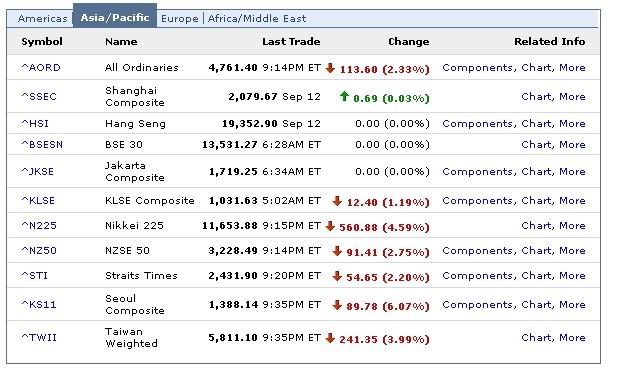
Asian markets getting shitkicked too!
"FLY THE AIRPLANE"!
http://www.youtube.com/hazatude
http://www.youtube.com/hazatude
-
sky's the limit
- Rank Moderator

- Posts: 4614
- Joined: Sat Jan 22, 2005 11:38 am
- Location: Now where's the starter button on this thing???
Re: Where were you when the stock market crashed?
Where was I when the Stock Market crashed? Oh, in real estate..... 
stl
stl


Re: Where were you when the stock market crashed?
I'm givin er all she's got..


Re: Where were you when the stock market crashed?
Where was I?
I was swimming laps in my pool.
The sky may be cloudy, but it isn't falling Chicken Little...
I was swimming laps in my pool.
The sky may be cloudy, but it isn't falling Chicken Little...
Qui desiderat pacem, praeparet bellum
Semper Fidelis
“De inimico non loquaris male, sed cogites"-
Do not wish death for your enemy, plan it.
Semper Fidelis
“De inimico non loquaris male, sed cogites"-
Do not wish death for your enemy, plan it.

Re: Where were you when the stock market crashed?
I was sitting here in Af, smiling because I have no more shares, and have invested in property in a small, sh*tty country that no one knows! 
Success in life is when the cognac that you drink is older than the women you drink it with.
Re: Where were you when the stock market crashed?
24000 lay offs at EDS, one major bank and one insurer...business travel will cool off... 
Success in life is when the cognac that you drink is older than the women you drink it with.
-
niss
- Top Poster

- Posts: 6745
- Joined: Sat Jun 25, 2005 8:54 pm
- Location: I'm a CPL trapped in a PPL's Body.
- Contact:
Re: Where were you when the stock market crashed?
*cough*poppy farmer*cough*Expat wrote:and have invested in property in a small, sh*tty country that no one knows!
She’s built like a Steakhouse, but she handles like a Bistro.
Let's kick the tires, and light the fires.... SHIT! FIRE! EMERGENCY CHECKLIST!
Let's kick the tires, and light the fires.... SHIT! FIRE! EMERGENCY CHECKLIST!

Re: Where were you when the stock market crashed?
I was at work at an oil company as usual.
I've watched the CBC news just Sunday and here's how they explain it:
Somebody came up with the idea of selling really low rate mortgages to American families...the catch is that it's like those credit cards with a low "introductory" rate (but these rates skyrocket after a few years). Mortgage brokers and people were given incentives (and higher commissions) to sell these sub-prime loans over any other mortagage or loan.
This trend caught on like wildfire --- people were deceived into the extremely low rate and were told that when the rate does go up -- they can "re-finance" --- that turned out to be a lie and you can't
This Ponzi / Pyramid scheme bubble started to burst --- so they kept selling them at a more "aggressive" pace --- supply and demand says that as more people buy up houses the price goes up --- basic supply and demand theory....but it turns out people can't afford anything other than the introductory rate and started defaulting on their mortgages --- now housing proces collapse to the point the the amount they owe the bank exceeds the value of the house.
TO MAKE THINGS WORSE --- the financial institutions (that lended money to questionable people with questionable credit --- EVEN THOSE WITH NO PROOF of income) -- took these mortgages as "secured" "guaranteed" investments as the basic foundations for OTHER investments...so when people default their loans--- mortgage backing drops and so do every other investment tied into them...most of which actually had nothing to do with stocks. The fine print on these guarantees made the guarantee meaningless which is why Standard and Poors (US Credit Agency) refuses to even rate them! However the scheme continued since these mortgage brokers and bankers get commission.
Now the US government decided to buy all these mortgages for trillions...OK --- that saves the credit situation but the tax-payer has to pay for it.
I've watched the CBC news just Sunday and here's how they explain it:
Somebody came up with the idea of selling really low rate mortgages to American families...the catch is that it's like those credit cards with a low "introductory" rate (but these rates skyrocket after a few years). Mortgage brokers and people were given incentives (and higher commissions) to sell these sub-prime loans over any other mortagage or loan.
This trend caught on like wildfire --- people were deceived into the extremely low rate and were told that when the rate does go up -- they can "re-finance" --- that turned out to be a lie and you can't
This Ponzi / Pyramid scheme bubble started to burst --- so they kept selling them at a more "aggressive" pace --- supply and demand says that as more people buy up houses the price goes up --- basic supply and demand theory....but it turns out people can't afford anything other than the introductory rate and started defaulting on their mortgages --- now housing proces collapse to the point the the amount they owe the bank exceeds the value of the house.
TO MAKE THINGS WORSE --- the financial institutions (that lended money to questionable people with questionable credit --- EVEN THOSE WITH NO PROOF of income) -- took these mortgages as "secured" "guaranteed" investments as the basic foundations for OTHER investments...so when people default their loans--- mortgage backing drops and so do every other investment tied into them...most of which actually had nothing to do with stocks. The fine print on these guarantees made the guarantee meaningless which is why Standard and Poors (US Credit Agency) refuses to even rate them! However the scheme continued since these mortgage brokers and bankers get commission.
Now the US government decided to buy all these mortgages for trillions...OK --- that saves the credit situation but the tax-payer has to pay for it.
Re: Where were you when the stock market crashed?
MONEYNETDAILY
Guess again who's to blame for U.S. mortgage meltdown
Analysts point not to greed, but to social activist politics
----------------------------------------------------------------------------
----
Posted: September 19, 2008
6:19 pm Eastern
While many pundits are pointing to corporate greed and a lack of government
regulation as the cause for the American mortgage and financial crisis, some
analysts are saying it wasn't too little government intervention that cased
the mortgage meltdown, but too much, in the form of activists compelling the
government to pressure Freddie Mac and Fannie Mae into unsound – though
politically correct – lending practices.
"Home mortgages have been a political piñata for many decades," writes Stan
J. Liebowitz, economics professor at the University of Texas at Dallas, in a
chapter of his forthcoming book, Housing America: Building out of a Crisis.
Liebowitz puts forward an explanation that he admits is "not consistent with
the nasty-subprime-lender hypothesis currently considered to be the cause of
the mortgage meltdown."
In a nutshell, Liebowitz contends that the federal government over the last
20 years pushed the mortgage industry so hard to get minority homeownership
up, that it undermined the country's financial foundation to achieve its
goal.
"In an attempt to increase homeownership, particularly by minorities and the
less affluent, an attack on underwriting standards was undertaken by
virtually every branch of the government since the early 1990s," Liebowitz
writes. "The decline in mortgage underwriting standards was universally
praised as 'innovation' in mortgage lending by regulators, academic
specialists, (government-sponsored enterprises) and housing activists."
He continues, "Although a seemingly noble goal, the tool chosen to achieve
this goal was one that endangered the entire mortgage enterprise."
"As homeownership rates increased there as self-congratulation all around,"
Liebowitz writes. "The community of regulators, academic specialists, and
housing activists all reveled in the increase in homeownership."
An article in the Los Angeles Times from the late '90s praised the sudden
surge in homeownership among minorities, calling it "one of the hidden
success stories of the Clinton era."
John Lott, a senior research scientist at the University of Maryland,
however, claimed in a Fox News article yesterday that the success came at a
great price.
According to Lott, the Federal Reserve Bank of Boston produced a manual in
the early '90s that warned mortgage lenders to no longer deny urban and
lower-income minority applicants on such "outdated" criteria as credit
history, down payment or employment income.
Furthermore, claims Lott, Fannie Mae and Freddie Mac encouraged and praised
lenders – like Countrywide and Bear Stearns – for adopting the slackened
policies toward minority applicants.
"Given these lending practices mandated by the Fed and encouraged by Fannie
Mae and Freddie Mac," writes Lott, "the resulting financial problems for
financial institutions such as Countrywide and Bear Stearns are not too
surprising."
Liebowitz' contention that lenders were under pressure to loosen their
standards for racial and political goals was confirmed years ago by the
companies at the heart of today's crisis: Fannie Mae and Freddie Mac.
A New York Times article from Sept. 1999 states that Fannie Mae had been
under increasing pressure from the Clinton administration to expand mortgage
loans among low- and moderate-income people and that the corporation
loosened its lending requirements to comply.
An ominous paragraph of the article reads, "In moving, even tentatively,
into this new area of lending, Fannie Mae is taking on significantly more
risk, which may not pose any difficulties during flush economic times. But
the government-subsidized corporation may run into trouble in an economic
downturn, prompting a government rescue similar to that of the savings and
loan industry in the 1980s."
Liebowitz likewise predicted in a 1998 paper the risk of sacrificing sound
financial policy for social activism.
"After the warm fuzzy glow of 'flexible underwriting standards' has worn
off," Liebowitz wrote, "we may discover that they are nothing more than
standards that led to bad loans. … It will be ironic and unfortunate if
minority applicants wind up paying a very heavy price for a misguided policy
based on a badly mangled idea."
And though some have speculated that lenders in the '90s dove into sub-prime
mortgages in an effort to gouge new markets, the president and chief
operating officer of Freddie Mac in 1999, David Glenn, confessed his company
was pushed by a federal agenda.
"The mortgage industry intends to pursue minorities with greater intensity
as federal regulators turn up the heat to increase home ownership," Glenn
said in his remarks at the annual convention of the Mortgage Banker
Association of America.
"The federal government in the meantime has increased pressure on lenders to
seek out minorities, as well as low-income groups and borrowers with poor
credit histories," Glenn said. "Fannie Mae recently reached an agreement
with the U.S. Department of Housing and Urban Development to commit half its
business to low- and moderate-income borrowers. That means half the
mortgages bought by Fannie Mae would be from those income brackets."
In that same year, Freddie Mac warned of the logical pitfalls of pursuing
loans on the basis of skin color and not credit history.
The Washington Post reported that the company conducted a study in which it
was found that far more black people have bad credit than white people, even
when both have the same incomes. In fact, the study showed a higher
percentage of African Americans with incomes of $65,000 to $75,000 had bad
credit than white Americans with incomes of below $25,000.
Such data demonstrated that when federal regulators demanded parity between
racial groups in lending, the only way to achieve a quota would be to begin
making intentionally bad lending decisions.
The study, however, came under brutal attack in the U.S. Congress and was
ridiculed with charges of racism.
A few years later, when Greg Mankiw, chairman of President Bush's Council of
Economic Advisers, voiced a warning about weakened underwriting standards,
Congress rebuffed him as well.
The Wall Street Journal quoted Congressman Barney Frank, D-Mass., in 2003 as
criticizing Greg Mankiw "because he is worried about the tiny little matter
of safety and soundness rather than 'concern about housing.'"
Frank, Chair of the House Financial Services Committee, rejected a Bush
administration and Congressional Republican plan for regulating the mortgage
industry in 2003, saying, "These two entities – Fannie Mae and Freddie Mac –
are not facing any kind of financial crisis." According to a New York Times
article, Frank added, "The more people exaggerate these problems, the more
pressure there is on these companies, the less we will see in terms of
affordable housing."
Guess again who's to blame for U.S. mortgage meltdown
Analysts point not to greed, but to social activist politics
----------------------------------------------------------------------------
----
Posted: September 19, 2008
6:19 pm Eastern
While many pundits are pointing to corporate greed and a lack of government
regulation as the cause for the American mortgage and financial crisis, some
analysts are saying it wasn't too little government intervention that cased
the mortgage meltdown, but too much, in the form of activists compelling the
government to pressure Freddie Mac and Fannie Mae into unsound – though
politically correct – lending practices.
"Home mortgages have been a political piñata for many decades," writes Stan
J. Liebowitz, economics professor at the University of Texas at Dallas, in a
chapter of his forthcoming book, Housing America: Building out of a Crisis.
Liebowitz puts forward an explanation that he admits is "not consistent with
the nasty-subprime-lender hypothesis currently considered to be the cause of
the mortgage meltdown."
In a nutshell, Liebowitz contends that the federal government over the last
20 years pushed the mortgage industry so hard to get minority homeownership
up, that it undermined the country's financial foundation to achieve its
goal.
"In an attempt to increase homeownership, particularly by minorities and the
less affluent, an attack on underwriting standards was undertaken by
virtually every branch of the government since the early 1990s," Liebowitz
writes. "The decline in mortgage underwriting standards was universally
praised as 'innovation' in mortgage lending by regulators, academic
specialists, (government-sponsored enterprises) and housing activists."
He continues, "Although a seemingly noble goal, the tool chosen to achieve
this goal was one that endangered the entire mortgage enterprise."
"As homeownership rates increased there as self-congratulation all around,"
Liebowitz writes. "The community of regulators, academic specialists, and
housing activists all reveled in the increase in homeownership."
An article in the Los Angeles Times from the late '90s praised the sudden
surge in homeownership among minorities, calling it "one of the hidden
success stories of the Clinton era."
John Lott, a senior research scientist at the University of Maryland,
however, claimed in a Fox News article yesterday that the success came at a
great price.
According to Lott, the Federal Reserve Bank of Boston produced a manual in
the early '90s that warned mortgage lenders to no longer deny urban and
lower-income minority applicants on such "outdated" criteria as credit
history, down payment or employment income.
Furthermore, claims Lott, Fannie Mae and Freddie Mac encouraged and praised
lenders – like Countrywide and Bear Stearns – for adopting the slackened
policies toward minority applicants.
"Given these lending practices mandated by the Fed and encouraged by Fannie
Mae and Freddie Mac," writes Lott, "the resulting financial problems for
financial institutions such as Countrywide and Bear Stearns are not too
surprising."
Liebowitz' contention that lenders were under pressure to loosen their
standards for racial and political goals was confirmed years ago by the
companies at the heart of today's crisis: Fannie Mae and Freddie Mac.
A New York Times article from Sept. 1999 states that Fannie Mae had been
under increasing pressure from the Clinton administration to expand mortgage
loans among low- and moderate-income people and that the corporation
loosened its lending requirements to comply.
An ominous paragraph of the article reads, "In moving, even tentatively,
into this new area of lending, Fannie Mae is taking on significantly more
risk, which may not pose any difficulties during flush economic times. But
the government-subsidized corporation may run into trouble in an economic
downturn, prompting a government rescue similar to that of the savings and
loan industry in the 1980s."
Liebowitz likewise predicted in a 1998 paper the risk of sacrificing sound
financial policy for social activism.
"After the warm fuzzy glow of 'flexible underwriting standards' has worn
off," Liebowitz wrote, "we may discover that they are nothing more than
standards that led to bad loans. … It will be ironic and unfortunate if
minority applicants wind up paying a very heavy price for a misguided policy
based on a badly mangled idea."
And though some have speculated that lenders in the '90s dove into sub-prime
mortgages in an effort to gouge new markets, the president and chief
operating officer of Freddie Mac in 1999, David Glenn, confessed his company
was pushed by a federal agenda.
"The mortgage industry intends to pursue minorities with greater intensity
as federal regulators turn up the heat to increase home ownership," Glenn
said in his remarks at the annual convention of the Mortgage Banker
Association of America.
"The federal government in the meantime has increased pressure on lenders to
seek out minorities, as well as low-income groups and borrowers with poor
credit histories," Glenn said. "Fannie Mae recently reached an agreement
with the U.S. Department of Housing and Urban Development to commit half its
business to low- and moderate-income borrowers. That means half the
mortgages bought by Fannie Mae would be from those income brackets."
In that same year, Freddie Mac warned of the logical pitfalls of pursuing
loans on the basis of skin color and not credit history.
The Washington Post reported that the company conducted a study in which it
was found that far more black people have bad credit than white people, even
when both have the same incomes. In fact, the study showed a higher
percentage of African Americans with incomes of $65,000 to $75,000 had bad
credit than white Americans with incomes of below $25,000.
Such data demonstrated that when federal regulators demanded parity between
racial groups in lending, the only way to achieve a quota would be to begin
making intentionally bad lending decisions.
The study, however, came under brutal attack in the U.S. Congress and was
ridiculed with charges of racism.
A few years later, when Greg Mankiw, chairman of President Bush's Council of
Economic Advisers, voiced a warning about weakened underwriting standards,
Congress rebuffed him as well.
The Wall Street Journal quoted Congressman Barney Frank, D-Mass., in 2003 as
criticizing Greg Mankiw "because he is worried about the tiny little matter
of safety and soundness rather than 'concern about housing.'"
Frank, Chair of the House Financial Services Committee, rejected a Bush
administration and Congressional Republican plan for regulating the mortgage
industry in 2003, saying, "These two entities – Fannie Mae and Freddie Mac –
are not facing any kind of financial crisis." According to a New York Times
article, Frank added, "The more people exaggerate these problems, the more
pressure there is on these companies, the less we will see in terms of
affordable housing."
Re: Where were you when the stock market crashed?
UPDATED:
Wall Street dropped sharply Tuesday, the price of bank shares plummeting because of renewed concern over rising losses, casting a long shadow over Main Street's excitement for the new presidency of Barack Obama.
Two of the major indexes lost more than 5 percent and the Nasdaq fell below 1,500.
At the close of a stormy Inauguration Day session, the Dow Jones Industrial Average plunged 332.13, or 4.01 percent, to 7949.09 in its worst day since Dec. 1. The tech-heavy Nasdaq plummeted 88.47, or 5.78 percent, to 1440.86. The broader Standard & Poor's 500 sank 44.90, or 5.28 percent, to 805.22.
The steep drop in the markets served as a bitter reminder of the domestic turmoil that awaits Mr. Obama when he gets down to business in the White House Wednesday. For one thing, the banking sector seems unable to find stability despite billions of dollars in bailout money sent its way from the U.S. Treasury.
Another $350 billion of the original $700 billion congressional authorization is standing by.
The catalyst for the free fall among bank stocks Tuesday was a report by State Street Corp., the world's biggest money manager for institutions, that its earnings for the last quarter of 2008 nosedived by 71 percent. The company lost nearly half the value of its shares.
That came on the heels of an announcement Monday that the Royal Bank of Scotland lost $41.3 billion in the fourth quarter of last year, the biggest loss in history for a British corporation. There was little doubt that the severe problems affecting banks were linked worldwide.
On Wall Street Tuesday, shares of troubled Bank of America dropped more than 29 percent, JPMorgan Chase & Co. was off by more than 20 percent, shares of Wells Fargo sank by nearly 24 percent and Citigroup's stock slid by more than 17 percent.
Citigroup announced after the markets closed that it was cutting its dividend from 16 cents a share to a penny.
Much of the problem appeared to be the declining value of assets held by the banks, most of which are in securities that are based on mortgages and credit card and auto loans. Consumers have been defaulting on those loans in an economy in which 2.6 million people lost their jobs last year, with worse expected.
Frederick Lane, chairman and CEO of Lane Berry & Co., an investment banking firm in Boston, told CNBC that "radical" steps must be taken to instill confidence in the economy and that the banks must "get rid of these assets that nobody wants to buy."
Commodities also fell as the price of a barrel of oil rose by more than $2 to close at $38.74 on the New York Mercantile Exchange.
In a bright spot, computer maker IBM announced after the close that it's earnings per share for the final three months of 2008 were $3.28 a share, far beyond analysts' expectations of $3.03 a share.
Problems in the U.S. financial sector, chiefly with giants Bank of America and Citigroup, have been a drag on the markets generally for more than a week because of concerns that some banks will not have enough capital to see them through the worsening 13-month recession.
In Britain, the Financial Times newspaper reported that Bank of America might cut 4,000 jobs, most of them in New York, as it consolidates its purchase of Merrill Lynch, the giant brokerage house. The bank said in December that it planned to reduce its workforce by 35,000 people.
Britain's decision Monday to embark on a second round of bailouts following the $55 billion it provided to banks in October ignited concern that it would nationalize the Royal Bank of Scotland because of its huge losses. The British government has increased its stake in that bank to nearly 70 percent.
So the title of this thread should read "Where were you when the stock market started to crash and where will you be when it reaches the bottom ?"
Jan. 20 (Bloomberg) -- The Dow Jones Industrial Average fell 14 percent between Barack Obama’s election and Inauguration Day, the biggest decline ever. The second-biggest drop gave way to a 75 percent rally in 1933.
The CHART OF THE DAY compares the Dow’s retreat since Nov. 4 with the 13 percent slide between Franklin D. Roosevelt’s election and his inauguration on March 4, 1933. The red line goes on to show the Dow’s surge during FDR’s first 100 days. No other new president since the beginning of the last century produced gains or losses of 10 percent or more in the analogous periods.
“Obama is realizing the historic parallels,” said Richard Sylla, an economic and financial historian at New York University’s Leonard N. Stern School of Business in New York. “The situation isn’t quite as serious as the 1930s but it’s serious enough that I expect Obama to take a page from FDR’s book to restore some of the confidence that’s been shattered.”
Obama becomes president today during the most severe economic crisis since Roosevelt was sworn in 76 years ago. Like his fellow Democrat, Obama plans to create jobs and boost the economy by investing in roads, bridges and public buildings and increasing oversight of the securities industry.
Stock exchanges closed for more than a week when FDR declared a bank holiday and enacted reform days after becoming president. The Dow jumped 15 percent on the day markets re- opened.
The Dow average declined 332.13 points, or 4 percent, to 7,949.09 today.
Wall Street dropped sharply Tuesday, the price of bank shares plummeting because of renewed concern over rising losses, casting a long shadow over Main Street's excitement for the new presidency of Barack Obama.
Two of the major indexes lost more than 5 percent and the Nasdaq fell below 1,500.
At the close of a stormy Inauguration Day session, the Dow Jones Industrial Average plunged 332.13, or 4.01 percent, to 7949.09 in its worst day since Dec. 1. The tech-heavy Nasdaq plummeted 88.47, or 5.78 percent, to 1440.86. The broader Standard & Poor's 500 sank 44.90, or 5.28 percent, to 805.22.
The steep drop in the markets served as a bitter reminder of the domestic turmoil that awaits Mr. Obama when he gets down to business in the White House Wednesday. For one thing, the banking sector seems unable to find stability despite billions of dollars in bailout money sent its way from the U.S. Treasury.
Another $350 billion of the original $700 billion congressional authorization is standing by.
The catalyst for the free fall among bank stocks Tuesday was a report by State Street Corp., the world's biggest money manager for institutions, that its earnings for the last quarter of 2008 nosedived by 71 percent. The company lost nearly half the value of its shares.
That came on the heels of an announcement Monday that the Royal Bank of Scotland lost $41.3 billion in the fourth quarter of last year, the biggest loss in history for a British corporation. There was little doubt that the severe problems affecting banks were linked worldwide.
On Wall Street Tuesday, shares of troubled Bank of America dropped more than 29 percent, JPMorgan Chase & Co. was off by more than 20 percent, shares of Wells Fargo sank by nearly 24 percent and Citigroup's stock slid by more than 17 percent.
Citigroup announced after the markets closed that it was cutting its dividend from 16 cents a share to a penny.
Much of the problem appeared to be the declining value of assets held by the banks, most of which are in securities that are based on mortgages and credit card and auto loans. Consumers have been defaulting on those loans in an economy in which 2.6 million people lost their jobs last year, with worse expected.
Frederick Lane, chairman and CEO of Lane Berry & Co., an investment banking firm in Boston, told CNBC that "radical" steps must be taken to instill confidence in the economy and that the banks must "get rid of these assets that nobody wants to buy."
Commodities also fell as the price of a barrel of oil rose by more than $2 to close at $38.74 on the New York Mercantile Exchange.
In a bright spot, computer maker IBM announced after the close that it's earnings per share for the final three months of 2008 were $3.28 a share, far beyond analysts' expectations of $3.03 a share.
Problems in the U.S. financial sector, chiefly with giants Bank of America and Citigroup, have been a drag on the markets generally for more than a week because of concerns that some banks will not have enough capital to see them through the worsening 13-month recession.
In Britain, the Financial Times newspaper reported that Bank of America might cut 4,000 jobs, most of them in New York, as it consolidates its purchase of Merrill Lynch, the giant brokerage house. The bank said in December that it planned to reduce its workforce by 35,000 people.
Britain's decision Monday to embark on a second round of bailouts following the $55 billion it provided to banks in October ignited concern that it would nationalize the Royal Bank of Scotland because of its huge losses. The British government has increased its stake in that bank to nearly 70 percent.
So the title of this thread should read "Where were you when the stock market started to crash and where will you be when it reaches the bottom ?"
Jan. 20 (Bloomberg) -- The Dow Jones Industrial Average fell 14 percent between Barack Obama’s election and Inauguration Day, the biggest decline ever. The second-biggest drop gave way to a 75 percent rally in 1933.
The CHART OF THE DAY compares the Dow’s retreat since Nov. 4 with the 13 percent slide between Franklin D. Roosevelt’s election and his inauguration on March 4, 1933. The red line goes on to show the Dow’s surge during FDR’s first 100 days. No other new president since the beginning of the last century produced gains or losses of 10 percent or more in the analogous periods.
“Obama is realizing the historic parallels,” said Richard Sylla, an economic and financial historian at New York University’s Leonard N. Stern School of Business in New York. “The situation isn’t quite as serious as the 1930s but it’s serious enough that I expect Obama to take a page from FDR’s book to restore some of the confidence that’s been shattered.”
Obama becomes president today during the most severe economic crisis since Roosevelt was sworn in 76 years ago. Like his fellow Democrat, Obama plans to create jobs and boost the economy by investing in roads, bridges and public buildings and increasing oversight of the securities industry.
Stock exchanges closed for more than a week when FDR declared a bank holiday and enacted reform days after becoming president. The Dow jumped 15 percent on the day markets re- opened.
The Dow average declined 332.13 points, or 4 percent, to 7,949.09 today.

Re: Where were you when the stock market crashed?
Like Obama or not, it's not like he can make it worse now can he?
Where was I when the market crashed: Flying home.
Where was I when the market bottomed out: Standing in the EI line up?
Where was I when the market crashed: Flying home.
Where was I when the market bottomed out: Standing in the EI line up?
No trees were harmed in the transmission of this message. However, a rather large number of electrons were temporarily inconvenienced.
Re: Where were you when the stock market crashed?
Which time? '81, 89, 2001, or 2008?
____________________________________
I'm just two girls short of a threesome.
I'm just two girls short of a threesome.
-
. ._
- Top Poster
- Posts: 7374
- Joined: Fri Feb 20, 2004 5:50 pm
- Location: Cowering in my little room because the Water Cooler is locked.
- Contact:
Re: Where were you when the stock market crashed?
Drinking beer and posting on Avcanada. 


