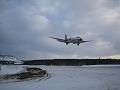
ok all the float experts , you are flying out of a long very narrow lake
with your wind right on the nose the hills are 2-3 hundred ft in all quadrants . now we all know that the wind though taking off into ,you becomes downflow as you approach the end of the lake .
is there some formula ( other than smart ass comments ) that one applies
so that after takeoff one avoids the downflow air ( is already above it )
like if the hill is x height and the wind is y knts the distance one should be airborne and at x height to avoid the downflow air.
I always give my self lots of room but would be good to here if there is a bit more prcise method . thx fly safe
There are so many variables in real life that any answer you would get from a contrived formula would only be the exception that proved the rule. The shape of the hill more than its height would affect the flow of air over it. If you came up with a formula based on observation of one hill, it wouldn't work on a different one. I thought your question was imaginative though.
---------- ADS -----------
If I'd known I was going to live this long, I'd have taken better care of myself
Old man Arthur Fecteau used to give a little quiz to his new pilots. He'd draw out a narrow dog-leg lake on a piece of paper. The short arm of the lake would be oriented E/W, with the long arm SW/NE. Then he'd say "Da wind is sou'west at t'irty knot. How you land in dere?" The guy would say, "I'd land on the SW arm." The old man would then draw an island half-way down the long arm and ask the same question. Most guys would say, "Well, I could take the left crosswind on the short arm, it's only about 30-40 degrees off." Then he'd make a couple of dots at strategic places on the short arm and say, "Wal, dere's a reef here and a sand bar dere, what you do now you?" At this point the guy would say "I'd say the hell with it and go to another lake." The old man would grin and say "Dat's what I want to hear, me. You can't get in dere wit' the wind like dat"
There is no known formula, but it would be reasonably straight forward to come up with one. To figure out the subsidence, you could multiply the sine of the slope of the hill by the wind direction (or if you want to get really technical, the vector divergence of the hill as a function of wind velocity).
OK, think I got a rough approximation
Angle of climb =arcsin (rate of climb - sin (hill slope)*wind velocity)/(Vy-wind velocity)
OK, here it is: if the following expression is >1, the best angle will be into wind. If < 1, go down wind is the best angle of climb. Again rough approximation.
Alternatively, you could just trust your judgement.
Wow. That was 30 minutes of my time I'll never get back. Happy float flying.
Oh, I should add, this assumes, you can make a turn before the hill or the hill is so short it is of minimal consequence. If you can't, just take off downwind. If the DW is too much, stay on the ground.
A 'simple' vector analysis will not work. We are dealing with fluid mechanics here. What is the maximum slope before you get flow separation? (ie: turbulence). What other mechanical factors are going to affect the flow? (rough terrain, trees, etc). How will different wind velocities and/or directions affect the airflow's interaction with the slope? At what point is the flat ground (the lake) going to influence the direction of the air flow?
Bottom line, there are too many variables. A ROT I use is multiply the prominence of the terrain by three (visually, rough guess) and fly that distance away to avoid the worst of the turbulence and subsidence, when dealing with extreme (100% or higher slope) terrain in moderate winds. But that is just a place to start; every place and every day is different.
Flat ground tends to moderate subsidence (no downdraft is going to slam you into flat ground unless you are dealing with thunderstorms or microbursts) so try and make obstacle clearance height before you get into hills. Know how much room your aircraft takes to turn around and know the performance penalty for doing so.
The more fancy your flying or mathematics, the more likely something is going to go wrong...
I totally agree, that's why I said you're better of with your judgement and that the first expression was a rough approximation. The second equation would work pretty ideally (the one with the del operator), because it models the subsidence of the air over the hill, but you would have to model the fluid flow first, which would, for all intents and purposes, be impossible.
The purpose of my post was just to show that a formula was possible, and to help me get to sleep.
bede thx very much for that I was hoping that i would not have to pull out my scinetific calulator every time I was hoping for smart folks like you to to do a chart for us hands on folks.
maybe similar to a cap gen climb grade thing only the wind velocity and the height above hill.
I agree witrh you folks exp is key as I said in my orginal post I always give myself lots of room . but like most things wanting to put another tool in the tool box . just like v1 no go thing. it is a published #
Just trust your best judgment. Like I mentioned earlier, fluid flow is far more complex than the simple equation I did, but than on the other hand, so are the rules of thumb for landing in grass. I guess someone could always add a good safety factor to it. It would be interesting for someone to try it out and see how it compares with the prediction.
Heh heh, yeah who wants to solve the Navier stokes equations in three dimensions. Even if you assume no compressibility and knock off the nonlinear terms (which is wrong to do) you're still gonna need a computer to solve the equations. So the short answer is YES there definitely is an equation but I you'd ever find the solution especially with changing boundary conditions for every single hill or change in density of the air or even wind velocity.
Just get some experience and then you'll know...or...shuttle a big load in a small lake to a nearby big lake and then take it all.
Where in the hell did you guys learn this stuff? I thought I had a good edu-macation, I can't remember any of that stuff. The words "Navier-stokes" ring a bell, but I can't remember why. My brain hurt trying to punch through BEDE's equation, and I didn't try very hard before giving up, believe me!
---------- ADS -----------
If I'd known I was going to live this long, I'd have taken better care of myself
boozy wrote: So the short answer is YES there definitely is an equation but...
I imagine there's an equation for everything. We'll wait for BEDE and BOOZY to reconcile quantum and relativity and then we will be able to calculate ANYTHING!
A formula for calculating takeoff weight for your bush float operation
pax standard weight X No of pax + USA male weight delta* + declared baggage weight + weight of the 5 bags they "forgot to give you when you were weighing he bags" + 5 extra cases of beer + 2 bottles of propane - weight required to be removed in order to get the aft spreader bar out of the water = Actual takeoff weight
*The difference between the TC standard weight and the average weight of a lardass American fisherman
The Navier Stokes equations are a set of equations used to apply Newtonian mechanics to fluid flow, and for all intents and purposes would be impossible to solve in this application without a computer, hence why I came up with a real rough approximation.
Navier Stokes equations and the stuff I put up would not be found in any flying books, so don't feel bad for not knowing it. You might see this stuff in a fluid dynamics physics class or something like that. Keep in mind, the stuff we learn as pilots is a very basic treatment of the subjects. There are people that complete PhD's and do research in every one of the fields that we learn about (met, aerodynamics, human factors, etc) so you can dig really deep into these fields.
The field of mathematics that deals with coming up with equations is called modelling and is incredibly difficult. The more precise a model, the more complex it is. For this example, the first equation I gave is very simple. You can up the accuracy using vector calculus or the NS equations. However, these will only model laminar flow, which of course does not occur (hence why we have turbulance). I'm not sure if it would be possible to realistically model turbulant flow. I guess you could use chaos theory and a bid ass super computer, but even than I'd have my doubts.