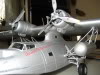
Congrats to Kenn Borek Air for another successful medevac from the South Pole to McMurdo Station where the patient was transferred to USAF C-17 and flown to Christchurch NZ for further treatment.
KBA Baslers C-GJKB and C-FMKB were used for the the flights to the pole on Oct 17.
Raytheon's station manager Renee Nicole Douceur suffered an stroke in August and had been pushing for an evac asap garnering much media attention.
The Baslers arrived at Rothera from Punta Arenas at 0730 Saturday morning (it was Friday afternoon at Rothera) (Boston Globe article)...the crews rested and hoped to depart for Pole later that day to reach Pole at 6:00 Sunday morning...but this arrival was postponed until Monday (Christchurch Press update late Sunday morning). The flight to Pole was about 7 hours, and after refueling it continued on to McMurdo with Renée and her medical escort--another five-hour flight.
On Sunday the Basler flights from Rothera to Pole had been postponed for 24 hours due to bad weather...they reconsidered things again at 2300 (0700 Rothera time) on Sunday...and the Baslers headed to Pole a bit later, arriving Monday morning (left). Temperature was -73.8°F. The aircraft was only on deck for about 30 minutes, and always kept one engine running even while refueling (right). After refueling, the aircraft with Renée and medical escort aboard took off for McM just after 0900 (below left...the first Basler is heading for McMurdo while the second one is being refueled). Earlier Monday morning Renée had emailed the media that she was about to board the aircraft Washington Post article) (all photos here by Christy Schultz, used by permission).
More on the link with photos and links to the previous KBA medevacs in April 2001 and Sept 2003 ...
bigsky wrote:Well done guys ( gals?) Worthy of posting the crew names if any one knows them. -73!! Damn - makes "Ice Pilots" look like a tropical show.
That's still only -58C. I saw that many times living up in northern Canada and colder. Not saying it's pleasant but it still happens in Canada often enough.
...Apart from the freshies, the real big event yesterday was the landing of the first planes of the season. Two of them arrived. Their primary reason for landing here was not to bring us freshies, but to refuel on their way across the continent from Rothera, the British research station on the Antarctic Peninsula, to McMurdo. They are Baslers, vintage DC-3 airplanes that have been refurbished for polar travel. They are chartered to the US Antarctic Program from Kenn Borek, a Canadian company. It took them about two weeks to arrive, coming all the way from Calgary, in Canada, hopping from airport to airport along the American continent, and then across Antarctica. They will be stationed at McMurdo for the rest of the season, carrying passengers and cargo to the South Pole first, and then to field camps in Antarctica. While they were refueling today, they also picked up three of us who had urgent needs to get back to the US, leaving only 46 of us to run the station until the summer crew arrives in a few days.
The pilots and mechanics of the two Baslers took the time, on their last stop in Punta Arena in Chile, to go to the store and, out of their own good heart and pockets, buy some fresh fruit and vegetables for us. They handed us large grocery store bags full of apples, oranges, pears, and lettuce. It is not the first time that these pilots come to the South Pole, and they know what we most long for after 8 months of isolation. There was enough for a big apple for each of us, an orange and a large bowl of lettuce. We love you, Kenn Borek pilots and mechanics!
bigsky wrote:Well done guys ( gals?) Worthy of posting the crew names if any one knows them. -73!! Damn - makes "Ice Pilots" look like a tropical show.
That's still only -58C. I saw that many times living up in northern Canada and colder. Not saying it's pleasant but it still happens in Canada often enough.
Many times you saw -58C. Only -58C?? You make it sound like it's not that cold. I would agree with that temp if it was wind chill, but -58C ambient? In my many years working and living in the north and far north I don't recall seeing those temperatures on a regular basis. I've seen wind chills greater than that, but -58C ambient many times. . . I call BS! -58C is pretty damn cold no matter how you slice it. . .
bigsky wrote:Well done guys ( gals?) Worthy of posting the crew names if any one knows them. -73!! Damn - makes "Ice Pilots" look like a tropical show.
That's still only -58C. I saw that many times living up in northern Canada and colder. Not saying it's pleasant but it still happens in Canada often enough.
Many times you saw -58C. Only -58C?? You make it sound like it's not that cold. I would agree with that temp if it was wind chill, but -58C ambient? In my many years working and living in the north and far north I don't recall seeing those temperatures on a regular basis. I've seen wind chills greater than that, but -58C ambient many times. . . I call BS! -58C is pretty damn cold no matter how you slice it. . .
Of course its f-in cold. I couldn't start my truck when it was that cold and it had 4 heaters on it. The coldest I saw in the north was -62.6 ambient at 60 degrees north latitude on the ground and below -55 for a week straight. My point was that the temp was written in Fahrenheit and I think maybe the poster saw Celsius.
In early '05, Key Lake, Saskatchewan it got down to -68C and they are in the "far south".
I'm not trying to sound arrogant but -58 sounds like nice summery weather for living on a giant ice sheet at 10,000 feet. Its been -90C there before.
Congrats to your crew JC. Awesome work. I'd love to be down there. I bet you guys know every shade of white and blue
Meatloaf wrote:
In early '05, Key Lake, Saskatchewan it got down to -68C and they are in the "far south".
I have to call Bull-shit on that !
(-68) degrees Celsius = -90.4 degrees Fahrenheit
In early February of 1947, the bottom dropped out of the thermometer across Canada's Yukon Territories. Before the morning of 3 February dawned on Snag (Yukon), the alcohol in the thermometer had vacated the thermometer's stem and receded into the instrument's bulb, leaving the minus 80 oF (minus 62.2 oC) mark behind, the last tick on the thermometer's scale.
The initial estimate of that day's minimum temperature by weather officer-in-charge Gordon M. Toole was minus 83 oF ( minus 63.9 oC), the coldest temperature ever recorded in North America. (Only a few other sites in Siberia, Greenland and Antarctica have ever registered officially recognized colder temperatures.) The previous record had been set the preceding day at Snag when the thermometer bottomed out at minus 80 oF (minus 62.2 oC). Although the temperature reading was later officially pegged at "only" minus 81.4 oF (minus 63 oC), it set a new standard for cold in North America which still stands today.