For reference sake, the 3 accident reports are as follows;
1. Click Here N824BJ SR-22 February 02, 2008 in Lindsay, OK
(N824BJ) The National Transportation Safety Board determines the probable cause(s) of this accident as follows:
The flight instructor's failure to maintain control of the airplane, which resulted in an inadvertent stall while maneuvering.
2. Click Here N526CD SR-22 January 09, 2006 in Lancaster, CA
(N526CD) The National Transportation Safety Board determines the probable cause(s) of this accident as follows:
The student pilot's failure to maintain an adequate airspeed while maneuvering, and, the flight instructor's inadequate supervision of the flight. A factor in the accident was the strong tailwind encountered as the airplane turned from an upwind to a downwind during the teardrop maneuver.
3. Click Here N929CD SR-20 October 11, 2006 in Manhattan, NYC (Cory Lidle accident)
(N929CD) The National Transportation Safety Board determines the probable cause(s) of this accident as follows:
The pilots' inadequate planning, judgment, and airmanship in the performance of a 180º turn maneuver inside of a limited turning space.
RIP Lisa Sener . . . Pilot Cirrus SR-22 G3 TC-SAS
Moderators: sky's the limit, sepia, Sulako, lilfssister, North Shore
-
bizjets101
- Rank 10

- Posts: 2105
- Joined: Fri Sep 17, 2010 7:44 pm
Re: RIP Lisa Sener . . . Pilot Cirrus SR-22 G3 TC-SAS
The cirrus rolls INTO the turn when the inner wing stalls in the video.robertsailor1 wrote:Looking at the first utube I can't see anything unique about this aircrafts handling characteristics. A 172 would do the same thing. Its too bad that stalls in steep turns are not demonstrated more often. Inside wing stalls and the aircraft rolls opposite the turn. Forget about rudder and simply change the angle of attack on the wing by giving it forward stick and you will fly away easy peasy. Even if you mishandle the rudder a bit forward stick is still the answer.
Here are some videos of stalls in steep turns:
http://www.youtube.com/watch?v=zpX4bwbFMdE
http://www.youtube.com/watch?v=3ZG7BnDc ... ure=relmfu
http://www.youtube.com/watch?v=LL7h4Z-oeOk
As you can see, sometimes the stall causes the roll to steepen and you essentially enter an incipent spin, while other times the plane simply rolls wings-level. It seems to depend on propeller torque, whether you're climbing or descending, how steep the turn is, and perhaps the shape of the wing.
If the cessna 172 rolls out of the turn and the cirrus rolls into the turn then that could explain why the cirrus is more dangerous. It would seem to be easier to recover from a turning stall if either the nose drops or the wings roll level, than if you suddenly enter an incipent spin.
-
robertsailor1
- Rank 7

- Posts: 643
- Joined: Wed Feb 02, 2011 6:05 pm
Re: RIP Lisa Sener . . . Pilot Cirrus SR-22 G3 TC-SAS
No matter which way it goes release the back pressure on the stick

Re: RIP Lisa Sener . . . Pilot Cirrus SR-22 G3 TC-SAS
The first video (Avweb anatomy of a cirrus stall/spin) shows the speed at which the inside wing can reload lift to snap-roll right with the touch of right rudder. Will it do that too without (very little) right rudder input when the left aileron comes back into the picture once the left-only stalled wing so-quickly un-stalls (unloads drag) if AOA there is reduced just enough by "stick forward" ?
The left aileron (passive safety concept) comes back into play as instantly as the left reloads its lift ... while likely yoke-stick is also full in right turn deflection. Upset training teaches that it takes concentration to keep ailerons neutral for the stall recovery ... and that 's also why (the Avweb Video concludes) the abusive control inputs like that 60 degree bank are out of place in the pattern.
Sundre AB sept 24 2010 SR22 GS (report should by now be available).
The left aileron (passive safety concept) comes back into play as instantly as the left reloads its lift ... while likely yoke-stick is also full in right turn deflection. Upset training teaches that it takes concentration to keep ailerons neutral for the stall recovery ... and that 's also why (the Avweb Video concludes) the abusive control inputs like that 60 degree bank are out of place in the pattern.
Sundre AB sept 24 2010 SR22 GS (report should by now be available).

Re: RIP Lisa Sener . . . Pilot Cirrus SR-22 G3 TC-SAS
Let me add my condolences to the families for the loss of loved ones in an aviation crash.bizjets101 wrote:As with accident postings, often the families of lost ones in Internet searches come across posts.
To Lisa and Kikmet's family I offer my sincere condolences.
But bizjet101 invited me to this forum as someone who has studied Cirrus accidents. The misinformation about the Cirrus aircraft in which this tragedy unfolded warrants some rebuttal and factual information.
Sadly,
Rick
(Cirrus SR22 owner with 3,000+ hours, and defacto accident historian for Cirrus Owners and Pilots Association)
Re: RIP Lisa Sener . . . Pilot Cirrus SR-22 G3 TC-SAS
Do you have a factual source for this claim?Colonel Sanders wrote:It's incredible that the Cirrus has a fatal accident rate
THREE TIMES higher than a Cessna, despite all the
fancy safety stuff.
One source on the internet with similar claims works as a Cessna salesman. But for comparisons, what is a Cessna? And who knows how much they fly?
Accident rates need three things: # fatal accidents, # flying hours, and a time period.
At the Cirrus Owners and Pilots Association (the other COPA
 ), we track the # fatal accidents all over the world. As of today, 91 fatal Cirrus accidents. That's slightly more than the common source from the NTSB database because it includes all known foreign accidents, including Canadian ones, that do not get included in the US-based NTSB database.
Cirrus Aircraft trackes flight hours using times submitted with warranty cards, completion cards for service bulletins and airworthiness directives. They then create a reliability distribution of flight hours for the Cirrus fleet of about 5,200 aircraft.
Then we plot the 12-month and 36-month fatal accident rates. Longer intervals smooth out the effects of a small population. With only 1 in 30 registered single-engine piston aircraft, small numbers of accidents create big swings in accident rates.
Here's the plot of the Cirrus fatal accident rate since first introduction of the SR20 in mid-1999.
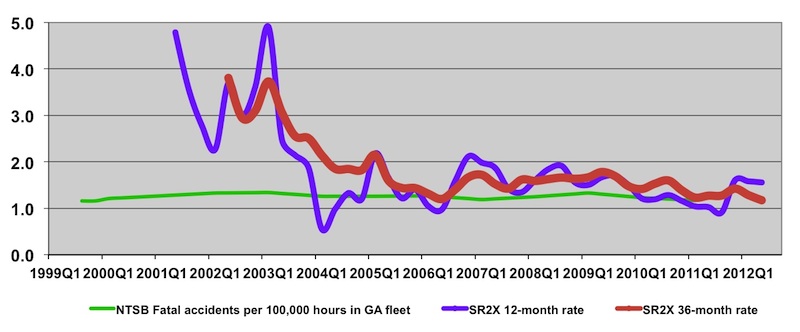
Comparisons with the NTSB fatal accident rate show that the Cirrus rate has declined over time to a level inconsistent with the claim of three times a Cessna rate.
Cheers
Rick
(Cirrus SR22 owner with 3,000+ hours, and defacto accident historian for Cirrus Owners and Pilots Association)
Re: RIP Lisa Sener . . . Pilot Cirrus SR-22 G3 TC-SAS
Fascinating glimpse into one person's opinion about the history and development of safety features of the Cirrus aircraft.Colonel Sanders wrote:I'm not sure you can call an airplane with such a highCirrus are a great airplane
fatality rate a "great airplane" ...You don't understand. They were specifically designed and marketedIt's unfortunate they get in the hands of so many people who have no business flying them
to get them into the hands of people who have no business flying
them.
...
The Cirrus and Columbia were specifically built for bozos who
didn't have enough experience to get insurance on retractable
gear airplanes. Toss in a BRS, and those weiners will fly into
any kind of weather.
Cirrus designed the SR20 with fixed gear to avoid maintenance and weight issues. With modern computer modeling of aerodynamic surfaces, Cirrus achieved comparable airspeeds without the need for retractable gear.
And actually, the target market aimed for people who did have business needs for personal air transportation. Having reinvigorated the general aviation market with over 5,000 new airplanes produced in the past 10 years, Cirrus -- and other competitors -- helped reverse a decline in aircraft production. Now we need to keep innovating so that the pilot population grows. Calling Cirrus pilots "bozos" doesn't help.
By the way, about three-quarters of the accident pilots in Cirrus fatals had more than 400 hours flying time. That's several years of prior experience, right?
Cheers
Rick
(Cirrus SR22 owner with 3,000+ hours, and defacto accident historian for Cirrus Owners and Pilots Association)
Re: RIP Lisa Sener . . . Pilot Cirrus SR-22 G3 TC-SAS
Unfortunately, what you call a "better explanation" doesn't help address what to do. Should we have a "bozo" test? Should we require all Cirrus pilots to fly Cessnas for years before they are approved by such opinionated forum posters?Stallspin wrote:Colonel - You're right, "great" was a bad choice of words. "Good performer" is maybe more accurate. And that is definitely one of the better explanations for the high fatality rate as I have seen.
Better explanations come from better understanding of what actually happens in Cirrus accidents (and any other accident, for that matter).
Mission differences stand out as a significant contributing factor to Cirrus accident scenarios. More capable airplanes being used to fly longer missions raise the risks -- unfamiliar destinations, changing weather systems, fatigue, passenger distractions, mechanical issues, etc. Cirrus pilots face more of these challenges because they fly more challenging missions for personal air transportation than most $100 hamburger runs.
Consequently, IMHO, Cirrus pilots need better risk-assessment skills than most instructors know how to teach. Hence, the Cirrus transition syllabus includes extensive aeronautical decision-making scenarios to address this gap. And without any regulatory requirement for higher levels of skills, knowledge or abilities, too many instructors treat a Cirrus as just another airplane. A Catch-22 that likely creates too many opportunities to be caught in bad situations.
Cheers
Rick
(Cirrus SR22 owner with 3,000+ hours, and defacto accident historian for Cirrus Owners and Pilots Association)
Re: RIP Lisa Sener . . . Pilot Cirrus SR-22 G3 TC-SAS
Indeed, six fatal accidents in Cirrus aircraft had instructors in the right seat. None were primary training, such as one might expect of a Cessna 172.CpnCrunch wrote:Not sure what caused this particular accident, but there have been at least 3 other fatal stall/spin Cirrus accidents with a student and instructor on board, which seems unusually high. When was the last time you heard of a Cessna 172 doing a stall/spin and killing a student and instructor? Either there is something fundamentally wrong with the plane, or even the instructors can't handle the relatively high stall speed.
But 3 of those 6 instructors had less than 30 hours in a Cirrus -- choose your instructor carefully.
Park Falls, WI -- during transition training, we believe wind shear during a simulated power-off emergency landing dropped the plane into a river
Lindsay, OK -- during a BFR, plane was overcontrolled during a simulated power-off emergency landing attempting to recover from flying through the final approach course, instructor was conducting a BFR but had zero hours in a Cirrus
Lancaster, CA -- instructor was teaching a power-off return-to-airport maneuver to a transitioning experienced helicopter pilot, both had less than 30 hours in a Cirrus; such maneuvers are prohibited by the Cirrus Pilot Proficiency Program below 4,000 feet.
Manhattan, NY -- box canyon maneuver over the East River under the Class Bravo shelf for Laguardia that turned with the wind and accelerated the turn to avoid buildings, instructor had little to no experience in a Cirrus but was planning on training pilot for an instrument rating
Guatemala -- during a long multi-country trip with an experienced instructor, a transitioning pilot SR20 attempted a go-around at hot, high, mountainous airport and failed to gain altitude
Deltona, FL -- two commercial pilots from an airline training academy were practicing slow flight and stalls when power was added as the plane was rolling and initiated a left-turn into a 10-turn spin where the power was never reduced until impact; parachute was deployed just prior to impact rather than any other time in the 25-second spin
To my reading, this does not implicate the stall characteristics of a Cirrus but rather the consequences of uncoordinated flight and power management.
Cheers
Rick
(Cirrus SR22 owner with 3,000+ hours, and defacto accident historian for Cirrus Owners and Pilots Association)
Re: RIP Lisa Sener . . . Pilot Cirrus SR-22 G3 TC-SAS
It's not the airplane, it's us, the pilots. 94% of NTSB probable causes of Cirrus fatal accidents were pilot-related.Lurch wrote:Why? What makes the Cirrus so dangerous?Colonel Sanders wrote:Maybe, but IMHO it's easier for an incompetent pilot to kill himself in a Cirrus as opposed to a Cessna.If these pilots weren't buying Cirrus they'd find another plane to kill themselves in
In almost all cases, the pilots had the requisite training and certificates, yet persisted in flying in bad situations. Poor decision-making shows up in a huge number of Cirrus accident reports -- VFR in IMC is a big one, including instrument-rated pilots! Poor handling of abnormal situations also shows up -- avionics weirdnesses, engine problems, diversions, etc. Finally, lack of proficiency contributes to the Cirrus fatal accident rate.
And then there is the failure of the pilots to deploy the Cirrus airframe parachute. Tragically, by my reckoning, 106 people have died in accidents where the pilot faced a bad situation similar to one where another pilot pulled the parachute handle and all lived. There has not been a fatality when the parachute was deployed within its design parameters -- airspeed below 133 knots and altitude above 1000 feet AGL.
Cheers
Rick
(Cirrus SR22 owner with 3,000+ hours, and defacto accident historian for Cirrus Owners and Pilots Association)
Re: RIP Lisa Sener . . . Pilot Cirrus SR-22 G3 TC-SAS
Hi Rick,
Thanks for your input - very useful information.
The new ESP envelope protection should also help prevent these turning stalls in future. It doesn't seem to be standard, but if you buy the GFC 700 autopilot package (which I imagine most owners would get), it is included.
Thanks for your input - very useful information.
The new ESP envelope protection should also help prevent these turning stalls in future. It doesn't seem to be standard, but if you buy the GFC 700 autopilot package (which I imagine most owners would get), it is included.
-
YYZSaabGuy

- Rank 8

- Posts: 851
- Joined: Wed Aug 04, 2010 7:32 am
- Location: On glideslope.
Re: RIP Lisa Sener . . . Pilot Cirrus SR-22 G3 TC-SAS
My understanding is that deploying the BRS usually results in significant structural damage to the aircraft hull - is that correct? If so, people may be trying to save their expensive airplane by deferring the BRS until they run out of time - and options.sdbeach wrote:And then there is the failure of the pilots to deploy the Cirrus airframe parachute. Tragically, by my reckoning, 106 people have died in accidents where the pilot faced a bad situation similar to one where another pilot pulled the parachute handle and all lived.
BTW, I agree with CpnCrunch, sdbeach - good additional information. Thanks for providing an alternative point of view.
Re: RIP Lisa Sener . . . Pilot Cirrus SR-22 G3 TC-SAS
Safety innovations continue to be a priority with the Cirrus community.CpnCrunch wrote:The new ESP envelope protection should also help prevent these turning stalls in future. It doesn't seem to be standard, but if you buy the GFC 700 autopilot package (which I imagine most owners would get), it is included.
Indeed, ESP for the Cirrus Perspective provides great feedback and controls for the pilot experiencing unusual attitudes. Avidyne provides similar capabilities in both their DFC90 for Entegra systems (most of the Cirrus fleet) and the DFC100 for Release 9 systems. (Unfortunately, my old six-pack with an ancient STEC-55X autopilot won't help me, so I have to do all this myself!)
The way that pilots continue to screw up doing old things fascinates me about these innovations! Consequently, I put the onus back on the instructors, who are the ones doing flight reviews and recurrent training to detect lack of proficiency and inappropriate attitudes toward flying. IMHO, pilots need training to help them realize what they don't know and to encourage them to do something about that!
Cheers
Rick
(Cirrus SR22 owner with 3,000+ hours, and defacto accident historian for Cirrus Owners and Pilots Association)
Re: RIP Lisa Sener . . . Pilot Cirrus SR-22 G3 TC-SAS
Correct. But repairable.YYZSaabGuy wrote:My understanding is that deploying the BRS usually results in significant structural damage to the aircraft hull - is that correct?sdbeach wrote:And then there is the failure of the pilots to deploy the Cirrus airframe parachute. Tragically, by my reckoning, 106 people have died in accidents where the pilot faced a bad situation similar to one where another pilot pulled the parachute handle and all lived.
Of the 31 CAPS events with survivors, at least 9 of those planes flew again. The second one, C-GEMC involved in a CAPS pull (Cirrus Airframe Parachute System handle) over Mount O'Leary in BC, was repaired and flew again, based in Calgary. In fact, you can buy it!
Repair costs obviously vary with the amount of damage to the aircraft. We've seen actual repair bills range from about $80,000 to $160,000 for planes valued at between $240,000 to $500,000. Good to have insurance, eh?!
Interestingly, some Cirrus insurance underwriters waive the deductible for CAPS pulls, encouraging pilots to consider saving themselves before the plane. When I asked the VP of Starr Aviation Insurance, who is a Cirrus owner and insurer, about what he would say to Cirrus pilots, his response: "Pull CAPS! I would rather keep you as a customer than deal with your estate!"
Cheers
Rick
(Cirrus SR22 owner with 3,000+ hours, and defacto accident historian for Cirrus Owners and Pilots Association)
Last edited by sdbeach on Fri Aug 17, 2012 11:55 am, edited 1 time in total.
Re: RIP Lisa Sener . . . Pilot Cirrus SR-22 G3 TC-SAS
Unfortunately, most pilots in Cirrus accidents cannot answer your question.YYZSaabGuy wrote:If so, people may be trying to save their expensive airplane by deferring the BRS until they run out of time - and options.
What we know from observing Cirrus pilots in the full-motion simulator with a CAPS parachute handle, they are simply unaware in the stressful moment -- even for instructors who teach this stuff, even for pilots who just completed several hours of ground instruction on emergency procedures! Task focus gets in the way. Panic gets in the way. Lack of primacy effect gets in the way.
Funny story about one pilot who tried to save the plane and landed on a road in Texas. During a repositioning flight for the fractional operator, the pilot mistakenly assumed the fuel tanks were full -- they weren't! No problem, he'll just land on that road over there, get a fuel truck, take off again and save the hassle. Except, he landed and rolled through a cattle guard and broke the wing spar. Cirrus doesn't inventory spare wings, so it takes awhile to get a new one and costs a lot. CEO of the fractional listened to one of my talks about the history of Cirrus parachute pulls and told me afterwards "If that pilot had pulled the CAPS handle rather than risking an off-airport landing, we would have had an insurance check within a week, bought a replacement plane and been making money again rather than having that plane AOG for six months!"
With a Cirrus airframe parachute, pilots truly need to rethink how they will handle emergency situations.
Cheers
Rick
(Cirrus SR22 owner with 3,000+ hours, and defacto accident historian for Cirrus Owners and Pilots Association)

Re: RIP Lisa Sener . . . Pilot Cirrus SR-22 G3 TC-SAS
.
Last edited by Stallspin on Mon Mar 10, 2014 11:35 pm, edited 1 time in total.
Re: RIP Lisa Sener . . . Pilot Cirrus SR-22 G3 TC-SAS
You may not see the downside, but extra speed can be fatal. Perhaps you have great technique, but enough Cirrus landing accidents have hurt airplanes and killed people to be the subject of a Safety Alert jointly issued by Cirrus and COPA (the Cirrus COPA). This reinforced airspeeds for landing: downwind 100 KIAS, base 90 KIAS, final 80 KIAS, Vref (over threshold) 73-77 KIAS (varies with weight), touchdown 60 KIAS (stall speed with full flaps).Stallspin wrote:Couple points, I've got about 500 hours on these things and I definitely agree, very easy airplane to fly.
I usually hold 90 until final, if I'm turning and close to the ground might as well have a bit of extra speed. I don't see the downside if I have 6000 feet of runway.
Because of the aerodynamic efficiency of the Cirrus wing, touching down a few knots above stall speed leaves you vulnerable to bouncing back into the air and flying again. Pilots who force the plane back down on the runway induce oscillation that has had bad outcomes. If you bounce once, then go around.
So, the downsides come from the fact that the Cirrus wants to fly at any speed above stall speed -- and we have to have the discipline not to overcontrol the plane.
Coincidentally, yesterday on the COPA forum (www.cirruspilots.org), we discussed nosewheel shimmy after a pilot posted a video of his nosewheel violently shaking side to side. We believe that the shimmy comes from slight yaw at touchdown, in this case caused by touching his left main wheel on the dirt to the left of the runway. We do not believe that properly adjusted Cirrus nosewheels weathervane much, but in high crosswinds they probably will. Again, touchdown at stall speed and keep the nose up as long as practical.Stallspin wrote:Every once in a while I'll land, hold the nose off til I run out of elevator and I'll get a small amount of nose shimmy. As you know these a/c are super easy to land well, and even with the nicest touch and holding the nose off, every once in a while it will start to shimmy. I'm not sure if it's because the crosswind is "weather vaning" the nose wheel to the side a bit or what. When/if that starts to happen I'll usually add a little power (runway permitting) and raise the nose off again. In my head I'm thinking the power will help line the nosewheel back up with the runway. I just always make sure I set the nose down easy just incase it tries to act up. Some do it worse than others, not sure if the taller gear and heavier weight up front on the turbo makes it worse or not. The SR20 we used to have never did it.
We had a Cirrus instructor shimmy the g3 turbo at Thief River Falls when we took training...so it can happen.
Wish we could organize a Cirrus Pilot Proficiency Program for Cirrus pilots in Canada. We cover the use of brakes extensively.Stallspin wrote:As far as the brakes. Where I fly out of is windy, taxiing with a 35kt x-wind is not uncommon. You need to ride the downwind brake to stay straight. I wouldn't want to taxi very far like this. I've never had an issue with brakes, it's just a known issue and I'd rather be careful with it than have to rebuild the brakes.
Three things you can do to avoid riding the brakes: 1) taxi on the right side of the centerline and take advantage of the crowning slope for drainage; 2) taxi a bit faster to ensure rudder authority as long as you plan ahead to slow down; 3) blip the right brake to turn the plane occasionally but not steadily drag the brake.
The Cirrus brakes are great, using the same components as other planes, but the aerodynamic wheel fairings keep the heat in longer. You can trust them to abort a full-power takeoff, but don't expect to do that twice in 30 minutes, or after riding the brakes while taxiing.
Cheers
Rick
(Cirrus SR22 owner with 3,000+ hours, and defacto accident historian for Cirrus Owners and Pilots Association)
Re: RIP Lisa Sener . . . Pilot Cirrus SR-22 G3 TC-SAS
.
Last edited by Stallspin on Mon Mar 10, 2014 11:35 pm, edited 1 time in total.
-
Colonel Sanders

- Top Poster

- Posts: 7512
- Joined: Sun Jun 14, 2009 5:17 pm
- Location: Over Macho Grande
Re: RIP Lisa Sener . . . Pilot Cirrus SR-22 G3 TC-SAS
Rick - from your statement above, it would appear that you agree with my evaluation of Cirrus pilots a bozos.It's not the airplane, it's us, the pilots. 94% of NTSB probable causes of Cirrus fatal accidents were pilot-related.
And even though you claim fixed-gear is irrelevant, I can assure you as someone who has been in aviation for many decades, that it was a brilliant marketing move to get low-time pilots into an airplane they could get insurance on.
Decades ago, the bozos flew Bonanzas. Now they fly Cirrus's.
I fly airplanes much much nastier than a frikken Cirrus. I don't crash them because I'm not a bozo with an excessive money to brains ratio.
Cirrus pilots are bozos. Sorry if the truth makes you feel bad. Get counselling perhaps.
Re: RIP Lisa Sener . . . Pilot Cirrus SR-22 G3 TC-SAS
No, I do not agree. Nor do I agree that 70-80% of the pilots who are determined to the probable causes of other general aviation accidents are bozos. They may have poor pilot skills, lack proficiency, made a mistake -- but they paid a death sentence for that situation. And nowhere but here do they get called a bozo.Colonel Sanders wrote:Rick - from your statement above, it would appear that you agree with my evaluation of Cirrus pilots a bozos.It's not the airplane, it's us, the pilots. 94% of NTSB probable causes of Cirrus fatal accidents were pilot-related.
Calling someone names simply does nothing to help increase safety for general aviation. Perhaps that is your mindset -- you know better than anyone else who is or who isn't a bozo and so we should just listen to you. Then if everyone were qualified by you, there would never be another fatal accident in a Cirrus -- or any other aircraft.Colonel Sanders wrote:Cirrus pilots are bozos. Sorry if the truth makes you feel bad. Get counselling perhaps.
As for me, I put my energy into helping others understand what we can learn from accident history. It's not a game of blame-the-pilot, because we were not there, and we don't know all the factors that contributed to the decisions made in a particular accident. What we can do is learn from these accidents and ask: What would I do differently to handle a similar situation? Then we can do things to address the risks we learned about.
Unfortunately, general aviation activity declines with attacks (or name calling) like this. Who wants to be labeled a "bozo" because I have flown my Cirrus safely for 3,000 hours? Certainly reflects upon you more than me.
And because this forum does not require posters to use their real names, I have no idea who you are or why you choose to write this way.
Cheers
Rick
(Cirrus SR22 owner with 3,000+ hours, and defacto accident historian for Cirrus Owners and Pilots Association)
Re: RIP Lisa Sener . . . Pilot Cirrus SR-22 G3 TC-SAS
No need to take offence to that "bozo" adjective. Learning to fly (farmed) around the oldest flying club airport in Canada, got to go over to the club on rainy days to try to get in another lesson. Don't know how many times that word echoed through the club about someone; but every pilots' skills could be shaped in the understanding that at some point anyone can fit the description. Believe me, if you called up management and said you're interested to organize a proficiency program for "bozos" you would be taken seriously. 'Clowning' around (boneheadedness) that has anything to do with, or gets anywhere near the disciplines of flying, was eradicated at any time. Its still that way.sdbeach wrote:Wish we could organize a Cirrus Pilot Proficiency Program for Cirrus pilots in Canada. We cover the use of brakes extensively.
A good idea to start such a program. The safety seminar has proven be a very productive tool, separate of the sales initiatives.
Last edited by pdw on Sat Aug 18, 2012 5:58 am, edited 1 time in total.
Re: RIP Lisa Sener . . . Pilot Cirrus SR-22 G3 TC-SAS
Please understand that I took no offense that I was called a bozo. Instead, I argued that such name calling fails to improve safety.pdw wrote:No need to take offence to that word "bozo" here.
This seems like a juicy bone to chew on, so indulge me a bit longer.
Exactly. We need to do better. What worked in the past will not work in the current environment. You posed an example of a learning style that uses criticism to "eradicate" bad behaviors that turns off pilots instead of attracting people to flying.pdw wrote:Don't know how many times that word echoed through the club about someone; but every pilots' skills could be shaped in the understanding that at some point anyone can fit the description.... 'Clowning' around (boneheadedness) that has anything to do with, or gets anywhere near the disciplines of flying, was eradicated out of every student at any time. Its still that way.
Where does that get us in general aviation? With fewer pilots! How many prospective wanna-be pilots would hang around a club looking forward to being treated in a humiliating way? Not enough to grow general aviation and ensure that it continues to protect an important personal air transportation capability.
Of course, we all make mistakes. Some of those are boneheaded. Reading accident reports, or even news reports of things done by professional pilots, suggests that we may all do something boneheaded while flying. After all, we are fallible humans, not perfect automatons.
In the Cirrus community, things differ substantially. At the outset a decade ago, engineers designed systems that provide more information (the multifunction display), integrated advanced avionics (every Cirrus built had a GPS navigator, an autopilot and a situation indicator or later a primary flight display), added safety features (the wings would not stall without giving you lots of notice), and ultimately ensured that pilots could recover from bad situations with the airframe parachute system (don't suffer a death sentence for making a mistake). Given all of that, Cirrus built a transition training syllabus based on FITS (FAA/IIndustry Training Standards) that relies upon scenarios to explore flying skills, knowledge and decision-making. Finally, the owner/operator community evolved a safety culture that invites learning from the lessons of others and our own mistakes. Active COPA members (the Cirrus COPA) show up in accident reports about one-quarter of the number of times you would expect, and COPA members in general about one-half of the time expected.
Essentially, the COPA motto of "flight and safety" translated into serious efforts to improve safety.
Back to chewing on the bozo bone. In the early years of COPA discussions of accidents, posters often called accident pilots "dumb" or "stupid" as in "stupid pilot tricks." Of course, they would never get into those situations with their superior pilot skills. Essentially, they presented a superiority complex that these accident pilots were incompetent or boneheaded or bozos. Except, that did nothing to help understand what went wrong and how to fix it. Over time, a few sages promoted a different purpose to the discussions, as in "how would I handle a situation like that in this accident?" Examples, what if the weather was worse than forecast, then perhaps we need better weather training and decision-making, or what if I get smoke or fumes in the cockpit, then how do I prepare for the shock and surprise to ensure that we maintain control. Perhaps, the most influential discussions addressed when to deploy the Cirrus airframe parachute, ultimately encouraging many more pilots to deal with pilot incapacitation, high-altitude upsets, mechanical failures, avoiding high-energy off-airport landings, turbulent loss of control, and VFR-into-IMC situations.
The fatal accident rate of Cirrus aircraft continues to trend downward as the fleet increases and planes fly more. And the Cirrus community continues to grow by attracting more people to personal air transportation.
Do you really think that we could get there if people still called Cirrus pilots "bozos"?
Cheers
Rick
(Cirrus SR22 owner with 3,000+ hours, and defacto accident historian for Cirrus Owners and Pilots Association)
Re: RIP Lisa Sener . . . Pilot Cirrus SR-22 G3 TC-SAS
The "rainy days" lengthened the time for getting the license and during that time went through 8 instructors. The second one, Hans, reminded me often what 'things would get me killed' ... a few years later the float plane instructor over near Orillia had the same warning for the ultimate reality check in making the serious points about safe float flying. That always put verbal insults like "bozo" second in any contemplation of mortality.
-
Colonel Sanders
- Top Poster
- Posts: 7512
- Joined: Sun Jun 14, 2009 5:17 pm
- Location: Over Macho Grande
Re: RIP Lisa Sener . . . Pilot Cirrus SR-22 G3 TC-SAS
Congratulations! You have been on this website for ONE DAY. I have been on it for over 8 years, posting over 10,000 messages. Everyone here - that's been here for more than one day - knows who I am and where I am, and if they want a piece of me, where to stop by and take a swing at me in person.I have no idea who you are
Sometimes the truth hurts. My objective definition of a bozo is someone with an excessive money-to-brains ratio (Steve Wozniak comes to mind) who buys too much airplane for their skill and experience level, and ends up looking like a clown.why you choose to write this way
It's really very simple. If you don't want to be a bozo, don't fly like one.
This is not an attack on the Cirrus airplane, which I am sure is a fine aircraft. As I said before, long before you got into aviation, we made fun of the bozos who flew Bonanzas. We called them "fork-tailed doctor killers". The Bonanza (and Debonair) are fine airplanes, but back before you got into aviation, were flown by the bozos, who have now moved onto the Cirrus and Columbia due to the ease of being insured on fixed-gear aircraft.
It really isn't very important to me, whether you like me or not.
Why would I care? Life is not a popularity contest.
Here is another bozo:

Re: RIP Lisa Sener . . . Pilot Cirrus SR-22 G3 TC-SAS
Well, actually, TWO days when you replied!!!Colonel Sanders wrote:Congratulations! You have been on this website for ONE DAY.

Well, after a couple of private messages, I did learn more about you. Seems that I missed an opportunity when I flew into Smiths Falls twice this summer to visit family on Newboro Lake. BTW, I am less interested in you than the cool aviation stuff there!Colonel Sanders wrote:Everyone here - that's been here for more than one day - knows who I am and where I am, and if they want a piece of me, where to stop by and take a swing at me in person.
Obviously, my comments and desire for improving safety have little impact on your curmudgeonly approach to talking about aviation. So be it.
Cheers
Rick
(Cirrus SR22 owner with 3,000+ hours, and defacto accident historian for Cirrus Owners and Pilots Association)


