
Complete novice when it comes to propellors but here goes!
This propellor has been in my fathers shed as long as I can remember. He's always wanted to tidy it up and make an ornament out of it.
We would love to know a bit more about it as to what type of plane it is off. Please can anyone help?
There are some marking on the hub, but they are faded. as far I can make out they are as follows:
The question mark denotes either an undistinguishable letter or a guess as to the previous letter of the sequence
On one side it reads:
DH GYPSY MAJOR
DRG NO A? 49
GA ? S NO 6085
On the other side of the hub it reads,
D 6.75
P 4.17
AUG 1953
the metal on the leading edge is that Brass or another soft metal?
Thank you for your help (hopefully)
Vintage propellor identification
Moderators: sky's the limit, sepia, Sulako, lilfssister, North Shore, I WAS Birddog
Vintage propellor identification
- Attachments
-
- IMG_0719.JPG (805.77 KiB) Viewed 1434 times
-
- IMG_0712.JPG (757.5 KiB) Viewed 1434 times
-
- IMG_0711.JPG (604.68 KiB) Viewed 1434 times

Re: Vintage propellor identification
A quick google search of the numbers say Dehavilland Tiger Moth
In my highly biased personal opinion
Tom H
In my highly biased personal opinion
Tom H

Re: Vintage propellor identification
Definitely English built DH 82 A
However, they were also used on the DH Gypsymoth
However, they were also used on the DH Gypsymoth
...isn't he the best pilot you've ever seen?....Yeah he is ....except when I'm shaving.........
Re: Vintage propellor identification
The gypsy majour engine was widely used globally. Google gypsy major for best results
D is diameter 6.75 feet
p is pitch 4.17? Feet I believe
D is diameter 6.75 feet
p is pitch 4.17? Feet I believe
Last edited by Heliian on Mon Apr 07, 2014 4:10 pm, edited 1 time in total.
Re: Vintage propellor identification
A prop made to be installed on a Gipsy Moth wouldn't likely say "Gipsy Major." Of course, that's not to say this prop couldn't be used on a DH60, just that it wasn't made for one.fleet16b wrote:they were also used on the DH Gypsymoth
LnS.
Re: Vintage propellor identification
I should have known better , the Gypsymoth was powewered by a Cirrus Enginelownslow wrote:A prop made to be installed on a Gipsy Moth wouldn't likely say "Gipsy Major." Of course, that's not to say this prop couldn't be used on a DH60, just that it wasn't made for one.fleet16b wrote:they were also used on the DH Gypsymoth
LnS.
However, the Gypsy Major Engine varients were used on these aircraft , so the prop could be off anything
It is definitely English made from the looks of it
It does not look like any T/Moth prop that i have ever seen
DH.60GIII Moth Major
In 1934 from the 58th DH.60GIII onwards, the engine name was changed to Gipsy Major and the resulting variant was renamed the DH.60G III Moth Major. 96 were built including ten as fuselages for the Royal Air Force as Queen Bee target drones, production ending in May 1935. A final Moth Major was built by the de Havilland Technical School, giving total production of the DH.60GIII of 154
Airspeed Ferry
AISA I-115
Arrow Active
Auster Aiglet
Auster Autocar
Auster Autocrat
Beagle Terrier
Boulton Paul P.92
British Aircraft Cupid[7]
British Aircraft Eagle
British Aircraft Double Eagle
Blackburn B-2
Chrislea Super Ace
Comper Mouse
Comper Streak
Comper Swift
De Bruyne Snark
de Havilland Dragon
de Havilland Dragonfly
de Havilland Australia DHA-3 Drover
DHC-1 Chipmunk
de Havilland Fox Moth
de Havilland Hornet Moth
de Havilland Leopard Moth
de Havilland Moth Major
de Havilland Puss Moth
de Havilland Tiger Moth
de Havilland T.K.2
de Havilland T.K.4
Elliotts Newbury Eon
Fairey Primer
Foster Wikner Wicko
General Aircraft Cygnet Major
General Aircraft Monospar
Handley Page Manx
Hirtenberg HS.9
Ikarus Aero 2
Koolhoven F.K.43
Koolhoven FK.47[8]
Koolhoven F.K.54[9]
Miles Aerovan
Miles Falcon Major
Miles Gemini
Miles Hobby
Miles Hawk Trainer
Miles M.35 Libellula
Miles M.39B Libellula
Miles Magister
Miles Mercury
Miles Messenger
Miles Minor
Miles Monarch
Miles Sparrowhawk
Miles Whitney Straight
Percival Gull Major
Reid and Sigrist Desford
Rogozarski SIM-Х
RWD-5bis
RWD-19
Saab 91 Safir
Saunders-Roe Skeeter
Spartan Cruiser
Stampe SV.4
Thruxton Jackaroo
VL Viima
Last edited by fleet16b on Mon Apr 07, 2014 4:36 pm, edited 1 time in total.
...isn't he the best pilot you've ever seen?....Yeah he is ....except when I'm shaving.........

Re: Vintage propellor identification
Only about a half-dozen of the aeroplane types listed above ever operated in Canada..
How, where and when was it acquired? If it was acquired near a seaplane base/water aerodrome, or an ex-military aerodrome, it might help narrow down the search.
How, where and when was it acquired? If it was acquired near a seaplane base/water aerodrome, or an ex-military aerodrome, it might help narrow down the search.
Re: Vintage propellor identification
Contact Hercules Propellers. They refurbish used and vintage props.
http://www.hercprops.com/reproductionpropellers.html or Clark Industries of Tottenham, Ont.
http://clarkindustries.on.ca/
The second propeller from the top looks similar to yours:

http://www.hercprops.com/reproductionpropellers.html or Clark Industries of Tottenham, Ont.
http://clarkindustries.on.ca/
The second propeller from the top looks similar to yours:
Re: Vintage propellor identification
I think you're thinking of the original DH.60, often referred to as a Cirrus Moth. The DH.60G, M and I believe X were all powered by earlier upright (cylinders stick up) Gipsy engines.fleet16b wrote:I should have known better , the Gypsymoth was powewered by a Cirrus Engine
Same here. Those tips are very Spitfire-esque, aren't they?fleet16b wrote:It does not look like any T/Moth prop that i have ever seen
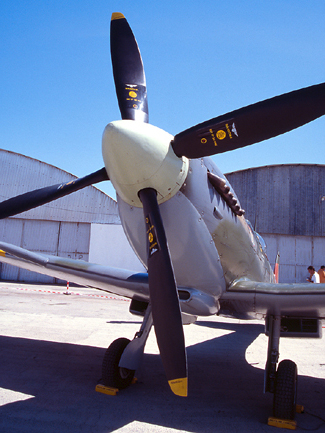
Note that the square side of the tip is actually on the leading edge, opposite to those funky props you see on Cirruses, Corvalises and whatnot nowadays.
LnS.


Re: Vintage propellor identification
My best guess is that it was a propeller from a DHC-1 Chipmunk which was powered by a Gypsy Major engine. One clue is the August 1953 date. By that time, the Chipmunk replaced the DH-82C Tiger Moth as the RCAF primary trainer.
The average pilot, despite the somewhat swaggering exterior, is very much capable of such feelings as love, affection, intimacy and caring.
These feelings just don't involve anyone else.
These feelings just don't involve anyone else.

Re: Vintage propellor identification
.
Last edited by pelmet on Mon Apr 07, 2014 8:17 pm, edited 1 time in total.
Re: Vintage propellor identification
If you really want to know....fleet16b wrote:I should have known better , the Gypsymoth was powewered by a Cirrus Enginelownslow wrote:A prop made to be installed on a Gipsy Moth wouldn't likely say "Gipsy Major." Of course, that's not to say this prop couldn't be used on a DH60, just that it wasn't made for one.fleet16b wrote:they were also used on the DH Gypsymoth
LnS.
You will find if you read about the DH.60 history that the original Moth was powered by a Cirrus engine. These were made from surplus WWI Renault engines modified by actually cutting it in half and then completing the modification as required. Why cut an engine in half?....because the engines available at the time were either too little power or too much.
This Cirrus powered Moth was called......a De Havilland Moth. But when later engines started being put on the DH.60, they came up with the different names to enable identification. So the Cirrus powered DH.60 became the Cirrus Moth, the few powered by the Genet engine were Genet Moths. The ones powered by the Gipsy engine(not spelled Gypsy which drives purists crazy) were called Gipsy Moths. All different types of the DH.60. Remember, the Gipsy Major engine is different than the Gipsy engine although based on its predecessor.
The Tiger Moth, later designated as the DH.82 was a significantly modified version of the DH.60 built mainly for the military to their specifications. Unless you are talking about the actual original Tiger Moth which was a totally different type.
All part of the Moth series which got its original name because of its folding wings that was done when resting on the ground as compared to the non-folding wings of other aircraft....which was like the a moth in real life when resting on the ground as compared to a butterfly with its open wings. De Havilland was a lepidopterist which explains the insect names for some of his aircraft.
And now you know....the rest of the story. Except which type of aircraft this particular prop was on.


