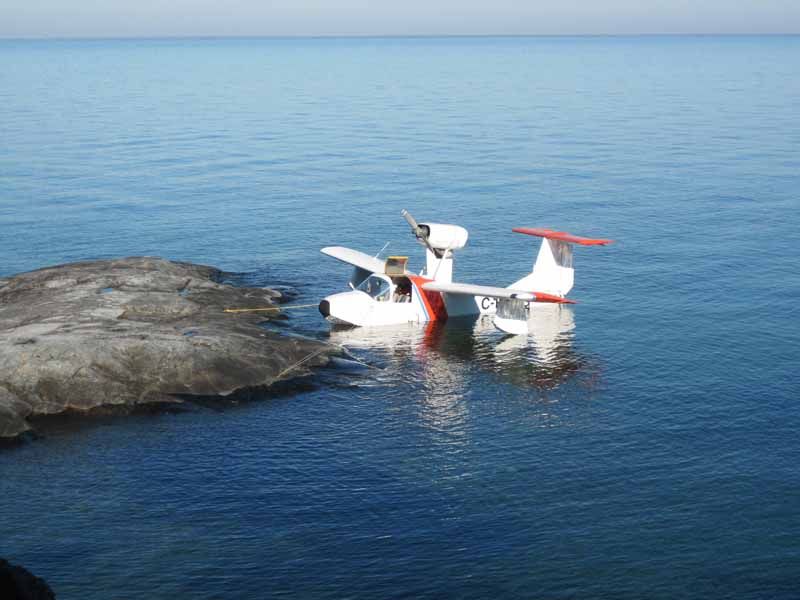

We know that we sometimes have an advantage, as with the gear all the way one way, or the other, we can pick our surface, and probably get the plane down with no damage. The problems begin when the gear is part up and part down, or its position cannot be confirmed. Then a land landing is the only choice. I've done it one side up, the other side down twice - both on ice - it worked.
My amphibian is happily rather trouble free in design, though not simple to operate. it's all mechanical, though three separate controls to be moved to select and lock gear position as desired. And a forth in the water. The tail wheel locks down on gravity, and there is no indication. It may not lock down, if you have dragged it through the weeds
 . The mains are extended by one lever, and locked by another. So you can get them down, but forget to lock them. They'll collapse backward when you touch the brakes. It was done in Norway a few years back to a friend's Teal. Not serious, but embarrassing, and you'll need a lift.
 My other charge these days is on Aerocets, which so far have been excellent. I've practiced on jacks, about 220 pumps of the hand pump to go either way. So far, the electric pump has done the job. It is a bit awkward to check the hydraulic level back in the tail boom though, as there is an AHRS one must pass to get there. I have trained the owner, if in doubt, head for a grass runway first, or pavement - but not the water.
I used to fly EDOs. One with an engine driven hydraulic pump, the other hand pump only. In both cases, flying in the very cold, the grease on the mainwheel slides would get so stiff, that they would not slide. The engine driven pump system would bypass, so the gear was frozen where it was - one up, one part way down. Ironically, those same floats were moved to a different plane, but with manual only. The problem was the high pressure relief was left in the system, so again, you could hand pump for all your were worth, but it would just bypass, and the gear was still frozen. One up, one down again - on the ice of Lake Simcoe. If the grommets on the EDO nosewheel cables pop out, you can flood the front float compartments, if you're not careful.
The PKs worked fine - if the plane could lift them! The Bristols seemed to work well, but it was funny seeing the nosewheel struts standing straight up! The Wiplines were great, other than the dual main wheels enabled the failure of one brake to blow all the brake fluid for the remaining brake out, so no brake - a few 359 degree turns taxiing in! I wonder about a restrictor in the T of the brake line, to allow a little bit of braking for a few attempts.
Lakes have their own interesting characteristics. Be sure the nosewheel is centered before you retract it. Easy after a runway takeoff, not so easy if you had taxiied into the water before takeoff...
Understand your system, and have a plan. Unfortunately, for my experience, many float amphibian systems can fail in a way which will not allow much benefit from the emergency extension systems.