
Those questioning why he turned back...
https://www.youtube.com/watch?v=H2zB7Z-b6Kc
Very similar, but no neighbourhoods to worry about there. Also didn't seem to stall the aircraft during the turn.
Snowbird crash in CYKA
Moderators: sky's the limit, sepia, Sulako, lilfssister, North Shore

Re: Snowbird crash in CYKA
An interesting video and it shows that he did not make it back to the runway eitherfrosti wrote: ↑Mon Jun 01, 2020 9:12 am Those questioning why he turned back...
https://www.youtube.com/watch?v=H2zB7Z-b6Kc
Very similar, but no neighbourhoods to worry about there. Also didn't seem to stall the aircraft during the turn.
...isn't he the best pilot you've ever seen?....Yeah he is ....except when I'm shaving.........

Re: Snowbird crash in CYKA
I can't comment on what the pilot in the incident did. All I can say is that it looks a fair bit like what I've seen done in similar, simulated, situations in the Harvard II. I'll also say that in those practice scenarios the failure was initiated when the energy state clearly favoured one option or the other (the failure either came when it was clear that you had to eject, or your clearly had enough energy to zoom back).Thanks I understand that that may be SOP
However , looking at the videos , it appears that he either made the left turn after the zoom to low key or the zoom caused enough airspeed loss to induce a stall dropping the left wing.
During the pretake-off brief we decided a minimum energy state (X KIAS and Y MSL) required before we would attempt a zoom. Any failure below that was an ejection. My first reaction to an EFATO, (only ever in the sim, thank heavens), was to check IAS and ALT. If I was above the briefed minimum energy state, action the Red-Page and turn for low key. If I was below the minimum energy state, eject. I know the Hawk guys did something similar also.
Re: Snowbird crash in CYKA
The zoom to low key serves two purposes. The zoom gets you away from the ground and buys you time to assess the situation. The turn points you towards a useable landing surface. You initiate a zoom to low key because you might have enough energy to make it back to the runway. The maneuver puts you in the best position to accomplish this and increases the amount of time you have to assess options. Sometimes you find yourself at low key and realize that you aren't going to make the runway, so ejection becomes the best option.fleet16b wrote: ↑Mon Jun 01, 2020 9:27 amAn interesting video and it shows that he did not make it back to the runway eitherfrosti wrote: ↑Mon Jun 01, 2020 9:12 am Those questioning why he turned back...
https://www.youtube.com/watch?v=H2zB7Z-b6Kc
Very similar, but no neighbourhoods to worry about there. Also didn't seem to stall the aircraft during the turn.
Re: Snowbird crash in CYKA
...isn't he the best pilot you've ever seen?....Yeah he is ....except when I'm shaving.........
Re: Snowbird crash in CYKA
Your logic is flawed. I can show you tons of videos where guys ejected straight ahead. Since none of them made it to a runway either, should we conclude that ejecting straight ahead is a flawed method?
The point is not that the Hawk made it or didn’t. The point being made is simply that the turn for low key is not unusual and can, if correctly done, in some instances result in a successful landing. This is preferred mainly because if a landing is relatively assured and carried out, its much safer than an ejection. In this video of the Hawk off 29R in CYMJ, the attempt was made to get to low key. If partial power was recovered or if he had more energy, the Hawk, and CYKA Tutor might’ve landed. In the end the Hawk couldn’t make low key and an ejection was carried out. There was nothing unsafe about the zoom or turn and if anything, it preserved options rather than continuing ahead which would’ve eliminated options. Only by turning and using up 100 kts of energy can you attempt this.
A 172 or Fleet doesn’t fly with 100+ kts of excess energy to bleed in a turn, so it makes no sense to try. In a GA airplane you’re forced landing after and engine fail. The only question is where and if you’re under control. Better to preserve control and land ahead because you have so little energy that using any in a turn generally is disastrous. Since you have no option but to stay with the aircraft, a controlled off field landing usually works out best. If a 172 had 1000 hp at was at 200 kts and/or 3000’ by the end of the runway, it would be a different story and making low key would be easily done without using up precious energy and having reduced control. Also, if you have an ejection seat, it is not a forgone conclusion that you’ll be riding the plane to the ground. If it appears that low key isn’t possible, you have an escape system.
I am merely trying to say that in this aircraft the zoom and turn for low key is a very reasonable way to handle the situation and commonly done. I am not looking for an argument or to one-up anyone. I don’t advocate it in a Cessna, I too was taught it won’t work out it a Cessna. When I flew other airplanes, I was taught other methods. I don’t fly a heavy wide body. I wouldn’t proclaim a blanket statement criticizing, for example, an emergency decent by arguing the correct way is to roll inverted and pull. Different airplanes, different methods.
Thankfully the tutor didn’t continue straight ahead, resulting in ejecting into the city.
After the initial zoom and turn, I wont comment or speculate on what happened in the cockpit, I wasn’t there and it’s not my place. See Mover’s YT video on professionalism and speculating.
In the Hawk video, no pulp mill, no river, no population, no rising terrain on both sides. Obviously this is a very familiar airfield. Bird goes in at :07, the decision to eject was made about :45 That’s about 38 seconds of time, not 12.
Re: Snowbird crash in CYKA
In the midst of handling this entire event, what you're suggesting requires that 2 radio lead to coordinate staying clear. There's no time to say "can you stay clear of me? I'm having an engine problem and I'm about to turn". Where should lead go? Where is 2 going? What altitude? Lead likely had no idea that 2 had an issue until he either looked back at his wing and saw no airplane, or heard 2's radio call (if 2 had time to make one). 2 needs to zoom anyway, so rather than coordinating a deconfliction plan on the radio and wasting time during a major in flight emergency, the SOP is to zoom and turn away from lead. Time permitting, you tell lead you're off and where you are.
[/quote]
Re: Snowbird crash in CYKA
Really?
It sure doesn't seem as if you're trying to understand, but rather have it all figured out and know a lot about parts of aviation that you've never flown. Please try to understand there may be things you don't know. We're just trying to have a reasonable conversation. Making sweeping assertions from an uninformed position, prognosticating about things without knowledge and speculating doesn't aid in the dialogue.fleet16b wrote: ↑Mon Jun 01, 2020 7:07 am one of the #1 rules in aviation and one that has been there since the beginning , LAND STRAIGHT AHEAD if you loose the engine in take off. ...
This was a totally avoidable had he have followed the rules .
The investigation will at some point address this turn back decision
...
are you a pilot ?
If you are and were not trained to land straight ahead when losing an engine on take off , you were poorly trained.
I’ve been in Aviation my whole life
...
I don’t know any pilot that does not know this rule of thumb and I very surprised that you don’t.
It’s been in training syllabus around the world since the start of aviation.
How could you not know this ?
Re: Snowbird crash in CYKA
[/quote]Gannet167 wrote: ↑Mon Jun 01, 2020 10:38 amIn the midst of handling this entire event, what you're suggesting requires that 2 radio lead to coordinate staying clear. There's no time to say "can you stay clear of me? I'm having an engine problem and I'm about to turn". Where should lead go? Where is 2 going? What altitude? Lead likely had no idea that 2 had an issue until he either looked back at his wing and saw no airplane, or heard 2's radio call (if 2 had time to make one). 2 needs to zoom anyway, so rather than coordinating a deconfliction plan on the radio and wasting time during a major in flight emergency, the SOP is to zoom and turn away from lead. Time permitting, you tell lead you're off and where you are.
No I would assume that the a/c in trouble would have made some kind of quick call to Twr as to trouble and that there would be some kind of SOP that the other aircraft would have c/out to keep away. (?)
I agree maybe there was no time for a call from the stricken aircraft and in that case the other aircraft would have just been continuing on oblivious to the problem
...isn't he the best pilot you've ever seen?....Yeah he is ....except when I'm shaving.........
Re: Snowbird crash in CYKA
Gannet167
Thank you for the responses
I have a question.
What is the standard climb rate for the Tutor on takeoff
In the video and on the close to 100 times I’ve seen the snowbird shows , they appear to always do shallow climb outs
Now I understand doing that in a show to keep thing close for the crowd but this was not a show situation
So IF they did a shallow climb out , why , that would just decrease the safety factor would it not ? Especially in this situation
Thank you for the responses
I have a question.
What is the standard climb rate for the Tutor on takeoff
In the video and on the close to 100 times I’ve seen the snowbird shows , they appear to always do shallow climb outs
Now I understand doing that in a show to keep thing close for the crowd but this was not a show situation
So IF they did a shallow climb out , why , that would just decrease the safety factor would it not ? Especially in this situation
...isn't he the best pilot you've ever seen?....Yeah he is ....except when I'm shaving.........
Re: Snowbird crash in CYKA
I don't know off hand. However, the general concept is speed is life. Ignoring obstacle clearance IMC, the faster the better as it provides more energy - to climb, turn to low key, turn away from things etc using a moderate amount of g. Most jets climb relatively shallow to build speed. Many use AB to get as much energy as possible as fast and early in the takeoff as possible, even though they could likely get airborne with reduced thrust. In formation, a gentle rotation rate with generous airspeed, climbing fast in a shallow climb is much easier to fly than at slow airspeed. In addition, lead can't use 100% thrust or wingman can't maintain position, so a somewhat shallower climb is necessary compared to max thrust. From the video, without any numbers to look at, it appears to be a very standard departure.
Re: Snowbird crash in CYKA
Ahhhh....?Thankfully the tutor didn’t continue straight ahead, resulting in ejecting into the city.
I can see how some amount of "zoom" has merit, following an EFATO, yes, trade reserve energy for altitude, and thinking time. That said, and even more relevant to airplanes which don't store energy so well, initiating a zoom is edging on an aerobatic maneuver (the accelerations not incidental to normal flying part). Zooming up takes one closer to the point where the plane is pitched a little too high up, decelerating faster than expected, and more aerobatics are required to maintain flying speed. If one zoomed too aggressively, the inertia of the maneuver could carry the plane upward into a stall and possible spin entry, unless an opposing pitch down were applied rapidly at just the right moment. An unstable departure, so to speak. I'm no jet pilot, but I've let a few chandelles be a little late initiating the downward recovery element.....
Re: Snowbird crash in CYKA
Understood ... thank youGannet167 wrote: ↑Mon Jun 01, 2020 11:28 am I don't know off hand. However, the general concept is speed is life. Ignoring obstacle clearance IMC, the faster the better as it provides more energy - to climb, turn to low key, turn away from things etc using a moderate amount of g. Most jets climb relatively shallow to build speed. Many use AB to get as much energy as possible as fast and early in the takeoff as possible, even though they could likely get airborne with reduced thrust. In formation, a gentle rotation rate with generous airspeed, climbing fast in a shallow climb is much easier to fly than at slow airspeed. In addition, lead can't use 100% thrust or wingman can't maintain position, so a somewhat shallower climb is necessary compared to max thrust. From the video, without any numbers to look at, it appears to be a very standard departure.
...isn't he the best pilot you've ever seen?....Yeah he is ....except when I'm shaving.........
Re: Snowbird crash in CYKA
PilotDAR wrote: ↑Mon Jun 01, 2020 11:42 amAhhhh....?Thankfully the tutor didn’t continue straight ahead, resulting in ejecting into the city.
I can see how some amount of "zoom" has merit, following an EFATO, yes, trade reserve energy for altitude, and thinking time. That said, and even more relevant to airplanes which don't store energy so well, initiating a zoom is edging on an aerobatic maneuver (the accelerations not incidental to normal flying part). Zooming up takes one closer to the point where the plane is pitched a little too high up, decelerating faster than expected, and more aerobatics are required to maintain flying speed. If one zoomed too aggressively, the inertia of the maneuver could carry the plane upward into a stall and possible spin entry, unless an opposing pitch down were applied rapidly at just the right moment. An unstable departure, so to speak. I'm no jet pilot, but I've let a few chandelles be a little late initiating the downward recovery element.....
Definitely a possible cause for what happened
We will see .....
...isn't he the best pilot you've ever seen?....Yeah he is ....except when I'm shaving.........
Re: Snowbird crash in CYKA
In formation flight the lead is never at full power even at takeoff. You have to leave some for the wingman so he can use the full range of his power to "catch up" if necessary, and in a turn the aircraft on the outside needs to go faster than the one on the inside to maintain position - inside the turn the aircraft has to go slower. So less power, and in formation the job of lead is to be smooth and non-aggressive to make it less difficult for those on the wing.fleet16b wrote: ↑Mon Jun 01, 2020 11:02 am What is the standard climb rate for the Tutor on takeoff
In the video and on the close to 100 times I’ve seen the snowbird shows , they appear to always do shallow climb outs
Now I understand doing that in a show to keep thing close for the crowd but this was not a show situation
So IF they did a shallow climb out , why , that would just decrease the safety factor would it not ? Especially in this situation
Knowing this, it's particularly impressive given the lead is dragging 9 airplanes around doing vertical/rolling aerobatics in a pretty underpowered airplane without even getting to use all his own power. The 5 plane line abreast barrel roll must be very difficult with the outside aircraft at full power and the inside aircraft powered back with speed brakes to maintain position. Really impressive to watch knowing the difficulty.
-
rookiepilot
- Top Poster

- Posts: 5069
- Joined: Sat Apr 01, 2017 3:50 pm
Re: Snowbird crash in CYKA
Thank you Gannet for the detailed posts.
Learning a few things. What a terrible time in the flight profile to lose one's engine, not many good options.
From my know - nothing perspective, its seems shocking how fast energy bleeds off after the zoom climb, into the stall.
Learning a few things. What a terrible time in the flight profile to lose one's engine, not many good options.
From my know - nothing perspective, its seems shocking how fast energy bleeds off after the zoom climb, into the stall.

Re: Snowbird crash in CYKA
Some think that SB 11 should have continued straight ahead and punched out over the river or some other benign area.
While flying on someone's wing, you are totally focused on maintaining position and not hitting the other aircraft. There is no opportunity to do any sight-seeing. Thus, once the engine failed and #2 was still in formation, there is simply no time to start looking for a great ejection spot, particularly when the drill is to zoom and trade kinetic energy (speed) for potential energy (altitude). And, as has been pointed out many times by those that have done this type of flying, try to turn back toward the airport and a position abeam the runway threshold (approach end) known as low-key.
Attached is a diagram showing the various key positions and the desired energy state (speed and altitude). In the case of SB 11, there was no way he was going to get to high key so the idea is to at least get to low key with 130 kts/1500 ft agl, either by getting the energy from the zoom or zoom plus any thrust the engine may produce. In this case, the engine was producing no thrust so there was not enough energy available to make it to even low key, hence an ejection.
While flying on someone's wing, you are totally focused on maintaining position and not hitting the other aircraft. There is no opportunity to do any sight-seeing. Thus, once the engine failed and #2 was still in formation, there is simply no time to start looking for a great ejection spot, particularly when the drill is to zoom and trade kinetic energy (speed) for potential energy (altitude). And, as has been pointed out many times by those that have done this type of flying, try to turn back toward the airport and a position abeam the runway threshold (approach end) known as low-key.
Attached is a diagram showing the various key positions and the desired energy state (speed and altitude). In the case of SB 11, there was no way he was going to get to high key so the idea is to at least get to low key with 130 kts/1500 ft agl, either by getting the energy from the zoom or zoom plus any thrust the engine may produce. In this case, the engine was producing no thrust so there was not enough energy available to make it to even low key, hence an ejection.
 CT 114 PFL Pattern.PDF
- CT114 PFL Pattern
- (1.06 MiB) Downloaded 153 times
Re: Snowbird crash in CYKA
- 85B4BF7B-61C1-485B-B7B7-A3203A37B31B.jpeg (35.89 KiB) Viewed 3086 times
It confirms the Zoom maneuver but says nothing about low key / turn back to try for the runway
...isn't he the best pilot you've ever seen?....Yeah he is ....except when I'm shaving.........
Re: Snowbird crash in CYKA
There is precedent. 31 May 1976, CT114028 dual fatal, bird strike. Here's a synopsis.. "Shortly after take-off from the Regina airport, the aircraft flew through a flock of birds at approximately 600 to 800 feet above ground level (AGL) and a bird was ingested, causing an engine failure. The crew
turned toward the airdrome for a forced landing. The forced landing was aborted and the crew ejected. The aircraft crashed in a baseball diamond on the west-side of Regina, just outside of Regina Airport property. The ejection was initiated at too low an altitude and the crew were fatally injured. The engine was recovered from the wreckage. An
examination of the engine, by the Quality Engineering Test Establishment (QETE) and by Orenda engines, confirmed that the engine failure was caused by bird ingestion. The investigation found that ejection was initiated well outside the safe ejection envelope and was further compromised by the
nose-down attitude of the aircraft. The investigation further found that the nose-down pitching behaviour of the aircraft during the ejection sequence was similar to that experienced in the crash of Tutor 114127 on March 20th, 1972. Subsequent Aerospace Engineering Test Establishment (AETE) trials proved that the nose-down pitching was not due to canopy jettisoning. The AETE study did reveal, however, that the Tutor aircraft, in the landing configuration, runs out of nose-up trim at approximately 100 knots indicated airspeed (KIAS). An analysis of the evidence from these two accidents, plus the information in the AETE report, shows that at speeds below 110 knots, the aircraft will pitch
down rapidly when the pilot releases the canopy to begin the ejection sequence." Access to the Flight Safety Informations System would probably show quite a few compressor stalls on the Tutor from bird strikes.
turned toward the airdrome for a forced landing. The forced landing was aborted and the crew ejected. The aircraft crashed in a baseball diamond on the west-side of Regina, just outside of Regina Airport property. The ejection was initiated at too low an altitude and the crew were fatally injured. The engine was recovered from the wreckage. An
examination of the engine, by the Quality Engineering Test Establishment (QETE) and by Orenda engines, confirmed that the engine failure was caused by bird ingestion. The investigation found that ejection was initiated well outside the safe ejection envelope and was further compromised by the
nose-down attitude of the aircraft. The investigation further found that the nose-down pitching behaviour of the aircraft during the ejection sequence was similar to that experienced in the crash of Tutor 114127 on March 20th, 1972. Subsequent Aerospace Engineering Test Establishment (AETE) trials proved that the nose-down pitching was not due to canopy jettisoning. The AETE study did reveal, however, that the Tutor aircraft, in the landing configuration, runs out of nose-up trim at approximately 100 knots indicated airspeed (KIAS). An analysis of the evidence from these two accidents, plus the information in the AETE report, shows that at speeds below 110 knots, the aircraft will pitch
down rapidly when the pilot releases the canopy to begin the ejection sequence." Access to the Flight Safety Informations System would probably show quite a few compressor stalls on the Tutor from bird strikes.
...isn't he the best pilot you've ever seen?....Yeah he is ....except when I'm shaving.........
Re: Snowbird crash in CYKA
Thanks, I've been hoping to see something like that.L39Guy wrote: ↑Mon Jun 01, 2020 2:57 pm Some think that SB 11 should have continued straight ahead and punched out over the river or some other benign area.
While flying on someone's wing, you are totally focused on maintaining position and not hitting the other aircraft. There is no opportunity to do any sight-seeing. Thus, once the engine failed and #2 was still in formation, there is simply no time to start looking for a great ejection spot, particularly when the drill is to zoom and trade kinetic energy (speed) for potential energy (altitude). And, as has been pointed out many times by those that have done this type of flying, try to turn back toward the airport and a position abeam the runway threshold (approach end) known as low-key.
Attached is a diagram showing the various key positions and the desired energy state (speed and altitude). In the case of SB 11, there was no way he was going to get to high key so the idea is to at least get to low key with 130 kts/1500 ft agl, either by getting the energy from the zoom or zoom plus any thrust the engine may produce. In this case, the engine was producing no thrust so there was not enough energy available to make it to even low key, hence an ejection.
CT 114 PFL Pattern.PDF
Good judgment comes from experience. Experience often comes from bad judgment.
Re: Snowbird crash in CYKA
Attached is the instructions in the How-to-Fly manual describing what to do, Forced-Landing from the Traffic Pattern. Note: this was not an engine failure on take-off as the aircraft was beyond the point of landing on the runway.
Tutor students did lots of simulated engine failures from the traffic pattern, however they were invariably from a downwind position somewhere with circuit speed (240 knots) and altitude (1000 ft AGL). In other words lots of kinetic and potential energy. This accident aircraft did not have a lot of energy to start with however should the engine have relit or produced partial power, the aircraft could have eeked its way to low key. The issue is that one does not know whether there will be any thrust unless it either relights (if it flamed out) or it still turning. And the only way to figure that out is to zoom, get away from lead, and see if the engine responds. If it doesn't, then you won't make it to the runway so jump out.
The ingestion of the bird (or drone perhaps) could not have happened at a worst position - too far on the take-off to land on the runway remaining but past the end of the runway, in the traffic pattern with some usable energy. A confluence of many less than ideal circumstances.
- Attachments
-
- CT 114 Forced Landing.PDF
- (868.68 KiB) Downloaded 72 times
Re: Snowbird crash in CYKA
Ok Thank you great infoL39Guy wrote: ↑Mon Jun 01, 2020 5:46 pmAttached is the instructions in the How-to-Fly manual describing what to do, Forced-Landing from the Traffic Pattern. Note: this was not an engine failure on take-off as the aircraft was beyond the point of landing on the runway.
Tutor students did lots of simulated engine failures from the traffic pattern, however they were invariably from a downwind position somewhere with circuit speed (240 knots) and altitude (1000 ft AGL). In other words lots of kinetic and potential energy. This accident aircraft did not have a lot of energy to start with however should the engine have relit or produced partial power, the aircraft could have eeked its way to low key. The issue is that one does not know whether there will be any thrust unless it either relights (if it flamed out) or it still turning. And the only way to figure that out is to zoom, get away from lead, and see if the engine responds. If it doesn't, then you won't make it to the runway so jump out.
The ingestion of the bird (or drone perhaps) could not have happened at a worst position - too far on the take-off to land on the runway remaining but past the end of the runway, in the traffic pattern with some usable energy. A confluence of many less than ideal circumstances.
So some here are saying it’s standard SOP to establish low key and attempt to return to the runway however the manual and yourself state differently .
I also had discussions with other RCAF Tutor pilots Today that said in this low key situation, returning to the runway was not an option
This makes me feel that he was not intending to turn back to the runway and that it was in all likelihood a left wing drop stall spin maybe due to excessive zoom , but that of is just one of many possible scenarios.
...isn't he the best pilot you've ever seen?....Yeah he is ....except when I'm shaving.........
Re: Snowbird crash in CYKA
The How To Fly says exactly to turn towards a runway. Read paragraph 28...fleet16b wrote: ↑Mon Jun 01, 2020 6:05 pmOk Thank you great infoL39Guy wrote: ↑Mon Jun 01, 2020 5:46 pmAttached is the instructions in the How-to-Fly manual describing what to do, Forced-Landing from the Traffic Pattern. Note: this was not an engine failure on take-off as the aircraft was beyond the point of landing on the runway.
Tutor students did lots of simulated engine failures from the traffic pattern, however they were invariably from a downwind position somewhere with circuit speed (240 knots) and altitude (1000 ft AGL). In other words lots of kinetic and potential energy. This accident aircraft did not have a lot of energy to start with however should the engine have relit or produced partial power, the aircraft could have eeked its way to low key. The issue is that one does not know whether there will be any thrust unless it either relights (if it flamed out) or it still turning. And the only way to figure that out is to zoom, get away from lead, and see if the engine responds. If it doesn't, then you won't make it to the runway so jump out.
The ingestion of the bird (or drone perhaps) could not have happened at a worst position - too far on the take-off to land on the runway remaining but past the end of the runway, in the traffic pattern with some usable energy. A confluence of many less than ideal circumstances.
So some here are saying it’s standard SOP to establish low key and attempt to return to the runway however the manual and yourself state differently .
I also had discussions with other RCAF Tutor pilots Today that said in this low key situation, returning to the runway was not an option
This makes me feel that he was not intending to turn back to the runway and that it was in all likelihood a left wing drop stall spin maybe due to excessive zoom , but that of is just one of many possible scenarios.
I have Tutor experiencd and my takeoff brief included a speed at which I know I’ll make it back to a runway with a complete engine failure and what I’d do for engine loss of thrust before that (ZOOM and ASSESS), which included a turn towards a runway until I could confirm I wouldn’t make it. Those numbers and the brief were different for every runway I takeoff from.
I have practiced engine failures after takeoff to know that the turn back or a landing on a cross runway are very feasible.
What you don’t have in your Tutor checklist is the amplifications section 3 of the Aircraft Operating Instructions. There are mentions of ejecting or attempting to force land (at the pilot’s discretion)
Going for the deck at corner
Re: Snowbird crash in CYKA
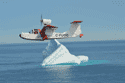
Is there anything in the AOIs regarding bailing in water? The tutor has a large wingspan for its size and it may be able to belly land and float for a bit, rather similar to an A320 in the Hudson. Tutors have dry wings and all that buoyancy could help. Having the drag of the smoke tanks could make things interesting but is it even an option? Eject the canopy and try for a water landing if you are below the threshold for a safe ejection. I know it’s easy to look at this now, but are water landings completely ruled out as unsafe?
Would an ejection, at this altitude and angle, be more survivable if they impacted water vs ground?
Would an ejection, at this altitude and angle, be more survivable if they impacted water vs ground?
-
flyingnorm
- Rank 0

- Posts: 13
- Joined: Sat May 20, 2017 8:37 pm
Re: Snowbird crash in CYKA
This talk about what the PF should have or should not have or could or could not have done is getting on my nerves. Nobody gets to be a Snowbird pilot without having proven to be one of the finest among us. That means they not only know how to take off an wobble around a pattern on a Sunday morning in a Cessna, they know what to do in each and every scenario that they might possibly encounter in jet formation flying elaborate demonstration routines. They think and operate in dimensions unlike most GA or Commercial pilots. They can also make mistakes and have proven they know how to be teachable, unlike some of the posters in this forum.
Until the report is made public, could we have a few months of respect for the PF who is reliving this incident every day, while mourning the loss of a teammate. Respect could be shown by less speculation, more support and appreciation of good memories with Canada's finest in the Snowbirds.
Captain MacDougall, you did your best. You always would. Thanks for your service. We stand with you as you recover.
Captain Casey, thanks for your service. We miss you. Sorry you did not make it.
To the rest of the team, keep you chin up. Dont let obnoxious characters get you down. Fly for fun, fly for serious, just fly because you can. Thanks for being the best.
Until the report is made public, could we have a few months of respect for the PF who is reliving this incident every day, while mourning the loss of a teammate. Respect could be shown by less speculation, more support and appreciation of good memories with Canada's finest in the Snowbirds.
Captain MacDougall, you did your best. You always would. Thanks for your service. We stand with you as you recover.
Captain Casey, thanks for your service. We miss you. Sorry you did not make it.
To the rest of the team, keep you chin up. Dont let obnoxious characters get you down. Fly for fun, fly for serious, just fly because you can. Thanks for being the best.

