Then we have Sunwukong. I'm not going to debate what you have to say. You have no merit. EDITED
If you didn't want to debate why did you call my name and wrote an entire nice and polite post...
My grand parents went to war, and not all of them survived. And I am myself a former paratrooper who went to africa in the 90s and saw mutilated bodies (yes I know maybe not the best choice just after high school). But the ones (ethnic group) we tried to help, the victims, attaqued the other (rival) ethnic group as soon as they could, not only using gun/weapons but axes aswell and became torturer.
When I left, I saw the official government and medias of many western countries telling a story that I didn't recognize. Ever since I have a total different viewpoint about hate, war, insult, official government information. And I know that in a war good and bad, (or good and evil for the ideologist and religious ones) are sometimes extremely close. I learnt aswell that it is extremely hard to counterbalance official propaganda, as propaganda is flattering ego, basic instincts power and motivates hate of its nationalist citizen ---don't fool yourself this is true for any country, if for you hero plus flag means tears and animal instincts/desire of power and unlimited pride, you are also victim---.
I trust universities and historians only, because years later I could find the real story in some of their university book.
Finaly, look at this topic. Did I say the initial poster (or the ones after) were wrong? No, I even said that the person they mention did the good thing. I ve just shown the real atrocity of the war (modern or not), the one we don't want to look because it hurts a bit our theories. What is the result, when I am not even against anybody: hate and insult.
SunWuKong wrote:The ones you can find in good universities.
So the ones you were fed by a professor who was extremely left leaning?
If I said something wrong, then tell me the truth.
Ok.
Some more if you want: the americans where not even sure Japan surrendered or not when they wanted to try their first european made nuclear bomb, killing a entire city of civilians. Same thing for the second. (150.000 civilians killed) Yeah I know I didn't watch pearl harbor, sorry about that my bad.
Wrong. The Americans demanded that the Japanese surrender in the Potsdam declaration in July of 45. The Japanese government specifically ignored it (they stated that they would ignore it), and on July 31, Hirohito demanded that Japan be defended. Japan didn't surrender until nearly a week after Nagasaki, and had previously stated they would not surrender. There was no uncertainty.
Apparently your education at a "good university" didn't include a class on not talking out of your ass and looking up your "facts" first.
If you want some more let me know.
No, you've made your level of intellect clear.
Hiroshima:
Yea, radiation burns are bad. I know. So are gunshot wounds. More people died in the battle of Okinawa than died in the two atomic bombings combined. But apparently having fewer people die as a result of an atomic bomb is worse.
---------- ADS -----------
no sig because apparently quoting people in context is offensive to them.
SunWuKong wrote:
But honnestly if we have to speak about Vietnam war, I am sure that in the reality there is much more amazing courage stories among vietnamese kids, mothers and fathers who saw their country invaded by murderers ready to use napalm against little girls. Those stories you won't find them in wikipedia, there is no vietnamese language on wikipedia.
Gar Alperovitz, Lionel R. Bauman Professor of Political Economy at the University of Maryland is the author of Atomic Diplomacy: Hiroshima and Potsdam and of The Decision to Use the Atomic Bomb.
This weekend marks the 60th anniversary of the August 6, 1945 bombing of Hiroshima. One might think that by now historians would agree on all the fundamental issues. The reality, however, is just the opposite: All the major issues involved in the decision are still very much a matter of dispute among experts. An obvious question is why this should be so after so many years.
Did the atomic bomb, in fact, cause Japan to surrender? Most Americans think the answer is self-evident. However, many historical studies�including new publications by two highly regarded scholars--challenge the conventional understanding. In a recently released Harvard University Press volume drawing upon the latest Japanese sources, for instance, Professor Tsuyohsi Hasegawa concludes that the traditional �myth cannot be supported by historical facts.� By far the most important factor forcing the decision, his research indicates, was the Soviet declaration of war against Japan on August 8, 1945, just after the Hiroshima bombing.
Similarly, Professor Herbert Bix�whose biography of Hirohito won the 2000 Pulitzer Prize for general nonfiction�also writes in a recent article that �the Soviet factor carried greater weight in the eyes of the emperor and most military leaders.�
Many Japanese historians have long judged the Soviet declaration of war to have been the straw that broke the camels back�mainly because the Japanese military feared the Red Army more than the loss of another city by aerial bombardment. (They had already shown themselves willing to sacrifice many, many cities to conventional bombing!)
An intimately related question is whether the bomb was in any event still necessary to force a surrender before an invasion. Again, most Americans believe the answer obvious�as, of course, do many historians. However, a very substantial number also disagree with this view. One of the most respected, Stanford University Professor Barton Bernstein, judges that all things considered it seems �quite probable�indeed, far more likely than not�that Japan would have surrendered before November� (when the first landing in Japan was scheduled.)
Many years ago Harvard historian Ernest R. May also concluded that the surrender decision probably resulted from the Russian attack, and that �it could not in any event been long in coming.� In his new book Hasegawa goes further: �[T]here were alternatives to the use of the bomb, alternatives that the Truman Administration for reasons of its own declined to pursue.�
(On the other hand, one recent writer, Richard Frank, argues Japan was still so militarily powerful the U.S. would ultimately have decided not to invade. He justifies the bombing not only of Hiroshima but of Nagasaki as well. Japanese historian Sadao Asada believes that �there was a possibility Japan would not have surrendered by November� on the basis of the Russian attack alone.)
What did the U.S. military think? Here there is also dispute. We actually know very little about the views of the military at the time. However, after the war many�indeed, most�of the top World War II Generals and Admirals involved criticized the decision. One of the most famous was General Eisenhower, who repeatedly stated that he urged the bomb not be used: �t wasn�t necessary to hit them with that awful thing.� The well-known �hawk,� General Curtis LeMay, publically declared that the war would have been over in two weeks, and that the atomic bomb had nothing to do with bringing about surrender. President Truman�s friend and Chief of Staff, five star Admiral William D. Leahy was deeply angered: The �use of this barbarous weapon at Hiroshima and Nagasaki was of no material assistance in our war against Japan. The Japanese were already defeated and ready to surrender. . . n being the first to use it, we . . . adopted an ethical standard common to the barbarians of the Dark Ages.�
Some historians believe such statements may have been made partly to justify postwar funding requests by the various military services. Several years after the war General George C. Marshall did state publicly that he believed the bombings were necessary. On the other hand, long before the atomic bomb was used Leahy�s diary shows he judged the war could be ended. And Marshall is on record months before Hiroshima as suggesting that �these weapons might first be used against straight military objectives such as a large naval installation and then if no complete result was derived from the effect of that... we ought to designate a number of large manufacturing areas from which the people would be warned to leave--telling the Japanese that we intend to destroy such centers....�
Why was the bomb used? The conventional view, of course, is that it was to save as many lives as possible. But if this is so, several historians now ask, why did President Truman and his chief adviser Secretary of State James Byrnes make it harder for Japan to surrender? Specifically, why did they remove assurances for the Japanese emperor from the July 1945 Potsdam Proclamation warning Japan to surrender? The assurances were strongly recommended by U.S. and British military leaders, and removing them, they knew, would make it all but impossible for Japan to end the war.
A traditional theory has been that the President feared political criticism if he provided assurances to the emperor. But, other historians note, leading Republicans were for�not against�clarifying the terms to achieve a surrender, and were calling for this publicly. Moreover, American leaders always knew the emperor would be needed to order a surrender�and, of course, in the end they did agree to an understanding which allowed such assurances: Japan still has an emperor.
Hasegawa believes the assurances were taken out of the Potsdam Proclamation precisely because American leaders wanted to have the warning rejected so as to justify the bombing�and, further, that they saw the bomb as a way to end the war before Russia could join the fighting. There is other evidence suggesting that policy makers, especially Secretary of State Byrnes, wanted to use the bomb to �make the Russians more manageable in Europe�--as he told one scientist.
(Full disclosure: My own view�as one of the historians involved in the debate--is that the bombings were unnecessary and that American policy makers were advised at the time that a combination of assurances for the emperor plus the forthcoming Russian declaration of war would likely bring about surrender in the three months available before the invasion could begin. I also believe the evidence is strong, but not conclusive, that American leaders saw the bomb above all as a way to impress the Russians and also as a way to end the war before the Red Army got very far into Manchuria.)
Why are historians still struggling over these issues? One reason is that few nations find it easy to come to terms with questionable actions in their past. Nor is this a simple left-right debate. In recent years liberals have been critical of the decision. At the time The Nation magazine defended the bombing while many conservative publications criticized it�including Human Events, and later, the National Review. �The use of the atomic bomb, with its indiscriminate killing of women and children, revolts my soul," former President Herbert Hoover wrote to a friend.
One of the most important reasons the issues don�t seem to get resolved has to do with the historical record. The fact is most discussions concerning the decision to use the atomic bomb were simply not recorded. Not only were such matters handled in an extremely secretive manner, they were largely handled outside the normal chain of command. There is also evidence of the manipulation of some documents and of missing documents in certain cases�and in some instances, evidence that documents were destroyed.
Perhaps one day we will know more and the long debate over Hiroshima will come to an end. We are unlikely, I think, to discover new official sources. However, a new generation of scholars may well be able to ferret out diaries, letters, or additional personal papers in the attics or basements of descendants of some of the men involved. An even more interesting possibility is that the President�s daughter Margaret will one day donate additional papers to the Truman Library. (In her own writing Margaret reports details which seem clearly to be based on documentary sources. However, she has so far refused to respond to inquiries from historians asking for access to these.) A third possibility is that if, as some believe, the Soviets bugged the Truman villa near Potsdam, Germany (or the villas of other American or British officials who were there for the July 1945 meetings just before the bombings), there may be tapes or transcriptions of some key conversations in NKVD or other files in the Russian archives.
---------- ADS -----------
Last edited by SunWuKong on Mon Jan 10, 2011 4:42 am, edited 1 time in total.
The Franck Report of June 1945 was a document signed by several prominent nuclear physicists recommending that the United States not use the atomic bomb as a weapon to prompt the surrender of Japan in World War II.
By an accident of history, we were among a very few who were aware of a new, world-threatening peril, and we felt obligated to express our views.
Glenn T. SeaborgThe report was named for James Franck, the head of the committee that produced it. The committee was appointed by Arthur Compton and met in secret, in all-night sessions in a highly secure environment. Largely written by Eugene Rabinowitch, the report spoke about the impossibility to keep the United States atomic discoveries secret indefinitely. It predicted a nuclear arms race, forcing the United States to develop nuclear armaments at such a pace that no other nation would think of attacking first from fear of overwhelming retaliation. This did, in fact occur. The report recommended that the nuclear bomb not be used, and proposed that either a demonstration of the "new weapon" be made before the eyes of representatives of all of the United Nations, on a barren island or desert, or to try to keep the existence of the nuclear bomb secret for as long as possible.
In the first case, the international community would be warned of the dangers and encouraged to develop an effective international control on such weapons. In the later case, the United States would gain several years time to further develop their nuclear armament, before other countries would start their own production. The Franck Report was signed by James Franck (Chairman), Donald J. Hughes, J. J. Nickson, Eugene Rabinowitch, Glenn T. Seaborg, J. C. Stearns, and Leo Szilard.
Franck took the report to Washington June 12, and a separate committee, appointed by the President, met on June 21 to reexamine the use of the atomic bomb. However this committee reaffirmed that there was no alternative to the use of the bomb and on August 6 and 9, the Americans dropped atomic bombs on Hiroshima and Nagasaki.
---------- ADS -----------
Last edited by SunWuKong on Mon Jan 10, 2011 4:30 am, edited 1 time in total.
Blum's argument rests on the following factual claims (for references
see the original article):
1. `By 1945, Japan's entire military and industrial machine was
grinding to a halt as the resources needed to wage war were all but
eradicated. The navy and air force had been destroyed ship by ship,
plane by plane, with no possibility of replacement. When, in the
spring of 1945, the island nation's lifeline to oil was severed, the
war was over except for the fighting. By June, Gen. Curtis LeMay, in
charge of the air attacks, was complaining that after months of
terrible firebombing, there was nothing left of Japanese cities for
his bombers but "garbage can targets". By July, U.S. planes could fly
over Japan without resistance and bomb as much and as long as they
pleased. Japan could no longer defend itself.[6]'
2. `Japan was militarily defeated long before Hiroshima. It had been
trying for months, if not for years, to surrender; and the U.S. had
consistently rebuffed these overtures. A May 5 cable, intercepted and
decoded by the U.S., dispelled any possible doubt that the Japanese
were eager to sue for peace. Sent to Berlin by the German ambassador
in Tokyo, after he talked to a ranking Japanese naval officer, it
read:
"Since the situation is clearly recognized to be hopeless, large
sections of the Japanese armed forces would not regard with disfavor
an American request for capitulation even if the terms were hard. [7]"
As far as is known, Washington did nothing to pursue this opening.
Later that month, Secretary of War Henry L. Stimson almost
capriciously dismissed three separate high-level recommendations from
within the Roosevelt administration to activate peace negotiations.
The proposals advocated signaling Japan that the U.S. was willing to
consider the all-important retention of the emperor system; i.e., the
U.S. would not insist upon "unconditional surrender"[8].'
3. ``In his later memoirs, Stimson admitted that "no effort was made,
and none was seriously considered, to achieve surrender merely in
order not to have to use the bomb". [11]
And that effort could have been minimal. In July, before the leaders
of the U.S., Great Britain, and the Soviet Union met at Potsdam, the
Japanese government sent several radio messages to its ambassador,
Naotake Sato, in Moscow, asking him to request Soviet help in
mediating a peace settlement. "His Majesty is extremely anxious to
terminate the war as soon as possible", said one communication.
"Should, however, the United States and Great Britain insist on
unconditional surrender, Japan would be forced to fight to the bitter
end." [12]''
4. ``On July 25, while the Potsdam meeting was taking place, Japan
instructed Sato to keep meeting with Russian Foreign Minister Molotov
to impress the Russians "with the sincerity of our desire to end the
war [and] have them understand that we are trying to end hostilities
by asking for very reasonable terms in order to secure and maintain
our national existence and honor" (a reference to retention of Emperor
Hirohito). [13]''
5. ``Having broken the Japanese code years earlier, Washington did not
have to wait to be informed by the Soviets of these peace overtures;
it knew immediately, and did nothing. Indeed, the National Archives in
Washington contains U.S. government documents reporting similarly
ill-fated Japanese peace overtures as far back as 1943. [14]''
6. ``Thus, it was with full knowledge that Japan was frantically
trying to end the war, that President Truman and his hardline
secretary of state, James Byrnes, included the term "unconditional
surrender" in the July 26 Potsdam Declaration. This "final warning"
and expression of surrender terms to Japan was in any case a charade.
The day before it was issued, Harry Truman had approved the order to
release a 15 kiloton atomic bomb over the city of Hiroshima. [15]''
7. ``Finally, we have Gen. Dwight Eisenhower's account of a
conversation with Stimson in which he told the secretary of war that:
Japan was already defeated and that dropping the bomb was
completely unnecessary. ... I thought our country should avoid
shocking world opinion by the use of a weapon whose employment was, I
thought, no longer mandatory as a measure to save American lives. It
was my belief that Japan was, at that very moment, seeking some way to
surrender with a minimum loss of "face". The secretary was deeply
perturbed by my attitude, almost angrily refuting the reasons I gave
for my quick conclusions. [17] ''
When I first went to Hiroshima in 1967, the shadow on the steps was still there. It was an almost perfect impression of a human being at ease: legs splayed, back bent, one hand by her side as she sat waiting for a bank to open. At a quarter past eight on the morning of August 6, 1945, she and her silhouette were burned into the granite. I stared at the shadow for an hour or more, then walked down to the river and met a man called Yukio, whose chest was still etched with the pattern of the shirt he was wearing when the atomic bomb was dropped.
He and his family still lived in a shack thrown up in the dust of an atomic desert. He described a huge flash over the city, "a bluish light, something like an electrical short", after which wind blew like a tornado and black rain fell. "I was thrown on the ground and noticed only the stalks of my flowers were left. Everything was still and quiet, and when I got up, there were people naked, not saying anything. Some of them had no skin or hair. I was certain I was dead." Nine years later, when I returned to look for him, he was dead from leukaemia.
In the immediate aftermath of the bomb, the allied occupation authorities banned all mention of radiation poisoning and insisted that people had been killed or injured only by the bomb's blast. It was the first big lie. "No radioactivity in Hiroshima ruin" said the front page of the New York Times, a classic of disinformation and journalistic abdication, which the Australian reporter Wilfred Burchett put right with his scoop of the century. "I write this as a warning to the world," reported Burchett in the Daily Express, having reached Hiroshima after a perilous journey, the first correspondent to dare. He described hospital wards filled with people with no visible injuries but who were dying from what he called "an atomic plague". For telling this truth, his press accreditation was withdrawn, he was pilloried and smeared - and vindicated.
The atomic bombing of Hiroshima and Nagasaki was a criminal act on an epic scale. It was premeditated mass murder that unleashed a weapon of intrinsic criminality. For this reason its apologists have sought refuge in the mythology of the ultimate "good war", whose "ethical bath", as Richard Drayton called it, has allowed the west not only to expiate its bloody imperial past but to promote 60 years of rapacious war, always beneath the shadow of The Bomb.
The most enduring lie is that the atomic bomb was dropped to end the war in the Pacific and save lives. "Even without the atomic bombing attacks," concluded the United States Strategic Bombing Survey of 1946, "air supremacy over Japan could have exerted sufficient pressure to bring about unconditional surrender and obviate the need for invasion. Based on a detailed investigation of all the facts, and supported by the testimony of the surviving Japanese leaders involved, it is the Survey's opinion that ... Japan would have surrendered even if the atomic bombs had not been dropped, even if Russia had not entered the war and even if no invasion had been planned or contemplated."
The National Archives in Washington contain US government documents that chart Japanese peace overtures as early as 1943. None was pursued. A cable sent on May 5, 1945 by the German ambassador in Tokyo and intercepted by the US dispels any doubt that the Japanese were desperate to sue for peace, including "capitulation even if the terms were hard". Instead, the US secretary of war, Henry Stimson, told President Truman he was "fearful" that the US air force would have Japan so "bombed out" that the new weapon would not be able "to show its strength". He later admitted that "no effort was made, and none was seriously considered, to achieve surrender merely in order not to have to use the bomb". His foreign policy colleagues were eager "to browbeat the Russians with the bomb held rather ostentatiously on our hip". General Leslie Groves, director of the Manhattan Project that made the bomb, testified: "There was never any illusion on my part that Russia was our enemy, and that the project was conducted on that basis." The day after Hiroshima was obliterated, President Truman voiced his satisfaction with the "overwhelming success" of "the experiment".
Since 1945, the United States is believed to have been on the brink of using nuclear weapons at least three times. In waging their bogus "war on terror", the present governments in Washington and London have declared they are prepared to make "pre-emptive" nuclear strikes against non-nuclear states. With each stroke toward the midnight of a nuclear Armageddon, the lies of justification grow more outrageous. Iran is the current "threat". But Iran has no nuclear weapons and the disinformation that it is planning a nuclear arsenal comes largely from a discredited CIA-sponsored Iranian opposition group, the MEK - just as the lies about Saddam Hussein's weapons of mass destruction originated with the Iraqi National Congress, set up by Washington.
The role of western journalism in erecting this straw man is critical. That America's Defence Intelligence Estimate says "with high confidence" that Iran gave up its nuclear weapons programme in 2003 has been consigned to the memory hole. That Iran's president Mahmoud Ahmadinejad never threatened to "wipe Israel off the map" is of no interest. But such has been the mantra of this media "fact" that in his recent, obsequious performance before the Israeli parliament, Gordon Brown alluded to it as he threatened Iran, yet again.
This progression of lies has brought us to one of the most dangerous nuclear crises since 1945, because the real threat remains almost unmentionable in western establishment circles and therefore in the media. There is only one rampant nuclear power in the Middle East and that is Israel. The heroic Mordechai Vanunu tried to warn the world in 1986 when he smuggled out evidence that Israel was building as many as 200 nuclear warheads. In defiance of UN resolutions, Israel is today clearly itching to attack Iran, fearful that a new American administration might, just might, conduct genuine negotiations with a nation the west has defiled since Britain and America overthrew Iranian democracy in 1953.
In the New York Times on July 18, the Israeli historian Benny Morris, once considered a liberal and now a consultant to his country's political and military establishment, threatened "an Iran turned into a nuclear wasteland". This would be mass murder. For a Jew, the irony cries out.
The question begs: are the rest of us to be mere bystanders, claiming, as good Germans did, that "we did not know"? Do we hide ever more behind what Richard Falk has called "a self-righteous, one-way, legal/moral screen [with] positive images of western values and innocence portrayed as threatened, validating a campaign of unrestricted violence"? Catching war criminals is fashionable again. Radovan Karadzic stands in the dock, but Sharon and Olmert, Bush and Blair do not. Why not? The memory of Hiroshima requires an answer.
So are we still going to pretend there were no doubt?
Are we going to continue to pretend there were no civilians?
Are we going to continue to pretend we couldn't avoid it?
For real?
Ok grimey, you got me, a wrong reference, and vietnamese on wikipedia. So can you read it? Did those vietnamese articles inspired you? Western government? Hollywood movie? Don't pretend you don't understand what I mean, so you can continue to try to find something wrong about me instead of speaking about the subject. Remember what you told me:
Wrong. The Americans demanded that the Japanese surrender in the Potsdam declaration in July of 45. The Japanese government specifically ignored it (they stated that they would ignore it), and on July 31, Hirohito demanded that Japan be defended. Japan didn't surrender until nearly a week after Nagasaki, and had previously stated they would not surrender. There was no uncertainty.
Apparently your education at a "good university" didn't include a class on not talking out of your ass and looking up your "facts" first.
So you wrote that because of what? Because I only spoke about a doubt:
Some more if you want: the americans where not even sure Japan surrendered or not when they wanted to try their first european made nuclear bomb, killing a entire city of civilians. Same thing for the second. (150.000 civilians killed) Yeah I know I didn't watch pearl harbor, sorry about that my bad.
And I beleive I have brought enough text here (from universities, the guardian, wikipedia, and historians) to support the fact that THERE IS a doubt.
---------- ADS -----------
Last edited by SunWuKong on Mon Jan 10, 2011 5:20 am, edited 1 time in total.
The Japanese government stated that they would not accept the surrender. So yea, I'm pretty certain that there was no doubt in the US government about whether they had surrendered or not. In addition, even once Hirohito accepted that japan must surrender on the 9th, after the Nagasaki bombing and invasion of Manchuria by the Soviets, it was still uncertain due to an attempted coup by the military leadership. Japan started the war against the United States, they were in no place to demand conditions on their surrender.
---------- ADS -----------
no sig because apparently quoting people in context is offensive to them.
Apparently your education at a "good university" didn't include a class on not talking out of your ass and looking up your "facts" first.
So you wrote that because of what? Because I only spoke about a doubt:
Some more if you want: the americans where not even sure Japan surrendered or not when they wanted to try their first european made nuclear bomb, killing a entire city of civilians. Same thing for the second. (150.000 civilians killed) Yeah I know I didn't watch pearl harbor, sorry about that my bad.
And I beleive I have brought enough text here (from universities, the guardian, wikipedia, and historians) to support the fact THERE IS a doubt.
What part about specifically rejecting the Postdam declaration 7 days before the Hiroshima bombing don't you get? And the only source you actually cited is a non-peer reviewed journal based on holocaust denial.
---------- ADS -----------
no sig because apparently quoting people in context is offensive to them.
And the only source you actually cited is a non-peer reviewed journal based on holocaust denial.
Which one? This is the only one I mention:
Gar Alperovitz, Lionel R. Bauman Professor of Political Economy at the University of Maryland is the author of Atomic Diplomacy: Hiroshima and Potsdam and of The Decision to Use the Atomic Bomb.
The others ones are the guardian, historians, wikipedia... You want the link, or anyway you won't read it?
If I gave you all those information/articles about what happened with Hiroshima, this is only because I have been challenged.
I have been challenged, so I clearly brought the proof of what I first said: "A DOUBT, NOT SURE" without answering to the insults. That's all.
1. Don't believe American propaganda.
American or not.
2. The two atomic bombs weren't necessary.
Possible.
3. Something about civilian casualties.
Yeah, call it something if you like.
My point is: YOU are impressed by the 'hero", I am impressed by the mass murder. My point is that in the west we glorify even our mistake. Even when we do something wrong, instead of admiting we fucked up, we will find THE HERO who will justify our choice, theories, even our hate sometimes, or more simply purify our atrocity. HEROES are easy to find, but they vary/change with time, vary with the geographic situation. Let's don't use them as an excuse for our idea, our theories, our wars.
The more countries have "war heroes" the more they want to fight. I know we like idolatry, like to admire, like to feel superior or become superior by using/inventing heroes, unfortunately it is the wrong way for human being to evolve peacefully.
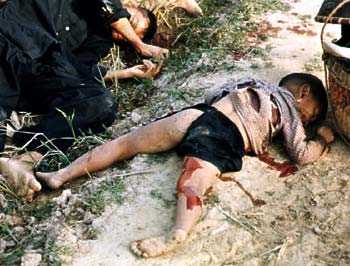
Further more, I was just following the first post, which was speaking about american soldier torturing killing kids/women/civilians. And all what we have to remember is this "hero"??? But I thought they (american army) were sent and payed exactly to do that, protecting civilians from communist, not torturing them!!! Sorry if I am not surprised a "hero" was against the mass women/babies murderer, sorry if I am instead highly surprised american army did that:(my lai massacre pic)
The My Lai Massacre (Vietnamese: thảm sát Mỹ Lai [mǐˀ lɐːj]; English pronunciation: /ˌmi:ˈleɪ, ˌmi:ˈlaɪ/ ( listen),[1] Vietnamese: [mǐˀlaːj]) was the mass murder conducted by a unit of the U.S. Army on March 16, 1968 of 347–504 unarmed citizens in South Vietnam, all of whom were civilians and a majority of whom were women, children (including babies) and elderly people.
Many of the victims were sexually abused, beaten, tortured, and some of the bodies were found mutilated. The massacre took place in the hamlets of Mỹ Lai and My Khe of Sơn Mỹ village during the Vietnam War. While 26 U.S. soldiers were initially charged with criminal offenses for their actions at My Lai, only William Calley was convicted. He served only three years of an original life sentence, spent on house arrest.
Soldiers went berserk, gunning down unarmed men, women, children and babies. Families which huddled together for safety in huts or bunkers were shown no mercy. Those who emerged with hands held high were murdered. ... Elsewhere in the village, other atrocities were in progress. Women were gang raped; Vietnamese who had bowed to greet the Americans were beaten with fists and tortured, clubbed with rifle butts and stabbed with bayonets. Some victims were mutilated with the signature "C Company" carved into the chest. By late morning word had got back to higher authorities and a cease-fire was ordered. My Lai was in a state of carnage. Bodies were strewn through the village.
—BBC News
---------- ADS -----------
Last edited by SunWuKong on Mon Jan 10, 2011 10:34 am, edited 4 times in total.
I can't believe morality is being discussed about war. The bombs were dropped, good or bad, and the world is the way it is now. There is an argument saying that if the bombs hadn't been dropped, far more people would be dead now from another war fought with more nuclear weapons without the benefit of knowledge of how terrible they were. FWIW, I've been to Hiroshima and had a discussion with Japanese students about this very thing. Again, obviously there have been wars since WW2 but what isn't considered is how relatively minor those wars have been. If the bombs hadn't been invented, who knows what Europe would look like now. Also, with how ferociously the Japanese were defending little bits of coral in the Pacific, you can understand that the US had no desire to send however many more hundreds of thousands of US soldiers and marines to their deaths.
SunwuKong, what do you know about Nanking? I would hope your arguments can cover a broader base than just Hiroshima and Nagasaki.
I can speak chinese so I know something about this chinese city.
I know that chinese governement have been using it for nationalistic purpose, encouraging hate of japanese, helping movies speaking about chinese heroes and japanese atrocity while any true movie about mao zedong are forbidden. Now all chinese people hate japanese and "admire" mao zedong (his pic is on many official support), who killed incredibely more with his communist party.
Now chinese army is growing non-stop (they do have the nuclear bomb), and all chinese have only one idea in head, prove how much of a hero they are and want to enter a war against japan, and use everything, any excuse to do so (diao yu dao chinese island, or even north korea...).
After years of brain washing about bad japanese and good chinese heroes, chinese people, chinese army, chinese small leaders really want to go to war, and the governement start to think they did a mistake with all their propaganda and brain washing.
They even forgot to mention to their people Japan paid billions to China in the 90s for the nanking (in fact nanjing but I forgive you) massacre, in order to try to say they were sorry about what their grand parents did.
It has been 3 generations since, mao zedong killed incredibely more, but heroes culture may lead to the third world war, so thank you for mentionning nanjing, you couldn't be more on the subject.
Wow, your like a rabid dog, attacking anyone that comments!!! You also read minds that's good, I merely commented on the topic of the post, you hijacked the thread without the respect of even apologizing, now you state what I am impressed by.
Your attempt at sarcasm translated to English in regards to Mai Lai,
sorry if I am instead highly surprised american army did that
is somewhat lost in translation, pun intended.
I'd be impressed to see you post what your posting here, on pprune or any American aviation website, amazing how easy going we Canadians are!!!!
I'd be impressed to see you post what your posting here, on pprune or any American aviation website, amazing how easy going we Canadians are!!!!
I said I could speak chinese (because I am an expat) I never said I was chinese nor asian... I insist on it because I exactly know where you want to go with you sentence quoted above.
And I don't really know what was lost in translation, and don't really understand what you did quote, I ve never said myself, sunwukong, is a hero.
I said I am more impressed (in fact shocked) by the fact the american army rapped, killed, tortured vietnamese babies, kid, women (mass murder) than by somebody who found this action abnormal. I said focusing on the "hero" instead of what happened make us forget our mistake, and I think this is wrong.
My point is: YOU are impressed by the 'hero", I am impressed by the mass murder. My point is that in the west we glorify even our mistake.
your response to my post, you are stating, (I) am impressed by hero.
You are no longer stating an opinion, you are putting words on my keyboard !! Not cool.
Furthermore - you go on and on about America's misuse of the atomic bombs killing thousands upon thousands of innocent Japanese citizens - that isn't shocking, but the rape and torture of up to 500 Vietnamese villagers - 23 years later - that made world news everywhere - that rocked the American public to the core - and swayed the support from Vietnam - thus in part set in motion America's end in the war.
This you never heard of after all your worldly experiences - you are now 43 years later - your shocked. So if you were living in a cage, and were unaware of the lengthy trials of the Mai Lai Massacre participants - the I guess it's my pun that's lost in translation.
SunWuKong wrote:Now all chinese people hate japanese and "admire" mao zedong (his pic is on many official support), who killed incredibely more with his communist party.
Now chinese army is growing non-stop (they do have the nuclear bomb), and all chinese have only one idea in head, prove how much of a hero they are and want to enter a war against japan, and use everything, any excuse to do so (diao yu dao chinese island, or even north korea...).
As a Chinese myself, who does not hate the Japanese (only the "historical re-visionists") and does not admire Mao and doesn't want to prove how much of a hero I am by entering a war against Japan, you have no right to speak on my behalf.
In other words, STFU.
I could debate you on all the points you made. Neither side in any war are blameless. But, since you've proven yourself to be irrational by grouping all Chinese into one single brain-washed entity, I don't see the point of trying to convince you. I suggest everyone else does the same.
Let the thread go back to it's original topic of a brave man who did the right thing when no one else did.
As a Chinese myself, who does not hate the Japanese (only the "historical re-visionists") and does not admire Mao and doesn't want to prove how much of a hero I am by entering a war against Japan, you have no right to speak on my behalf.
Well that is perfect because I didn't speak on your behalf.
And about what happens in China, I can see you have no clue at all. Saying that chinese people (you know the ones who live in china, not you) don't hate japanese that is just a joke. But a bad one. http://www.time.com/time/world/article/ ... 59,00.htmlYou don't have to look far to see why Chinese grow up learning to hate Japan...
Open this link if you can read chinese (which I doubt uninformed as you are), do you think this is not for real?http://www.anti-jp.com/
Now listen, I will speak very clearly: the vast majority of chinese people living in china hate japanese, is that clear enough??? Instead of insulting me and speaking about yourself, tell me I am wrong. Would you dare writting here this is not true? Do I lie? Come here to China and tell everybody you love japanese, please do it for me. Get real.
What I will do, however, is try and bring the thread back on topic, and point out the similarities between a soldier (or any member of the armed forces) ignoring superior's orders, and an FO objecting to the Capt's command decisions. Surely there must be some CRM to be shared and learned there.








 !! Not cool.

