PS What you can do, after you get some experience,
is learn to wheel land. Really reduces the wear and
tear on the tailwheel. Put the tail down after you have
slowed to taxi speed. Or if you have good brakes,
stick forward, power up and taxi in with the tail up.
Don't hit the prop.
4 Tailwheels...
Moderators: sky's the limit, sepia, Sulako, Right Seat Captain, lilfssister, North Shore
-
Colonel Sanders

- Top Poster

- Posts: 7512
- Joined: Sun Jun 14, 2009 5:17 pm
- Location: Over Macho Grande
-
tractor driver
- Rank 3

- Posts: 166
- Joined: Sun Nov 18, 2007 10:33 am
Re: 4 Tailwheels...
Absolutely correct. We almost always "wheel" land the Cessnas and DeHavillands. Because of the loaded landing speed (85KT touch down) we 3 point the 802s to enable the use of beta / reverse to shorten the landing roll, empty it's usually a wheel landing again. As spoken in earlier threads, different airplanes require different techniques, some definitely prefer one over the other. it's usually when you get caught in the middle that bad things can happen.
I actually mis-spoke a bit earlier, the tail tires last quite well, it's the tubes we wear out.
g
I actually mis-spoke a bit earlier, the tail tires last quite well, it's the tubes we wear out.
g
-
Colonel Sanders
- Top Poster
- Posts: 7512
- Joined: Sun Jun 14, 2009 5:17 pm
- Location: Over Macho Grande
Re: 4 Tailwheels...
IMHO beginner tailwheel pilots should first master
the 3-point landing. As their experience and skill
increase, they could look at the wheel landing. But
if a recreational pilot never does a wheel landing,
that's ok. I'm just happy when they can keep it
straight and not hurt the airplane.
However, I would hope that a professional taildragger
pilot would be a master of the wheel landing because
of the advantages of it, especially in certain types.
the 3-point landing. As their experience and skill
increase, they could look at the wheel landing. But
if a recreational pilot never does a wheel landing,
that's ok. I'm just happy when they can keep it
straight and not hurt the airplane.
However, I would hope that a professional taildragger
pilot would be a master of the wheel landing because
of the advantages of it, especially in certain types.
-
Shiny Side Up

- Top Poster
- Posts: 5335
- Joined: Tue Feb 17, 2004 5:02 pm
- Location: Group W bench
Re: 4 Tailwheels...
Squeezing in 6 to 10 landings an hour tends to put a little more wear on the tailwheel than usual use would. 
We can't stop here! This is BAT country!
-
Colonel Sanders
- Top Poster
- Posts: 7512
- Joined: Sun Jun 14, 2009 5:17 pm
- Location: Over Macho Grande
Re: 4 Tailwheels...
What really fries the tailwheels is the wind game.
You can get any four-bars to show it to you.
You can get any four-bars to show it to you.

Re: 4 Tailwheels...
That's somewhat reassuring although it still bugs me that I truly suck at wheel landings. Hopefully I can find the time this coming summer to get some dual.Colonel Sanders wrote:If a recreational pilot never does a wheel landing,
that's ok. I'm just happy when they can keep it
straight and not hurt the airplane.
LnS.
Re: 4 Tailwheels...
I was pretty inconsistent at two pointers too until CS suggested putting one wheel down a bit before the other. Presto, no more silly bounces and a much more control.
Works in everything from the slow stable moth to the fast nasty Pitts.
Give it a try.
Works in everything from the slow stable moth to the fast nasty Pitts.
Give it a try.
-
Colonel Sanders
- Top Poster
- Posts: 7512
- Joined: Sun Jun 14, 2009 5:17 pm
- Location: Over Macho Grande
Re: 4 Tailwheels...
Imagine how much better the advice would have
been if you could have gotten a four-bars to talk
to you instead
Everyone knows airline pilots are the Kings of
Aviation and the hottest sticks around.
For LnS: www.pittspecials.com/articles/Wheel_landings.htm
Read the last 3 paragraphs.
been if you could have gotten a four-bars to talk
to you instead
Everyone knows airline pilots are the Kings of
Aviation and the hottest sticks around.
For LnS: www.pittspecials.com/articles/Wheel_landings.htm
Read the last 3 paragraphs.
Re: 4 Tailwheels...
Thanks, Colonel. I get the theory behind it, I just think even an hour of supervised practice with a good instructor would be well worth it.
LnS.
LnS.
Re: 4 Tailwheels...
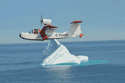
I have found that wheel landing is much better for the Teal. It's tailwheel is a bit overworked anyway, so anything I can do to reduce wear on it is a good thing. The Teal's main wheels are further ahead of the C of G than most tail draggers (necessary so it does not stand on it's nose with power, 'cause the thrust line is so high). The result is that the tailwheel takes a higher percentage of the total weight of the aircraft - it works hard. Thus, I keep it off the ground every moment possible.
I have also found that single wheel wheel landings are the most easy, this makes crosswinds even less intimidating. The key is not to attempt to flare at all, but rather, fly the aircraft into formation with the runway, and contact a wheel. With one on, let the other one on, while lowering the nose enough to stick the plane to the ground. The decrease in angle of attack by doing that will prevent a bounce. I discovered all of this quite by accident when I had to land one day suspecting the tail wheel was not locked down. I held the tail off as long as possible, and got a super landing out of it.
The thing to remember about three point landings is that the minute the tailwheel is on the ground, you no longer have pitch control of the aircraft. If it bounces then, there is nothing you can do to stop the bounce, unless you lift the tail back up, which will not be a smooth maneuver! You'll just have to wait it out, and that, I think, is the part of tailwheel flying which scares people - just being along for the ride after touchdown three point. You're focused on not liking the bouncing you cannot stop, while the aircraft is now beginning to ground loop, and you're going to sense that next in an alarming way.
If the elevator has enough control to hold the tail off, the rudder has enough control to effectively keep the plane straight (assuming you use it!). And, if during a wheel landing, you find that you cannot keep it straight, you're still flying, put the power to it, and go around!
Wheel landings are not the best for short field technique, but most taildraggers do well enough in short landing distance anyway that a wheel landing works fine in most runways.
For those who aspire to flying flying boats, the proper landing technique (very certainly unlike a floatplane) is identical to a wheel landing, fly in into formation with the water, contact gently, lower the nose a touch to keep it there, and remove power, if still on. Both my land and water landings will progress through the stick being held full forward, before the tail settles on/in.
I have also found that single wheel wheel landings are the most easy, this makes crosswinds even less intimidating. The key is not to attempt to flare at all, but rather, fly the aircraft into formation with the runway, and contact a wheel. With one on, let the other one on, while lowering the nose enough to stick the plane to the ground. The decrease in angle of attack by doing that will prevent a bounce. I discovered all of this quite by accident when I had to land one day suspecting the tail wheel was not locked down. I held the tail off as long as possible, and got a super landing out of it.
The thing to remember about three point landings is that the minute the tailwheel is on the ground, you no longer have pitch control of the aircraft. If it bounces then, there is nothing you can do to stop the bounce, unless you lift the tail back up, which will not be a smooth maneuver! You'll just have to wait it out, and that, I think, is the part of tailwheel flying which scares people - just being along for the ride after touchdown three point. You're focused on not liking the bouncing you cannot stop, while the aircraft is now beginning to ground loop, and you're going to sense that next in an alarming way.
If the elevator has enough control to hold the tail off, the rudder has enough control to effectively keep the plane straight (assuming you use it!). And, if during a wheel landing, you find that you cannot keep it straight, you're still flying, put the power to it, and go around!
Wheel landings are not the best for short field technique, but most taildraggers do well enough in short landing distance anyway that a wheel landing works fine in most runways.
For those who aspire to flying flying boats, the proper landing technique (very certainly unlike a floatplane) is identical to a wheel landing, fly in into formation with the water, contact gently, lower the nose a touch to keep it there, and remove power, if still on. Both my land and water landings will progress through the stick being held full forward, before the tail settles on/in.
-
Colonel Sanders
- Top Poster
- Posts: 7512
- Joined: Sun Jun 14, 2009 5:17 pm
- Location: Over Macho Grande
Re: 4 Tailwheels...
A little skip - which can be defined as the aircraft rising tojust being along for the ride after touchdown three point
a foot or so after touchdown - is no big deal. Freeze the
stick, maintain the 3-pt landing attitude, and wait for the
drag of the aircraft to reduce the airspeed and lift. It will
touch down again. We've never had one stuck up there yet.
However, when you bounce up to 3 feet, or 5 feet, or 10 feet,
or 20 feet, then doing nothing is no longer an option. Power
must be added. The higher the bounce, the more power is
required.
If you are Bob Hoover, you can salvage any bounce by adding
just the right amount of power to maintain airspeed (and hence
lift) and avoiding a very hard landing by sinking gently back
down again. Power all the way off again when you are less
than a foot high.
However, most people are not Bob Hoover. Not even the
four-bars here. When you bounce, add FULL POWER and
go around. Gently lower the nose as required to reduce
induced drag. Accelerate in ground effect, just like after
a soft field takeoff. Flaps up in stages, as the airspeed
increases.

Re: 4 Tailwheels...
+1lownslow wrote:That's somewhat reassuring although it still bugs me that I truly suck at wheel landings. Hopefully I can find the time this coming summer to get some dual.Colonel Sanders wrote:If a recreational pilot never does a wheel landing,
that's ok. I'm just happy when they can keep it
straight and not hurt the airplane.
LnS.
Maybe next year.
Although I found it much easier to wheel land the super cub than the J3. I think because the J3 I flew had low pressure tires, or maybe it was just because the super cub had power so I could fly it onto the runway instead of float it onto the runway.
Truthfully, I'm just happy to have survived 50 hours dragging tail and not ground looping.



