Groundloop

This forum has been developed to discuss flight instruction/University and College programs.

Moderators: lilfssister, North Shore, sky's the limit, sepia, Sulako, Right Seat Captain

ettw
Rank 8
Rank 8
Posts: 817
Joined: Thu Jan 26, 2006 8:33 pm
Location: CYFB or CNS4

Re: Groundloop

Post by ettw »

pelmet wrote:
photofly wrote:I was taught to use a controlled "ground-loop" to turn the aircraft (it was a Champ) around on a grass field: pick the right speed, full rudder and a burst of power to get the tail-wheel to skid, and you'll do a nice 180 more or less on the spot.

I remember reading somewhere that in some WWII aircraft (it had a wide undercarriage) a semi-controlled ground loop was the approved procedure for a late abort in a take-off run. Maybe that was just a myth.
I know a couple of guys that intentionally groundlooped a 40 passenger twin turboprop on a short, contaminated runway. Having no reverse capability in the design and little braking action, their alternative was a sharp dropoff at the end of the runway. So I believe rudder was combined with adding power on one engine. It worked.
The capt told me that as the old girl started to go around he snapped the other throttle up. Both screaming darts wet and 15000 rpm made short work of their lack of reverse. He then made a quick PA to apologize for the the sharp turn!! :lol:

Back to the thread. I have very little tail wheel time but someone who I have a lot of respect for told me that if it starts to get screwy on landing and you have the room, pour the coals to it and go around and try again. The power should straighten it out if it hasn't gone too far, no?

Cheers

ETTW
---------- ADS -----------
 
User avatar
looproll
Rank (9)
Rank (9)
Posts: 1462
Joined: Sun Mar 07, 2004 2:51 pm

Re: Groundloop

Post by looproll »

Mine is pretty solid during the roll-out. I have the stick buried back, though. Sometimes I feel a bit bouncy as the tailwheel passes over a bump or rough spot. Never used a locking tailwheel. Looks like it might be easier to control in a strong crosswind.
---------- ADS -----------
 
User avatar
Colonel Sanders
Top Poster
Top Poster
Posts: 7512
Joined: Sun Jun 14, 2009 5:17 pm
Location: Over Macho Grande

Re: Groundloop

Post by Colonel Sanders »

if it starts to get screwy on landing and you have the room, pour the coals to it and go around
That is the best advice EVER for tailwheel flying.

A new tailwheel pilot should never push a bad approach
into a bad flare, or a bad flare into a bad touchdown, or
a bad touchdown into a bad rollout. That can spend an
awful lot of money. Cha-ching ($$$).

If you ask yourself, "Self, should I go around?" then
shove the throttle full forward. Instantly the prop slipstream
will make the rudder and elevator more effective. All
you have to do is get one foot in the air again, and
you are safe.

A tailwheel aircraft is a wonderful flying vehicle, and a
horrible ground vehicle. You only want to let the tires
touch the ground when everything is perfect, and you're
going as slow as possible.

That's why you have lots of gas when you go flying.
You never, ever commit yourself to a full stop landing
as a new tailwheel pilot unless the prop is stopped or
it's on fire.

I knew a beginner Pitts pilot who would do 10 approaches
until he finally got one that he liked, and would land
out of. There is no shame in going around. There
is plenty of shame in rolling it up into a ball!
---------- ADS -----------
 
photofly
Top Poster
Top Poster
Posts: 11306
Joined: Tue Jan 18, 2011 4:47 pm
Location: Hangry and crankypated

Re: Groundloop

Post by photofly »

That is the best advice EVER for tailwheel flying.
Not just for tailwheel flying, either, right?
---------- ADS -----------
 
User avatar
Colonel Sanders
Top Poster
Top Poster
Posts: 7512
Joined: Sun Jun 14, 2009 5:17 pm
Location: Over Macho Grande

Re: Groundloop

Post by Colonel Sanders »

True - but especially for tailwheel flying.

The Prime Directive (tm) of tailwheel flying is to not
let the tires touch the pavement, unless the aircraft
is aligned with the direction of travel.

Landing with any measureable crab in a taildragger
is horrible on dry pavement. The tires will toss you
right into the ditch, like a 400 pound wrestler in tights.
You can get away with it on grass or gravel or snow
or ice or anything with a low coefficient of friction.
Dry pavement is enemy territory for a taildragger.
You pray for a "contaminated" runway in a taildragger.
Weird but true.


However, in a nosewheel aircraft, things aren't quite
so demanding. You can touch down in a slight
crab, and it will nicely straighten itself out. 5 degrees
is ok. Heck, even 10 degrees will work.

The main thing about a nosewheel aircraft is to baby
the nose gear because they are all delicate junk. They
will shimmy, and if you porpoise, you can rip the sucker
right off.


Don't do that. Baby the nosewheel. Always touch down
slightly mains first, and keep pulling on the control column
to keep the nose tire 1/4 inch in the air as you slow down.
Eventually you will run out of aft elevator at a slow speed
and the nose tire will touch, and that's ok. I make every
nosewheel landing a sort of soft-field landing, unless there
is a reason to do otherwise (eg squat switch on L39 nose gear)
---------- ADS -----------
 
white_knuckle_flyer
Rank 3
Rank 3
Posts: 175
Joined: Wed Jan 16, 2013 8:43 am

Re: Groundloop

Post by white_knuckle_flyer »

I recall seeing that video before. Each time I see it, I find myself thinking "go around...go around...go around" or at least "add some power and try landing it again. ".

I always assumed that porpoising involved the nose-wheel coming up off the runway, but I guess that was just my interpretation of it. Or is this guy performing the uniquely horrible "porpoise-wheelbarrow" maneuvre ?

In both nosewheel and taildragger a/c, you are touching down on the two mains ( most of the time ) yet groundloops are more probable for the latter type. What is the main culprit ? Is it the rearward c of g ? Diminished rudder effectiveness ?
---------- ADS -----------
 
User avatar
Beefitarian
Top Poster
Top Poster
Posts: 6610
Joined: Wed Dec 01, 2010 10:53 am
Location: A couple of meters away from others.

Post by Beefitarian »

Because if the steerable wheels are at the front you're more stable. Next time you're at the grocery store, find a nice wide open space, push a shopping cart backwards. Once you get some speed turn a little and let it go. Now do it again with handle on the back and it's much more stable.

It's because the weight will want to bring it around the wheels that are not steerable.
---------- ADS -----------
 
white_knuckle_flyer
Rank 3
Rank 3
Posts: 175
Joined: Wed Jan 16, 2013 8:43 am

Re: Groundloop

Post by white_knuckle_flyer »

So the real groundloop danger kicks in when the tailwheel makes contact, not before ? If so, then that makes sense to me.
---------- ADS -----------
 
User avatar
Beefitarian
Top Poster
Top Poster
Posts: 6610
Joined: Wed Dec 01, 2010 10:53 am
Location: A couple of meters away from others.

Post by Beefitarian »

No, it's when the mains on a taildragger touch down because they won't steer. Therefore the weight will push the tail around them if they are not going straight. The shopping cart can go fast straight with the handle at the front it just will spin if you turn it. If you are going slow enough you can turn it ok also.

Add weight like fill the cart up and it will be even worse.
---------- ADS -----------
 
User avatar
Beefitarian
Top Poster
Top Poster
Posts: 6610
Joined: Wed Dec 01, 2010 10:53 am
Location: A couple of meters away from others.

Post by Beefitarian »

The weight want's to get ahead of the wheels that don't steer. The mains on a tricycle gear plane are farther back like a shopping cart going forward as you push on the handle. Nice and stable and you can push it full fairly fast.
---------- ADS -----------
 
photofly
Top Poster
Top Poster
Posts: 11306
Joined: Tue Jan 18, 2011 4:47 pm
Location: Hangry and crankypated

Re: Groundloop

Post by photofly »

I'm going to throw my inexpert opinion into the ring.

You're more likely to ground loop towards the end of the landing run than immediately after the mains touch. That's because at flying speed the tail fin is still doing it's job of preventing the aircraft swapping ends.

However, if you're not straight when you touch down, this situation will only get worse as the fin effectiveness diminishes. Eventually the natural stability of the aircraft to fly nose first is overcome by its tendency to roll tail first. At that point it will groundloop.
---------- ADS -----------
 
User avatar
Rookie50
Rank (9)
Rank (9)
Posts: 1819
Joined: Mon Apr 09, 2012 6:00 am
Location: Clear of the Active.

Re: Groundloop

Post by Rookie50 »

That is one nasty video to watch.
---------- ADS -----------
 
white_knuckle_flyer
Rank 3
Rank 3
Posts: 175
Joined: Wed Jan 16, 2013 8:43 am

Re:

Post by white_knuckle_flyer »

Beefitarian wrote:The weight want's to get ahead of the wheels that don't steer. The mains on a tricycle gear plane are farther back like a shopping cart going forward as you push on the handle. Nice and stable and you can push it full fairly fast.
Okay, so the difference isn't a "steerable wheel" issue ( since neither type of a/c has steerable main gear ), it is about c of g ?
---------- ADS -----------
 
User avatar
Colonel Sanders
Top Poster
Top Poster
Posts: 7512
Joined: Sun Jun 14, 2009 5:17 pm
Location: Over Macho Grande

Re: Groundloop

Post by Colonel Sanders »

Correct. Really C of M. Here's a sure cure
for your insomnia tonight:

http://www.pittspecials.com/articles/Tailwheel.htm

That is one nasty video
Indeed. Flipper may have been a wonderful dolphin
but there's no place for a porpoise when an aircraft
lands!


PS I know of a guy who did that in a T-33. Wiped
the nose gear right off.
---------- ADS -----------
 
cgzro
Rank (9)
Rank (9)
Posts: 1735
Joined: Wed Jul 25, 2007 7:45 am

Re: Groundloop

Post by cgzro »

That's why you have lots of gas when you go flying.
You never, ever commit yourself to a full stop landing
Amen, i remember a trip to a contest in the states in the
Pitts. Destination airport had two runways nice big long wide one and tiny one with cliff at one end and hill at the other. Two big Xs on the big one When i got overhead. While not quite 10 attempts it was probably 3 or 4 till i was comfortable. When i stopped Mike Guolian leaned into the canopy shook my hand and laughed..
anyway have lots of gas to go around or go somewhere else...excellent advice.
---------- ADS -----------
 
white_knuckle_flyer
Rank 3
Rank 3
Posts: 175
Joined: Wed Jan 16, 2013 8:43 am

Re: Groundloop

Post by white_knuckle_flyer »

Colonel Sanders wrote:Correct. Really C of M. Here's a sure cure
for your insomnia tonight:

http://www.pittspecials.com/articles/Tailwheel.htm
I actually read it. Guess I'll sleep tonight.

Probably overstating for dramatic effect, but should I really expect to rollout a tricycle gear a/c without using rudder ? I rent 172s from a flight school. I don't think you could roll more than 20 feet without some rudder input. :rolleyes:
---------- ADS -----------
 
pelmet
Top Poster
Top Poster
Posts: 7952
Joined: Tue Jun 14, 2005 2:48 pm

Re: Groundloop

Post by pelmet »

Colonel Sanders wrote:True - but especially for tailwheel flying.

The Prime Directive (tm) of tailwheel flying is to not
let the tires touch the pavement, unless the aircraft
is aligned with the direction of travel.

Landing with any measureable crab in a taildragger
is horrible on dry pavement. The tires will toss you
right into the ditch, like a 400 pound wrestler in tights.
You can get away with it on grass or gravel or snow
or ice or anything with a low coefficient of friction.
Dry pavement is enemy territory for a taildragger.
Good advice. I experienced a not straight landing in a tailwheel type once that scared the crap out of me. Pulled over to the side of the runway almost instantly. That is when instinctive rudder input and brake saved the day but it flashed through my mind that I was going off the paved surface. Felt foolish. Main problem....having an excessively long float and not concentrating enough on being straight while in a relatively strong crosswind. And a bunch of people were watching. Remember, you can use the aircraft parts in front of you such as the nose cowl, etc for runway alignment.

Then last summer....one go-around on a gusty day when after touchdown a gust/thermal lifted me up again. Why try to save the landing in a near stalled condition. Best decision of the day. Add power smoothly.

On some big planes however, it can be perfectly normal and approved as a technique in the manual to land in a crabbed position for touchdown on a wet runway. Dry....not so good.

Porpoises....heard about them for years but never experienced one until not that long ago. But seemed like a non-event as I just pulled back on the CC a bit and it was solved. I think it might relate to excess airspeed. But seeing thaose videos, I would say that if the runway is long enough, just add a burst of power to get airborne again and slowly reduce power again for a normal flare....or go-around if there is any doubt.
---------- ADS -----------
 
User avatar
Colonel Sanders
Top Poster
Top Poster
Posts: 7512
Joined: Sun Jun 14, 2009 5:17 pm
Location: Over Macho Grande

Re: Groundloop

Post by Colonel Sanders »

Overall, oscillations in aviation are bad. Often really bad.

White Gloves in the Maule appeared to have an oscillation
going in roll. He was sawing back and forth on the control
column. This is more likely to happen with an aircraft with
a lot of mass a long way out on the wings, away from the
fuselage, increasing it's Polar Moment of Inertia (PMI).

A porpoise is simply an oscillation in pitch. The porpoises
that I've seen are generally a result of a too-fast approach
in a nosewheel aircraft - the nosegear touches prematurely,
and if the pilot starts pulling back and forth on the control
column ...

A groundloop is often a result of a divergent oscillation in
yaw. Usually a tailwheel aircraft (inherent instability with
tires on pavement) but people have managed to groundloop
nosewheel aircraft, too. Again, poor pilot technique is to
blame here. It's actually quite simple: if the aircraft yaws
left, the pilot applies right rudder but keeps it on too long.
He needs to get off it before he straightens out, but often
a low-time pilot will hold the right rudder until he has a real
problem heading for the right. Then full left rudder is applied,
and the rinse, lather, repeat as it says on the shampoo bottle.

All pilots need to know about this thing called a "Pilot Induced
Oscillation" - when the pilot is behind the aircraft and his inputs
are making the oscillation worse. When that happens, the
pilot needs to either freeze or simply let go of the controls.

At different speeds, configuration and conditions, aircraft are
more likely to be susceptible to oscillations. Oscillations can
be annoying (nosewheel or tailwheel shimmy) or fatal (flight
control flutter) depending upon how much energy is in the
oscillation.


Very similar to a porpoise is hand-flying in the bumps. More
than once, teaching someone to fly under the hood when it
is bumpy, I see people working very hard, pulling back and
forth on the control column. Unfortunately the timing of
their inputs is poor.

I tell them "I have control" but I only put my feet on the
rudder pedals. I don't put my hands on the control column.
I point out to the student, how much better the aircraft
flies when they aren't working so hard.

Obviously a PIO in pitch is more likely with a rearward C of G.
---------- ADS -----------
 
User avatar
Beefitarian
Top Poster
Top Poster
Posts: 6610
Joined: Wed Dec 01, 2010 10:53 am
Location: A couple of meters away from others.

Post by Beefitarian »

white_knuckle_flyer wrote:
Probably overstating for dramatic effect, but should I really expect to rollout a tricycle gear a/c without using rudder ? I rent 172s from a flight school. I don't think you could roll more than 20 feet without some rudder input. :rolleyes:
No, but the difference is, I can be pretty lazy and wait until I want the tricycle gear plane to turn or correct before I need to use a small bit of rudder. The bad thing about that is sometimes it leads to bad habits like not paying enough attention to winds while I taxi.

In a conventional gear plane the pilot needs to use lots of rudder inputs proactively to prevent it from getting away on them pretty much anytime the craft is in motion.

As was mentioned at higher speeds the vertical stabilizer helps keep the plane straight like the feathers on a dart or arrow. That is also why it's important to try to be approaching the runway centerline nice and straight.
---------- ADS -----------
 
User avatar
Colonel Sanders
Top Poster
Top Poster
Posts: 7512
Joined: Sun Jun 14, 2009 5:17 pm
Location: Over Macho Grande

Re: Groundloop

Post by Colonel Sanders »

Baby the nosewheel. Always touch down
slightly mains first, and keep pulling on the control column
to keep the nose tire 1/4 inch in the air as you slow down.
Eventually you will run out of aft elevator at a slow speed
and the nose tire will touch, and that's ok. I make every
nosewheel landing a sort of soft-field landing, unless there
is a reason to do otherwise
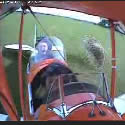
Baby the nosewheel. And this is why:

Image
---------- ADS -----------
 
User avatar
Beefitarian
Top Poster
Top Poster
Posts: 6610
Joined: Wed Dec 01, 2010 10:53 am
Location: A couple of meters away from others.

Post by Beefitarian »

Worst lawn mower ever.
---------- ADS -----------
 
Post Reply

Return to “Flight Training”