If one was to keep it simple Colonel we could just fall back to the ol' ANC list of priorities.
Aviate
What do I need to know to fly this damn thing? I'll agree that speeds are rarely important and one will be able to figure them out if one takes a few minutes to survey the cockpit. Gear speeds and flaps speeds are usually placarded, so are a lot of the other things that "MAY RESULT IN INJURY OR DEATH" A few minutes of cockpit time with brain in gear should solve a lot of problems. The fuel and other possibly complex systems as I've said are the main flying issues one is going to have to figure out before hand.
Depending on circumstance, I would also say knowing some numbers on weight is a need to know depending on what you're doing. Take off and landing performance also depending on your circumstance. Most planes with four seats or more can take off with two people and full fuel, and probably get out of the runway that hopefully someone got them into. Which brings us to...
Navigate
What do we need to know about where we are, where we're going, and how we're going to get there. Note that Navigate is a less priority than Aviate's issues, and depends on circumstance. If you don't think you can aviate and navigate, then learn to do aviate first. Take the time to do so. Here's a pet peeve I have that a lot of low time guys don't think about - they want to do training and go somewhere at the same time. Usually because of our location that means into the Rocks. I don't do this, I used to think people would be up to that challenge but I no longer am of that opinion. If someone is having trouble aviating and doesn't have everything they need in that step done, they will suck at remembering all those things you've mentioned that relate to navigating. Maybe those guys knew there were things to run into out there, but forgot since all processing power was used up aviating, and possibly our last and lowest priority, which of course is...
Communicating
The nice to know stuff. The stuff that helps you adhere to Guideline #1 of flying - try not to piss people off. Review the pertinent stuff. If I have time I like to make a list of frequencies, but most of the time I'll look it up when I need to or if I must need to talk to a controller, he'll probably tell me what to do. Not rocket science. With the proliferation of GPSs with databases these days, realistically one needs to know squat, as long as you know how to use the magic box, you can figure out who to talk to. If not, there's the magic words "Sorry" and "Unfamiliar".
Don't we hammer this home to new pilots all the time? Why do they forget? Read something new I liked the other day: Don't drop the airplane to fly the radio.
Four things you probably do badly
Moderators: sky's the limit, sepia, Sulako, Right Seat Captain, lilfssister, North Shore
-
Shiny Side Up

- Top Poster

- Posts: 5335
- Joined: Tue Feb 17, 2004 5:02 pm
- Location: Group W bench
Re: Four things you probably do badly
We can't stop here! This is BAT country!
-
Colonel Sanders

- Top Poster
- Posts: 7512
- Joined: Sun Jun 14, 2009 5:17 pm
- Location: Over Macho Grande
Re: Four things you probably do badly
If you've been reading this thread, you've probably
figured out that I have a pet peeve about the comm
radio.
I hate it. It does more harm than good, I swear, and
when you need it the most - when it gets busy - it's
designed to fail.
Despite this, people don't look outside and instead rely
on the comm radio for VFR separation and take offense
when they don't hear another aircraft, which might be
on a different freq - or have the audio panel mis-selected -
or they themselves might have the volume turned down,
etc.
So many times, I have been riding along in the right
seat, and I watch people stop flying the airplane, as
they listen to some long-winded @sshole - AT A DIFFERENT
AIRPORT - tell his life story, with of course a gratuitous
"Conflicting traffic please advise".
Or someone is turning final. He's got his hands full with
the turn, and the airspeed, and keeping the ball centered,
and what does he do? Stop flying the airplane to transmit
that he is now on final.
F__K the radio, ok? Fly the airplane.
So many pilots are so concerned with sounding like a
late-night FM disc jockey on the comm. Oh, please.
Shut up and fly.
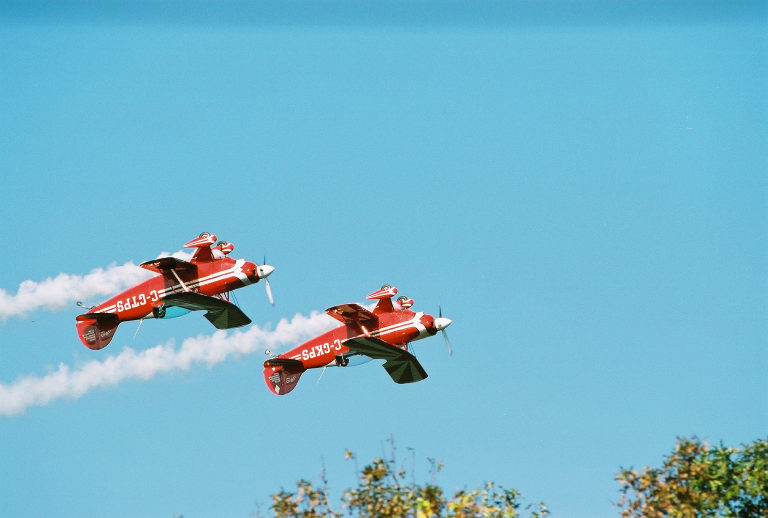
I do a lot of formation flying, and this is all I ever
want to hear from the wing:
- "Two's up"
- "Lead's on fire"
- "I'll take the fat one"
figured out that I have a pet peeve about the comm
radio.
I hate it. It does more harm than good, I swear, and
when you need it the most - when it gets busy - it's
designed to fail.
Despite this, people don't look outside and instead rely
on the comm radio for VFR separation and take offense
when they don't hear another aircraft, which might be
on a different freq - or have the audio panel mis-selected -
or they themselves might have the volume turned down,
etc.
So many times, I have been riding along in the right
seat, and I watch people stop flying the airplane, as
they listen to some long-winded @sshole - AT A DIFFERENT
AIRPORT - tell his life story, with of course a gratuitous
"Conflicting traffic please advise".
Or someone is turning final. He's got his hands full with
the turn, and the airspeed, and keeping the ball centered,
and what does he do? Stop flying the airplane to transmit
that he is now on final.
F__K the radio, ok? Fly the airplane.
So many pilots are so concerned with sounding like a
late-night FM disc jockey on the comm. Oh, please.
Shut up and fly.
I do a lot of formation flying, and this is all I ever
want to hear from the wing:
- "Two's up"
- "Lead's on fire"
- "I'll take the fat one"
-
Pop n Fresh

- Rank (9)

- Posts: 1270
- Joined: Mon Jan 06, 2014 3:46 am
- Location: Freezer.
Re: Four things you probably do badly
EXPIRED?!Colonel Sanders wrote:PM me your snail mail address, I willMakes me wish I had a paper CFS though
send you a CFS expired 6 Feb 14.
You twying to kiww me in a fiawee pwane cwash?
I did just pay the ransom for a new VNC though. Nice to see it's from almost a year ago.

Re: Four things you probably do badly
You are correct of course with these issues. For me I essentially don't do night vfr, (long cross countries) and never, ever somewhere I don't know. I do sure know the MSA for the airport I'm going, and used that as a guide even before I had an IFR rating.Colonel Sanders wrote:The youngsters probably don't remember this:
On October 30th, 1991 Hercules tail number 130322, had taken on it's load of fuel at Thule and had been requested to fly passengers on to Alert ... as 322 was nearing Alert, about 15 kms south flying VFR with the lights of Alert in sight it clipped the top of a hill. Wreckage was strewn over a wide area and the fuel carried in the bladder covered the entire area. When the aircraft crashed, it also caught fire.
http://www.ntsb.gov/doclib/safetyalerts/SA_013.pdf
Now, what's more important: radio frequencies or terrain knowledge?Recent NTSB investigations have identified several accidents that involved controlled flight into terrain (CFIT) by both instrument flight rules (IFR)-rated and visual flight rules (VFR) pilots operating under visual flight conditions at night in remote areas.
• In many of these cases, the pilots were in contact with air traffic control (ATC) at the time of the accident and receiving radar service.
• The pilots and controllers involved all appear to have been unaware that the aircraft were in danger
o A Learjet departed Brown Field, south of San Diego, California, and struck terrain while being radar vectored in a mountainous area east of the airport, resulting in three fatalities.
o A Piper Saratoga departed Bakersfield, California, en route to Santa Barbara, California, descended from 8,500 feet to 6,500 feet, and collided with a 6,700-foot peak, resulting in two fatalities.
o A Beech-Raytheon King Air struck a 5,700-foot ridge while descending on a visual approach to Bozeman, Montana, resulting in three fatalities.
o A Piper Cherokee collided with trees and terrain at 2,800 feet while descending for landing at Winchester, Virginia, killing all three occupants.
o A Beech-Raytheon King Air struck terrain at the 11,700-foot level of the Rocky Mountains while descending southwest of Alamosa, Colorado, resulting in three fatalities.
o A Cessna 182 departed Las Vegas, Nevada, and struck an 8,400-foot mountain at the 7,000-foot level about 12 miles southwest of the city, resulting in two fatalities.
Guelph and Rockcliffe are nasty at night. Never landed Rockcliffe at night, but taken off 09 twice, that's bad enough. Total black hole effect. Burlington (my field ) is ok, especially 14, but 32 at night with no papi, gotta be careful with that displaced threshold.
-
Colonel Sanders
- Top Poster
- Posts: 7512
- Joined: Sun Jun 14, 2009 5:17 pm
- Location: Over Macho Grande
Re: Four things you probably do badly
Doesn't Burlington have a hill a mile or two
southwest? Might not be pleasant to encounter
at night, although a very long time ago, I used
to ride Mount Nemo on my bicycle
PS Built a hangar at Burlington in 1980. No
instrument approach in those days - maybe
you've got one now. I remember one night,
arriving late, the Kovachicks left the lights off,
place was deserted, did a black landing on 32.
Ugh.
southwest? Might not be pleasant to encounter
at night, although a very long time ago, I used
to ride Mount Nemo on my bicycle
PS Built a hangar at Burlington in 1980. No
instrument approach in those days - maybe
you've got one now. I remember one night,
arriving late, the Kovachicks left the lights off,
place was deserted, did a black landing on 32.
Ugh.
Re: Four things you probably do badly
Yes, it sure does, has a whole escarpment to the west / southwest. With a few nice radio towers on top, to boot. I did my ppl and night there, and you don't want to descend early for the circuit from the west.Colonel Sanders wrote:Doesn't Burlington have a hill a mile or two
southwest? Might not be pleasant to encounter
at night, although a very long time ago, I used
to ride Mount Nemo on my bicycle
PS Built a hangar at Burlington in 1980. No
instrument approach in those days - maybe
you've got one now. I remember one night,
arriving late, the Kovachicks left the lights off,
place was deserted, did a black landing on 32.
Ugh.
I do think that's a good habit, as I am inherently mistrustful of those who build towers, to delay dropping to circuit height -- well until you are just about overhead the field or joining downwind.
My first time into savannah GA, I was (slightly) surprised to discover a cluster of towers, like close to 2000 agl....and not that far from the field. Big ones.
Re: Four things you probably do badly
What's nice now about Burlington is 27 is now paved, and since it seems every second day around here it's 240 -260 at 15G25+, that's nice to use. Especially as I've gotten comfortable in my plane, and can use maybe half of 27's 2000 foot length. Amazing what proper speed control with 40degree flaps will let you do.
-
Colonel Sanders
- Top Poster
- Posts: 7512
- Joined: Sun Jun 14, 2009 5:17 pm
- Location: Over Macho Grande
Re: Four things you probably do badly
Many, many airports in the USA have high
terrain or high towers nearby.
I would not want to fly into Roanoke, VA
or Wilkes Barre, PA or Craig, FL night VFR
for the first time.
Or Homestead, FL. Take a look just northwest
of the airport
You don't think of Florida of having much in
the way of hills, do you? But near Key West,
which has an elevation of 4 feet, there is a
16,000 foot obstacle which 4 guys in a 182
died tangling with, a couple years back.
terrain or high towers nearby.
I would not want to fly into Roanoke, VA
or Wilkes Barre, PA or Craig, FL night VFR
for the first time.
Or Homestead, FL. Take a look just northwest
of the airport
You don't think of Florida of having much in
the way of hills, do you? But near Key West,
which has an elevation of 4 feet, there is a
16,000 foot obstacle which 4 guys in a 182
died tangling with, a couple years back.
Re: Four things you probably do badly
I flew into greensboro, NC -- not far from Roanoke -- and as was my first time ever there, I asked for the ILS. Dark night, dark terrain. They were happy to do it, especially when I said I'd never been there.
-
Colonel Sanders
- Top Poster
- Posts: 7512
- Joined: Sun Jun 14, 2009 5:17 pm
- Location: Over Macho Grande
Re: Four things you probably do badly
Free advice: Just because you are on radar
vectors, does NOT mean that ATC is providing
you separation from terrain.
You MUST ask for a "pop-up" IFR (with vectors
to the ILS). If you are VFR, vectors to the ILS
does NOT guarantee you won't hit something.
Hell, you can vector yourself to the ILS.
vectors, does NOT mean that ATC is providing
you separation from terrain.
You MUST ask for a "pop-up" IFR (with vectors
to the ILS). If you are VFR, vectors to the ILS
does NOT guarantee you won't hit something.
Hell, you can vector yourself to the ILS.
Re: Four things you probably do badly
I was on an IFR flight plan, they offered me the visual -- which I define simply as "youre on your own" -- I politely requested the ILS, being night. Day, sure I'll do the visual every time as soon as I have positive contact.


