Every pilot knows that spins are very complicated
and need precise control inputs to recover. This is
especially true of large airplanes with huge amounts
of rotating momentum.
February 2, 1970 ... the F-106 aircraft entered a flat spin. The pilot, Gary Foust, attempted to recover, including the desperation move of deploying the aircraft's drag chute; but recovery proved to be impossible, and Foust fired his ejection seat and escaped the stricken aircraft at an altitude of 15,000 feet.
The reduction in weight and change in center of gravity caused by the removal of Foust and the ejection seat caused the aircraft, trimmed for takeoff and with the throttle at idle, to successfully recover itself from the spin.
One of the other pilots on the mission is reported to have radioed Foust during his descent under his parachute that "you'd better get back in it!".
Foust watched incredulously as the now-pilotless aircraft descended and skidded to a halt in a farmer's field near Big Sandy, Montana. Foust drifted into the nearby mountains; he was later rescued by local residents using snowmobiles.
Shortly thereafter, the local sheriff arrived at the scene of the crash, and was surprised when he observed the aircraft – the heat of the crash landing, combined with the exhaust from the still-idling jet engine, melted the snow which allowed the aircraft to start to move.
Having contacted the air base, he was informed that he should simply allow the jet to run out of fuel, which occurred an hour and forty-five minutes later without further incident.
A recovery crew from McClellan Air Force Base arrived on the scene and began to dismantle the aircraft, removing its wings for transport aboard a railroad flat car. The damage to the aircraft was minimal; indeed, one officer on the recovery crew is reported to have stated that were there any less damage he would have simply flown the aircraft out of the field.
Following its misadventure, the "Cornfield Bomber" was repaired and returned to service, operating with the 49th Fighter-Interceptor Squadron, the final USAF unit to operate the F-106.
Upon its retirement, it was presented to the National Museum of the United States Air Force, where it remains on display
Crisp and responsive, and I enjoyed them! The Tomahawk, had a few quirks, and justified a bit of "type familiarization", but it was a good trainer - which is what it was designed to do. Not good in muddy turf runways.....
Never spun one. I did spin the beech skipper. Seemed ok, until I made the mistake of watching the tail during a spin! I was told the Tomahawk was worse. They apparently drilled out some holes in the spar or something after certification, and did not retest it. I was told the wings would occasional flex in a spin and make things interesting...guess it was just hangar talk.
Stupid T tail was nothing but a marketing gimmick..
---------- ADS -----------
Accident speculation:
Those that post don’t know. Those that know don’t post
I heard a story in a similar vein.... might be apocryphal since I never read it anywhere.... about the Grumman Yankee.
I guess it had fuel stored in the tubular spars, and when it spun all of the fuel was flung out to the wingtips.... increasing the angular momentum to the point where the rudder could not overcome it. A few students and instructors were killed until they put a halt to it.
So they sent a test pilot up with a chute to try it out. Started to spin, couldn't recover. He opens the canopy, undoes his belt, and straddles the wind screen to jump, and the plane recovers.
Never did like those Traumahawks though..... they are fire-breathing dragons.
not to Threadjack but the "see also" section on the wiki link posted has this interesting case of a Mig that had a partial engine failure on autopilot, pilot ejected only to have the engine regain some health and fly on out of soviet territory and crash in Europe sadly killing a civilian on the ground.
I've flown hundreds of hours in the Tomahawk and spun it countless times and it certainly gets your attention. The spin is not as docile as a Cessna or Cherokee but as long as you follow the recovery procedure in the POH there is no problem.
As for the American Yankee fable noted above, that is BS. NASA did add a drag chute and carried the fuel in the fuselage. The pilot spun the aircraft in a number of configurations using the chute each time to recover from the flat spin which developed after about two turns. I've seen the video and the pilot did not attempt to bail out. I've been flying the type since 1969 and have owned one for 18 years but I have never attempted to spin it for the very reason that it is placarded against intentional spin..for a very good reason.
Sitting in the coffee shop at Blunder Bay one day and taxiing in were 3 Tomahawks. One of the young guys sitting at the table made a few remarks about that "Killer Traumahawk". He had just finished his CPL course. I asked him how many hours he had in the Tomahawk. "None" sez he.. Coffee shop cowboys with all that experience WOW!
That is one of the tests. During the project no fuel was carried in the tubular spars/fuel tanks which as was mentioned in one of the previous post does make the spin even flatter.
A fellow that I knew very well in the RCAF went to work for an FTU in Calgary that used the GA AA1A/B for training. on his first day, the CFI with over 15k hrs took Larry out to the practice area for a check out in the little beast. At about 5000' agl the CFI instructed the new guy to demonstrate a spin even though the thing was placarded. He refused and our CFI showed him how it was done!
The a/c went flat within one turn and continued in that manner to impact. The new guy survived after a year in hospital but the CFI died shortly after impact. The CFI had panicked when the a/c would not recover and Larry tried prying his hands off of the controls without success.
IFP: Not certain what you mean but we should have a brew some time and discuss it
I've only spun about 10 types, but man Tomahawksare great for spinning. Crisp indeed. Will stall aggressively, but will alway get out when you tell it to. Here's a video from my home club in Windsor.
DanWFC: Thanks for the video. I learned to fly at WFC in 1952 and it was great fun to spin the Fleet Canuck. I've built a scale model of CF-EAO, my first lesson on 2 July '52. It is on my web site http://www.barneysairforce.com
It's certainly prudent to not spin "spins prohibited" certified single engined light aircraft, but also remember that in the certification basis is the requirement:
"......(iii) It must be impossible to obtain unrecoverable spins with any use of the flight or engine power controls either at the entry into or during the spin; ....."
Therefore, if you blunder into a spin in one of these, don't give up getting it out. If you're prompt and effective, it'll come out, just don't let it stay in, and built up momentum.
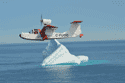
Some come out better than others. For the non spin approved aircraft I have been required to spin during flight testing, I liked the Lake Amphibian the best for spin recovery, and the Cessna 206 the least.
Also note that spin approved Cessnas lose spin approval if a STOL kit is installed. This not because they are more difficult to recover, but because they cannot meet another element of the requirement:
"....(1) The airplane must recover from any point in a spin up to and including six turns, or any greater number of turns for which certification is requested, in not more than one and one-half additional turns after initiation of the first control action for recovery. However, beyond three turns, the spin may be discontinued if spiral characteristics appear....."
STOL equipped Cessnas I have spun sometimes won't even stay in for one turn, much less three or six, the spin changes into a spiral dive. A spiral dive recovery applied to a spin will have a bad outcome.
The Zlin 242 was a nice spinning machine. It required correct, positive inputs to recover. Any deviation from this was sure to make the spin continue, and possibly accelerate.
Several years ago, one solo student learned this the hard way, and he wrote one off. At the same time, he was lucky it was a Zlin- he "walked away" from it.
A Harvard owner once told me that when recovering from a spin in a Harvard, one has to stop the anti-spin rudder input quite a bit before the spin stops. Apparently if the anti-rudder input is held until the spin stops and *then* you try to center everything, the momentum would carry you over into a spin in the other direction before you could stop it.
I chalked it up to being such a heavy airplane, and filed it under "maybe, someday, i'll get a chance to see this myself." With plenty of altitude just in case he was wrong.