A year or so ago, a nice young man (pre-PPL)
asked me to fly with him - his regular instructor
was out of town.
So, I showed up for the flight with my paperwork,
which consisted to 2 blank sheets of 8.5x11 paper,
which I proceeded to cover the entire left side of
the dashboard, by pushing the paper over the knobs
sticking out from the gauges.
He was a tad surprised, but managed to start, taxi
out, take off and climb out to the practice area with
no flight instruments. Didn't even need an airspeed
indicator or altimeter or heading indicator. Remember,
ATTITUDE + POWER = PERFORMANCE
If you put the nose of the aircraft where it usually is,
and the throttle where it usually goes, the aircraft is
going to do what it usually does.
We then did some slow flight in the practice area,
with no airspeed indicator. Didn't need it. The
horn in the 172 worked great.
Then, flew back home. Descended, joined the
circuit with no altimeter or heading indicator,
flew a base and final (slightly fast - I could tell
from the slightly nose-down attitude) and landed
and used a bit more runway than usual.
But it was no big deal, to fly visually with no
flight instruments. In fact, it was an incredibly
illuminating lesson for him. It forced him to
LOOK OUTSIDE
and visually orient the aircraft. And look for
traffic. Bonus.
I have a couple thousand hours in funny little
biplanes that have no gyroscopic flight instruments.
All they have is an airspeed indicator and an
altimeter. Not even a VSI, or even a ball.
Despite the lack of a "six pack" in the panel,
I have managed to fly them to and from
Central America, to fly airshows there.
This is the view, flying across the Gulf of
Mexico:
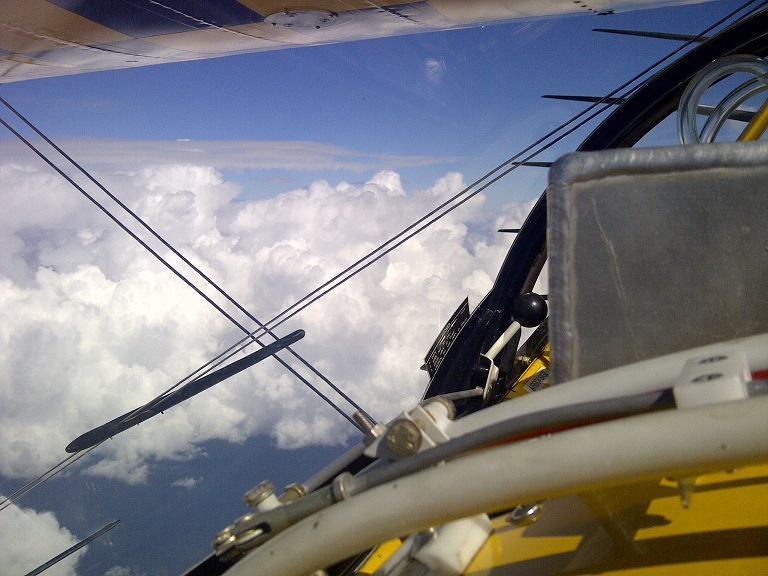
No flight instruments, apart from an airspeed
indicator and an altimeter.
I don't spend much time looking at them
when I am flying, but despite that, I am
able to visually fly the aircraft reasonably
precisely:
http://www.youtube.com/watch?v=Fcy4ZhGHHaE
I have nothing against instrument flying - I
used to teach IFR back in the 90's, and hold
both Canadian ATPL and FAA ATP - but that's
not what you're doing right now.
You're learning to fly visually. Try looking
outside.
Now, I probably don't know as much about
flying as your regular instructor, but I hold
class 1 instructor and class 1 aerobatic instructor
ratings, and I've been continuously instructing
(and a CFI at 3 different FTU's) for over 20
years now. Around 3,000 hours dual given.
I might suggest that you
LOOK OUTSIDE
Earlier this year, I checked out a couple of
new owners (licenced pilots, with hundreds
of hours) on their very nice new (to them)
RV-7A. They had a HUGE checklist, which
I gently took from them, and placed in the
back.
I told them that we would not be using a
checklist in this very simple aircraft. We
would spend nearly all of our time
LOOKING OUTSIDE
and we would accomplish our checks by using a
simple scan, from left to right, of the panel.
I really worry what they're teaching the kids
at flight schools, these days.
See "Cargo Cult":
http://en.wikipedia.org/wiki/Cargo_cult#Post-war
With the end of WWII in the Pacific, the military abandoned the airbases and stopped dropping cargo.
In attempts to get cargo to fall by parachute or land in planes or ships again, islanders imitated the same practices they had seen the soldiers, sailors, and airmen use.
Cult behaviors usually involved mimicking the day-to-day activities and dress styles of US soldiers, such as performing parade ground drills with wooden or salvaged rifles.
The islanders carved headphones from wood and wore them while sitting in fabricated control towers. They waved the landing signals while standing on the runways. They lit signal fires and torches to light up runways and lighthouses.
In a form of sympathetic magic, many built life-size replicas of aeroplanes out of straw and cut new military-style landing strips out of the jungle, hoping to attract more aeroplanes


 When we peeked at the altimeter on downwind we were within 50 feet of our desired altitude.